Wednesday, 26 June 2019
Review: Sophia by Charlotte Lennox
I expected my introduction to Charlotte Lennox to be through the copy of ‘The Female Quixote’ that has been sitting on my bookshelf the last few years but I received this for Christmas and started it instead. This book was written ten years after she was given a grand book launch part by The Club and was crowned with bays by Samuel Johnson. It was serialised in her ‘Lady’s Museum’ periodical and is the second serialised English novel and the first by a woman.
Harriot and Sophia are the daughter’s of a dead bankrupt who live with their mother on a small pension. Harriot is shallow, affected and vain whereas Sophia is well-read, kind and witty. The dilemmas start when the rich, handsome, yet attachment-wary Sir Charles is introduced to them - who will he like? Will he have the decency to make an honest woman of his choice?
From then we are given the usual run of misunderstandings, plots and schemes which serve to keep the virtuous Sophia away from her destined husband. It was one of those plots which could have been sorted out with ten minutes of clear and serious conversation, that such plots so frequently happen in fiction says a lot to the human powers of obfuscation.
If the plot is functional, so is the writing. While there is a balance of reported and direct speech, we are so often told that Sophia is witty but never get to see it for ourselves. Whenever her speech is reported, she is generally being kind, thoughtful or scolding. The people are largely described in terms of their actions and we are often then told what those actions signified and how the other characters read those signals.
I originally wrote that this would be a completely by-the-numbers 18th Century romantic tale if it wasn’t for the little bits of personality that shine out of the cracks in the rather bland format but in looking at these moments, most of them are really quite cruel.
She clearly hates the character of Harriot and people of that kind, making frequent tart comments about how well she fools herself into thinking other people are falling in love with her. At one point the narrator notes that; “Vanity is extremely ingenious at securing gratifications for itself.” In the happy ending of the book, she gives a truly horrible conclusion to Harriot’s tale. The man ‘keeping’ her grows weary and kicks her out, she gets sick, loses her looks and is paired off with an army Captain who takes her to another country where they hate each other and she is kept under house arrest till she dies. I can’t say I liked the character, but she was punished unduly by the fiction gods.
Indeed, nearly all the women are held to higher account than the men in this book. Men, like Sir Charles, are allowed to be wavering in their commitment, whereas all of the women have to be absolutely good (and seen to be good) at all times. It’s like each woman has to represent the best of womanhood whereas each man is allowed to go his own way. Other female characters who fail to represent womanhood are Miss Gibbons, a ridiculous old spinster who confuses politeness and fussiness; and Mrs Howard, who claims great generosity but doesn’t give it. Not even Mrs Darnley, the matriarch of the kind family who look after Sophia after she had fled Sir Charles, passes the test. Despite her family being represented as saints, she is described as being too quick to laugh and too ‘country’ in her manners.
The only spotless women are Sophia and her best friend Dolly. There are a few chapters where they gossip and joke with each other, and these are some of the best parts of the book. The speech may sound a little affected to modern ears bit the tone really is of a pair of good friends having private chats about boys.
I enjoyed the book while reading it, there’s nothing that stops the flow of the narrative and the way the characters think and act do seem drawn from life and very realistic, but it was only in looking back that I can see how exacting the standard Charlotte Lennox sets for women compared with that for men. The book doesn’t go to the ludicrous extremes of an Elizabeth Haywood, nor does it have the intricate set pieces in ‘Evelina; and is left a little stranded. One day I shall crack open my ‘The Female Quixote’ and give Lennox another try, but not for a bit.
Wednesday, 19 June 2019
Review: 'Murder by the Book' by Claire Harman
A few months ago my Mum sent me a message asking me if I was watching ‘The One Show’. The answer was of course no but she told me they were talking about a book I might really enjoy. She said it was about how some writer with a really long name who wrote books about highwaymen was implicated in a murder. When I asked her if it was William Harrison Ainsworth, I said yes and then told her it was that author I’ve being going on about recently. So, I cranked up my BBC iplayer, put on ‘The One Show’ and watched the little section, even though it was presented by Giles Brandreth.
The work discussed was, of course, ‘Murder by the Book’, by Claire Harman, an author like very much for her Fanny Burney biography. It tells the true-crime of Lord William Russell’s murder, and the way the murder impacted an argument about a certain sort of book and one book in particular, ‘Jack Sheppard’.
I’m no great true crime lover, I found ‘The Suspicions of Mr Whicher’ to be padded out with unnecessary detail and I would suggest that this book is too. Added to that, the crime lacks a certain sense of sensationalism and the route to discovering the murderer is not a particularly gripping one. (This is until the end, where Harman gives a postscript of unanswered questions which could change the crime quite significantly). What gives this book its hook is the discussion of the moral panic surrounding Harrison Ainsworth, ‘Jack Sheppard’ and the Newgate novel.
There have been recent worries about violent video games, video nasties and hard rock but before that, there were worries about violent novels and plays. The Newgate novel takes its inspiration from the ‘Newgate Calendar’, collections of works about thieves, murderers and conmen hanged at the infamous jail. The difference between these and other sensationalist retellings of criminal life, is that the reprobates are often the heroes of the story.
This means that in ‘Rookwood’, Dick Turpin is a noble romantic who bursts in and takes the gothic story over now and again and in ‘Jack Sheppard’, the eponymous hero may start out with a wild streak but actually has a heart of gold and a code of stone - most of his terrible crimes and most famous escapes happen in the novel so he can save other people from the villainous Wild. Wild in this book is an out-and-out villain, with a secret lair containing souvenirs of all the men he has had killed and a secret torture room.
I knew young Dickens and Ainsworth had been pals, but this book shows how close the two were at one point. They set out together, with a person called John Forster in what they called the ‘trio club’, determined to crack the literary scene. The break-out success was Ainsworth, funny, extremely handsome and generous with his success to aid Dickens into finding his own big break. ‘Jack Sheppard’ was Ainsworth’s second novel and built on the popularity of the Dick Turpin bits in ‘Rookwood’. It was an instant success and ran in Bentley’s Magazine, alongside Dickens’ own efforts at thieves and vagabonds, ‘Oliver Twist’.
Some of the things I learned about the creation of the book include the fact that Ainsworth’s forays into criminal ‘flash’ slang, (which has heightened some books and sunk others) were borrowed from reading criminal memoirs. His immersion in the world was so complete that former criminals wondered whether he had actually been one of them.
Another thing I learned was that Ainsworth wrote in a way that was intentionally bad. I have often said that he is a writer who has a wonderful flair visual and dramatic ideas but doesn’t have the same flair with words, it turns out that this is intentional. “The truth is,” Ainsworth wrote in a letter, “to write for the mob, we must not write too well.” He even advised Dickens from showing off too much and to keep it simple. I had always assumed Ainsworth couldn’t write all that well (and maybe he couldn’t) but I never knew that he chose not to.
The book was such a success it spawned seven plays at once in the West End. This couldn’t happen now but the copyright laws about page-to-stage were looser then. Some of the shows highlighted comedy, some visual spectacle and the one at The Adelphi (now showing ‘The Waitress, which is very good) had it all. The description of the performance in the book make me wish they would revive it.
The trouble was, crimes popped up all over the place with the criminals declaring that they had been inspired by ‘Jack Sheppard’, whether in book or play form. When the murderer of Lord William Russell claimed the same thing (possibly as a smokescreen for other elements of the crime), Ainsworth’s reputation took a huge hit from which he never fully recovered and Dickens, who had distanced himself from the Newgate style, left him in the dust.
The last few chapters dealt with the murderer’s execution. Although Ainsworth didn’t go, about a quarter of London did, including Dickens and Thackery. Dickens had himself written hanging scenes in ‘Oliver Twist’ and Thackery, yet to be famous for ‘Vanity Fair’ had been writing vicious parodies of the Newgate Novel style. Both this men were deeply moved and shocked by the affair, Dickens watching it from an upstairs window and Thackery from the crowd (though he covered his eyes at the fatal moments). Thackery wrote a scathing description of the hanging, calling for it to be done away from public eyes, a call that Dickens took up later. The book implies it was certain people going to this hanging that led to the end of public hanging altogether.
There was also a nice bit about fingerprint analysis…….
To be honest, what I really want is a good modern biography of William Harrison Ainsworth, but this partially scratched that itch, painted a picture of a very modern moral panic and told the story of an intriguing(ish) crime, all told in a clear and engaging way.
Wednesday, 12 June 2019
Simon Forman - the book, the art exhibition and the video game
Simon Foreman was a physician in the late 17th century who practiced despite not having all the official training and none of the official paperwork. He focused largely on astrological/humoral causes of illness and largely proscribed changes in lifestyle, diet and various concoctions of herbs (though sometimes it could become a little more peculiar, like burnt dog mess). He also slept with many of his patients, even after he had married. We know all this because he kept a diary and detailed case notes.
I’ve learnt about him in some peculiar ways. I think I first discovered him via twitter, where I follow a lot of accounts about the early modern period. Through this, I was led to a conceptual art exhibition in a basement, a computer game and finally, a book. I’m going to through these things.
Casebooks at the Ambika P3 (2017)
My first proper introduction to Simon Forman, and probably the strangest one.
I am not particularly adept and reading art and modern/conceptually type stuff is even further away from my comfort zone. So when I went into what looked like a carpark under a building on the Marylebone road, I was a little put out. The space was ugly and dark and grim, there were few people around and I had to duck through a rubber curtain to get to the main space. It felt forbidden.
In the middle of the room was a large mechanical arm, draped in greenery, in a pond and surrounded by pots. I still don’t understand what this had to do with Simon Forman, but the artist who makes it likes putting mechanical arms in things. Near that there was a large collection of pots and a big finger - a pointer towards the more alchemical side of Forman’s oeuvre, though I was still at a loss to really understand what it was trying to tell me.
I found the works more engaged with the subject matter to be more interesting. There was an AI, programmed with astrological information that told me I had Venus Envy and a large leather cow that repeated parts of the notes. I loved the cow, it was funny and informative and I was very interested to hear all the people’s complaints and illnesses, together with Forman’s treatments. I spent a while with the cow.
The other must interesting work was a video, shown on three large concave disks. It featured an actor telling parts of Forman’s life from his diaries but also mixing it in with the actor’s life. It was all about impossible affairs, guilt, pride at healing, hubris - and all other manners of feeling. I was left moved, touched by the human behind all the notes and star charts.
To be honest, I left the whole exhibition convinced that there was something interesting there but not really sure of what it was. I needed a more obvious way to get into the Simon Forman story.. I kept my eye on Twitter.
Astrologaster (2019)
Although I hadn’t pursued anymore of Simon Forman’s story, I hadn’t forgotten about him and a postcard from one of the pages of a casebook sits in the notebook I write my Dr Johnson’s Reading Circle Notes. But a couple of months ago, my Twitter blew up with him again. This time it was about… a computer game.
Again, I am not particularly knowledgeable when it comes to computer games. I used to love a bit of ‘Monkey Island’, was a dab hand at ‘Worms’ and occasionally play ‘Civilization’ but the last console I bought was an Xbox, and that was mainly because it also played DVDs. Checking that I could get it on my computer, I downloaded ‘Astrologaster’ and played it straight through one night.
In the game you play Simon Forman, various querents come to you with problems and you read their stars. The game mechanic allows you to look at between two and four vague astrological pronouncements and you have to pick the one you’re going with. Your decision then either makes your patient happy or not - sometimes it may make them initially happy but angry in the long run or vice-versa. If you do really well with the women and love hearts will glow above your head and an affair can begin. Please as many patrons as possible and you can gain your very own medical license.
For someone way out of computer games, it was a pretty simple idea and fun to do. Not only did you read the stars, but there were clues in the symptoms and actions of the querent when they first start talking to you. This means that you could give advice based on what you really thought might help the person, or based on what you think that person may want to hear. As such, you got to dabble between up-to-date 17th century thinking or go full quack.
Even more fun were the range of people, the characterisation and the introductory songs. Each time a person came to your door, they had a song about them. Some, like Dean Blague were religious catches that usually ended in insulting him. Others teased the beauty, the cunning or the stupidity of the querent, always with gorgeous harmonies. My favourite set of songs were for a man called Signor Ferrero, because they had more than a hint of ‘that’s amore’.
I’ve played the game through twice now and it was managed to make me laugh out loud on multiple occasions. I also had fun at seeing how my different choices bent the game in different ways and I look forward to playing again and doing everything differently.
What’s more, the game has a lot of history in it. Many of the characters were actually people from Forman’s Casebooks and many of their problems were problems that Forman was asked about. The characters who were not historical (or like Lord Essex, were historical but didn’t meet Forman) brought real historical ideas to the game. There was fear of Catholics, of foreigners, of the plague as well as belief in witches and all sorts of marriage difficulties and considerations. Even the stars used are as they were on the dates given.
I felt like a learned a lot (and had great fun) playing the game and now I really needed something a bit more authoritative to tell me about the man and his life.
Dr Forman: A Most Notorious Physician (2002)
This book came out before the exhibition and computer game, it’s the most accessible way of discovering Simon Forman but the last I came across. It’s written by Judith Cook who wrote a book I very much enjoyed about the community of writers in the 17th century called ‘Roaring Boys’.
There are definite links between the worlds of players and Dr Forman. Both lived and worked south of the Thames, where they were safe from much of interference from the City of London. Not only that, but Forman had many theatrical people in his casebooks, from actors, managers and even the woman who (some, like Rowe) propose to be Shakespeare’s dark lady.
What the book succeeds in doing, is paint a picture of the world and something of the character of Forman himself.
Simon Forman is not portrayed simply as a cynical hack but an optimistic man with a fierce desire for knowledge. He fought for knowledge his whole life, being constantly turned away from it by life. Everything he learns, he does it by determined effort. That a lot of his knowledge seems silly to us now, lessons of astrology and humoral theory, is irrelevant, in an age where Queen Elizabeth would consult Dr Dee, he mastered what there was to know. Not only that, the extensive use of documenting, the many casebooks and the written additions he made in the books he read, means that he at least tried to systematise his knowledge and rely on what worked for him. We can pick out the funny cures but a lot of what he proscribed was common sense or at the very least not harmful in itself.
Despite all this, Forman is not an angel. He is vain (as someone who wrote so much about himself has to be), he was fond of showing off, he could treat his closest relationships with an unusual coldness and he slept around.. a lot. The codeword he used for this was ‘halek’. There is a lot of haleking going on in this book, even after he was married. In some ways, he reminds me of Samuel Pepys who came about fifty years after. Both men had a drive to know, both had full social lives, both had irresponsible (and sometimes just cruel) sexual lives and both recorded themselves voraciously. Forman wrote that a man was beyond old age when he hit his 50s, with such a short lifespan, a lust for life seems a noble thing.
Although the book was concise, well written and full of interesting detail, there was a feeling that in relying on the diaries so much, it becomes a little monotonous. Even diaries by the best diarists are a bit of a slog as reading a life in that form feels like one thing after another, I’d have liked a little more shaping in the telling.
All that aside, this was a fantastic book and made a perfect ending (for now) in my lethargic meander into the life of Simon Forman. All there needs now is a mini-series and a self-help book and I think Forman has all his media bases covered. I recommend anyone to find out a little bit more about this fascinating individual in whatever way they can.
Wednesday, 5 June 2019
Trip to 'Writing: Making Your Mark' at the British Library
I find myself in the almost unknown position of writing about an exhibition three months before the things closes, I’m more used to going in the last week. This time, I went to the British Library to see ‘Writing: Making Your Mark’, which deals with the history (and future) of the written word.
I have to say that I’ve not been getting into exhibitions lately. a recent one at the Wellcome about what magic tricks teach about psychology was very interesting and well put together but I nipped through it in just over an hour - I just seem a bit too tetchy to share my exhibition experience with other people at the moment.
During my time at ‘Writing: Making Your Mark’ I was in direct competition with that most irritating of museum attendees, The Leaner. This is a person who holds their arms out directly over a case, leans into it, breathes heavily on the glass and lingers for just a few moments too long. I held back, trying to get behind The Leaner but still as other people overtook him, I found myself behind him again. There was no glimpsing the item in the case, nor even the description next to it as The Leaner so positioned himself to take up the whole area, appearing to be lost in another world as his breath fogged up the glass beneath him.
Apart from ruining the flow of an exhibition, it is a distinct annoyance to have to wipe the glass before each case you come to. Even when I overtook The Leaner, he then sped up and overtook me, leaning and obstructing and generally irritating me beyond measure. It became a slow, precise duel that played out between us, which I duly lost.
Maybe it’s because of my battles with The Leaner that I couldn’t really get involved in this exhibition but I also feel my lack of engagement may have been the reason I became so overwhelmed by him.
‘Writing: Making Your Mark’ tells its story in five sections.
The first was on the origins of writing. This part included a huge stone with early pre-Incan writing, a prayer in Egyptian hieroglyphs that took headlines as the oldest object in the British Library’s collection, a nice lump of clay with some cuneiform and told of a possible writing system from Rotoroa but didn’t have an example to show. When I was allowed to see these objects, they were interesting enough but easily found in huge numbers just down the road at the British Museum.
The second part was about writing systems and styles. This was probably the most interesting section of itself as it explained how other systems like Arabic, Chinese, Japanese and Korean writing systems work. Although I was a little muddled over the exact details, it was intriguing how different cultures had tackled the need to present sounds in meanings in different ways and got me thinking about how I take it for granted that I write my own language in the way I do.
This was followed by a very interesting bit showing the evolution of an ox-headed figure into the letter ‘a’ through four artefacts. Then there was a bit about the development of ‘Roman’ fonts based on a simpler writing form over the more elaborate and difficult to produce school/black font form of writing.
The next section was about materials and technology, this had the best objects to show. There were some quite terrifying tattoo spikes, some 9th century Chinese paper that still looks fresh and stable, examples of writing in clay and wax and even a scrap of old clay that was used as a one day pass for a woman called Annabella to ply her trade in the city of Elephantine. There were examples of Chinese printing (and movable type) that preceded the Gutenburg press, and then a copy of Caxton’s printing of ‘The Canterbury Tales’, borrowed from the permanent exhibition next door and a reproduction of an eighteenth century printing press, borrowed from... just outside the toilet.
Indeed, after the grandstanding Anglo-Saxon exhibition, this one feels a little on the cheap, I had seen many of the items before for free at the British Library. This section rounded off with a petulant telegram by John Osbourne, threatening to go to war with a critic, and a Chinese dual pigeon typewriter, which is both a simple solution to the problem of so many individual characters but is at the same time mindbogglingly complicated.
The next section on writing and people was a grab bag of anything else. There were handwriting guides and a very charming 2,000 year old bit of schoolwork. This is also the part where they crammed in the ‘famous people things, including; Joyce’s notes for Ulysses, Mozart’s notes, Florence Nightingale’s notes and Scott’s diary on the last, bleak page. These would have had the wow factor if I had not already seen them before at other British Library things. There was also some intriguing style guides for the BBC’s new ‘Reith’ font which they plan to roll out this year.
The last section was about the future of writing, which was a big screen with adults saying daft, outdated things about emojis and children imagining holographic ipads in the future…essentially, there was no content in this part.
The Leaner aside, I just didn’t feel that this exhibition told its story all that well, that most of the exhibits were things the British Library had hanging about and that the social, historical and political factors about how we write and how we may write in the future, were largely glossed over. I wouldn’t recommend this one, but the newspapers and other reviews loved it, so maybe I am just being a grump.
Wednesday, 29 May 2019
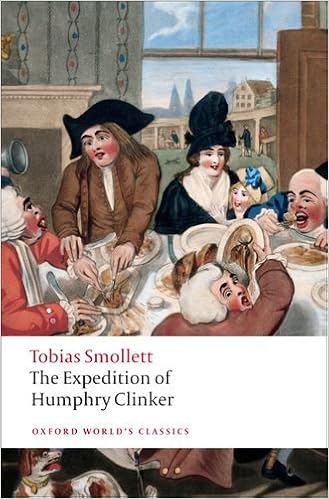
The Expedition of Humphry Clinker by Tobias Smollett at the Dr Johnson Reading Circle
‘The Expedition of Humphry Clinker’ was the last book written by Scottish doctor-turned-writer, Tobias Smollett and published in the last year of his life. It charts the journey of a Welsh family group wandering the spa towns of England, before a quick tour into Scotland and a return back towards Wales. The journey is meandering but peppered with incident and the book is pretty much the same.
The main interest of the text, as far as the group were concerned, were the opportunity for shedding light on interesting little details (which could be compared with our now extensive back-catalogue) and the treatment of the characters. The book is written in an epistolary manner and the events and places viewed through the different prisms of character brought everything to life.
The main writer is Mathew Bramble, an ageing, grumpy man in pursuit of health. He is scornful of most of the English spas; his description of Bath, with it’s waters with layers of pus and scabs, is truly stomach churning, while his description of London’s adulterated (and truly undrinkable) milk even found it’s way into ‘The Horrible Histories’ books. There are hints that Matthew isn’t as misanthropic as he first appears, however, with secret works of charity and he cheers up abundantly when they rich the clean, healthy towns of Scotland. Shortly before this work, Smollett had written a dyspeptic book about a European tour and had been ridiculed by Laurence Sterne as ‘Smelfungus’, Matthew Bramble seems to be playing up, and setting rest that image.
The next writer is Jeremy, Matthew’s nephew. He’s just finished university and is always on the look out for ‘originals’, oddballs that he can ridicule. He has a quick temper and almost fights several duals. Jeremy’s sister Lydia is another writer. She’s an optimistic dreamer who has recently fallen in love with a player (who might be something greater than he appears - hint, hint.)
The two other main writers are Tabitha, Matthews unmarried sister who is now so desperate to wed that she hopelessly throws herself at almost any single man they come across. She is fussy, cantankerous and not very kind to her servant Win. Win is the last main letter writer and she is not as stupid as she first appears. These two later writers create letters full of misspellings and malapropisms.
Indeed, Smollett’s malapropisms are probably the most sustained and skilled that any in the group had ever read. The women talk about how they will ‘deify the Devil and his works’, fear people who are ‘devils in garnet’ and implore people to ‘employ your talons’. Nor does Smollett neglect the art of creative spelling, no references to accounts are left unmolested and sometimes the characters will ‘lay in damp shits’. We all wanted more of these letters, which sadly dipped in the middle. (Interestingly, a lot of these misspellings and such are linked to a representation of the women’s ‘Welshness’, with attention to detail into the accent.)
There was a big question of representation in this book, especially female representation. The three female characters had far fewer letters between them than the two male (a disparity still seen in modern fiction and tv) but more disappointingly, it seems to be the females we are encouraged to laugh at, rather than with. Add to that the adventure where Matthew finds an old school friend whose life has been ruined by his wife, a rant about evil wives, and shortly afterwards, when that wife dies, a joy about it. Matthew even stays on with his friend to encourage him to not miss her. There is clearly something amiss here.
But taken at that level, there is something amiss with much of Smollett’s presentation of people. Like Jeremy, he is searching for ‘originals’, odd little individualistic people to mock. The gang meet up with a Scottish veteran called Lismahago, he is a wizened, argumentative man whose head is all blotchy because he was once scalped. He is ugly and ridiculous, being mistaken for a ghost in one town - yet we warm to him. As we also warm to Tabitha and Win. It may be a weakness in this method of searching for ‘originals’ that it can turn over into nastiness at times.
Lismahago is a Scottish character, Smollett was a Scottish author and the Welsh family find themselves in Scotland towards the middle of the book. After Bath and London, it is an oasis of good behaviour, kind people and natural beauty. Glasgow is represented as the most beautiful town there has ever been - some contemporary reviews called foul and concluded that this was all secret Scottish propaganda. Indeed, modern fans of Scottish independence would probably enjoy looking at the chapters that talk about that topic, the arguments on both sides haven’t changed much in 250-odd years.
And what about Humphry Clinker? I have barely mentioned him for the good reason that he is barely in the book. Is he a symbol of deep-rooted nobility? A side-eye at Methodism? An important part of the plot that somehow got lost in rewrites? We really couldn’t decide.
This book was very popular an influential, it pops up in Middlemarch, has fingerprints all over Dickens and was highly praised by George Orwell. It’s puerile, with plenty of falling over, naked bottoms and laxative jokes and it’s also a thoughtful travelogue of the country. It may not get the pulse racing but it does get the mouth smiling and occasionally the brain thinking. We all agreed that it was worth reading and were glad we did.
Wednesday, 22 May 2019
Snacks at Leghorn Road
I’ve mentioned my pathetic artworks a number of times on this blog. I am very aware of my limitations in this field but I do like playing with a paintbrush, especially during longer holidays.
About eight years ago I started a picture but was unable to finish it as I did not have the confidence to do faces. I finally overcome that feeling and put the faces on. They aren’t good - but they are done.
The picture is set in my old living room in my old shared house. It features the cloth and leather sofas. the wonky light, the custard coloured walls, the union flag cushions and the omnipresent mouse. It pictures me in the centre, handing crisps and beer to Samuel Johnson and Oliver Goldsmith. Outside, Samuel Pepys does just that.
Here is the picture.
I apologise.
Wednesday, 15 May 2019
Review: The History of Tom Jones, a Foundling’ by Henry Fielding (Part Two)
Last week I looked at ‘The History of Tom Jones, A Foundling’ and why I love it for its tone and narration. This time, I shall look at how the characters help make it the wonderful novel it is.
Tom is not much of a character himself. He’s likeable, charming and good at heart – relatable but not exactly interesting. Certainly, when comparing him to the more extravagant members of the rest of the cast, he doesn’t exactly shine.
Sophia his beloved, on the other hand, is contradictory, determined, smart and takes things into her own hands. Fielding based her on his first wife, Charlotte Craddock. Sophia is fantastic, starting out as something of a weak damsel but quickly gets bored of that situation and takes charge herself, quitting her house and going to seek Tom down. By the end of the novel, the main obstacle between Tom and Sophia’s marriage is not class, wealth or imprisonment – but whether Tom can prove that he’s even worthy enough to marry her. As well as being an enjoyable character in herself, she makes a great double act with Mrs Honour, her maid.
Another great servant character is that of Benjamin Partridge, the man accused of being Tom’s father, he later becomes his manservant. He’s a good man but heavily put upon by the world – and not very bright. He confuses theatre for real life, quite an old joke at the time, but done well. His misunderstandings and loose lips cause constant problems for Tom, but his heart is in the right place, and that is the most important in this book.
Leading those whose hearts are not in the right place is Blifil. He is the nephew of Squire Allworthy (who is as kind but dull as his name suggests). Blifil is outwardly kind and gentle but really is an oily schemer, who does all he can to get in Tom’s way. He is supported by Thwackum and Square, the boys’ tutors. Thwackum is a rough brute of a man, who believes in the appearance of religion above anything else. He is is the model of pretty much every evil teacher ever since, down to Miss Trunchbull. Square is a little more nuanced, he uses sophistry to argue all his worst impulses but by the end of the book manages to have a moral turnaround and support Tom.
Another enjoyably unpleasant character is Miss Wilson described as ‘no welcome visitor’, who has never seen a man without his jacket on, she is uncharitable and cruel to anyone she perceives as below her. She’s the one who finds Tom in Squire Allworthy’s bed and initially wants to take him to the parish to look after. She even declares that the baby doesn’t ‘smell Christian’. When Allworthy immediately takes to the baby, her opinion changes and she declares that it might be a Christian after all, though she is secretly pleased to hear every bad thing she hears about Tom after that.
Probably the largest character in the book is one whose heart veers wildly between the good and bad. His is just too volcanic a character to keep in one place and explodes wildly in joy, anger, grief and probably a little more anger. He is Squire Western and as Sophia’s father is the ogre that imprisons the maiden and chases after her when she escapes. His chase is one of the funniest parts of the middle section of the book, gallivanting around, blustering through other plot threads and then getting distracted with hunting. If he wasn’t such an entertaining character, he’d probably be a monster, but he is so entertaining.
I said a little before about how Fielding’s broad characterisation help his story, with some of the clearest and most distinctive delineation of types of people until Dickens came along. There are plenty of characters to love, hate, root for and boo - that, along with the playful tone of the book, succeed in bringing it to what is (for me) the pinnacle of the early novel. I love it, and you should too.
Subscribe to:
Posts (Atom)