Showing posts with label Experiences. Show all posts

Wednesday, 14 October 2026

I Love Shonky Museums

 In the summer, I went to Derby to visit three museums. One was a multi-million pound regeneration of a UNESCO heritage site, another, a local museum and gallery with a special exhibition about the town’s most famous artist, and the third, a house museum that included the UK’s largest toy theatre collection, an exhibition about the Tomb Raider games and a Victorian bathroom the visitors can use at their convenience. The third museum was my favourite, it was also the shonkiest. I love a shonky museum.


My favourite museum, one of my favourite places in the world, is Doctor Johnson’s House. It is a small museum, probably underfunded (at least, I’d like to see it have more money) but it’s not shonky, probably due to the principles established by its founder. So what is shonky museum? It’s a museum with a confused collection that shows residues of past fads in accumulation and presentation.. and I love them.


My Platonic idea of a shonky museum


This imaginary museum is in a medium-sized town, housed in an old library or mid-sized late Victorian building. It may have a small modern addition, probably with toilets and a school visitor’s room. 


It started as a local antiquary society and the original museum was in their meeting place or the house of a leading member. This leading member had an interest in something fairly obscure, say Etruscan pottery, which forms the core of the collection. This has been bulked up over the years by the various donations of other members and often a bunch of stuff the town council had which they didn’t know what to do with. There will be fossils and ammonites, some stuffed animals, items brought back by members in colonial service, some old toys and packaging, a few neolithic axe-heads and maybe a hoard discovered by some local detectorists. There will always be at least one shard of Roman Samian-ware. If the original collector had the funds and contacts, some of the Etruscan pottery may be significant but generally it will be full of the odds and ends found in any local museum. The modern curator will be faintly embarrassed of their collection and squeamish about providence.


In the early days, a person would have needed to book a visit to the collection but some time in 1934 it became available to the general public on weekends and bank holidays. Leading up to the Diamond Jubilee in 1977, it moved to some defunct library or council building where they now open Saturdays and weekdays, except Mondays and Wednesday afternoons. It had a long, cumbersome name but the locals called it something shorter (if not merely, The Museum).


At some point in the early 90s, the museum won a grant from the National Lottery and used it to modernise. They changed the name to something cool and flashy, but the locals kept calling it the name they always had. They invested in a new, immersive, themed part of the building, probably setting up a Victorian kitchen. This allowed them to display all the old packets of things they had laying around, use the old mangle and set up the cast iron cooking range that had been clogging up storage space. They filled it with replica cooking utensils and that plastic food you only ever see in museums. (I’ve been to so many of these places I now recognise the exact types of bread rolls, cabbages and meats, they all seem to be from the same place. They are expensive, a small mediaeval pie costs £35). This food will not be very well maintained, the tastier items will display a child’s bite mark and the drinks will be covered in a layer of grey dust.


They have also installed my favourite item in a shonky museum, a mannequin with a repeating speech track near it. In this case the mannequin has been dressed as a Victorian maid in a mob cap, the costume now looking slightly threadbare and seedy. The voice track is of the woman complaining about all the chores and tasks she has to do, there may also be the sound of servant’s bells. She will have been played by an actor putting on a poor accent, full Eliza Doolittle if near London, Vera Duckworth if near Manchester - you get the idea. The mannequin will be just that, no animatronics or anything and the looped speech track will mean that spending too long in the Victorian kitchen will be unbearable.


Coming up to the millennium, out museum received a grant for the big two-zero-zero-zero. They renamed the museum again, to a shorter version of the original name. The locals still call it what they always have. They updated their explanation cards and signage to make it more visual, but made it less informative. They brought in a small section where children can try on old clothes, top hats and mob-caps but many of these are now a little ripped and tatty. They also installed a number of interactive features, either with screens of mechanical sliding foors or pop ups - most of which no longer work. 


And since then, that’s it, because the new rejuvenation was canceled after the 2008 crash, then there was austerity, then Brexit and councils don’t have the money to spend on nice things anymore.


The council will hire a curator, who may have a number of sites to oversee but most of the day-to-day running will be by volunteers. These will mostly be retired folk, maybe the odd student for a few months. There will be two types of volunteers; the ones who do it to get out the house and talks to people, and the ones who have an obsessive knowledge of the town or some of the items in the collection (that Etruscan pottery again). The volunteers will incessantly snipe and bicker at each other for updating the visitor book wrong or setting out the souvenir pencils incorrectly. However, all the volunteers will be warm and welcoming to visitors and will be a good percentage of the museum’s charm.


I’m not sure I’ve been to anywhere that is all of this, but I’ve been to many that are some of it. I may have been taking the piss a little but I love these places and I hope they keep muddling through for decades to come. 

Wednesday, 10 December 2025

In which I meet the Great Flabber Dabber Flat Clapping Fish with hands


In the last weekend of November, I had the great pleasure of going to see a colony of seals. These animals have their pups in a place called Donna Nook on the Lincolnshire coast and, for the few weeks they are there, are a popular tourist attraction in the area.

It was a rainy day. An extremely rainy day. A so-rainy-it-soaked-through-my-boots-and-leather-jacket day but it was also quite a magical one. The car sloshed into the field used as a car park and we squelched up to the sand bank. As we climbed it, we heard this peculiar noise - was it seals, birds or people? It was hard to tell. I’d brought binoculars in case they were hard to see. These were not needed.


We came over the sand bank and they were there. Hundreds of seals, all slumped over the beach, some sleeping, some suckling little white pups and some groaning and hissing. There’s a fence to stop the people wandering around the seals (as they formally did) and some seals were right up to it, scratching themselves on the wire. They are the most wonderfully ridiculous animals, belching out their strange calls and flopping around like someone stuck in a sleeping bag. 


There was something magical about seeing these strange creatures, patting each other on the back with their flippers, seeming to have belly-flop races and hissing at another seal who tried to take their spot. I’d always thought of them as cute, but the way their faces seemed stuck on the top of their bodies reminded me of blemmyes, the mythical people with heads in their stomachs. 


As I stood there, soaked to the bone, it was also quite clear to me how ridiculous we humans are. We’d all schlepped out to the middle of nowhere, paid parking charges for a field of mud and shivered out in the pouring rain to see these other creatures who were fine and comfortable as they were. The fact is, seeing seals during birthing season is seeing them at their worst - they aren’t good on land but they are amazing at sea. They sleep upright in the water like buoys, with self closing nostrils if they dip down. They can dive for 200 metres and stay under water for half an hour. They swim hundreds of miles between colony sites. Laying on the beach, half-starved, worn out from childbirth, they still managed to be captivating and interesting creatures.


As usual, when I have a little animal adventure, I like to go to Goldsmith’s History of the Natural World. I was surprised to find the seal listed amongst the mammals, whales, dolphins and turtles are lumped in with fish. It’s a long entry, and it feels like Goldsmith may actually have seen seals because he sounds like he knows what he’s talking about, not just copying from an encyclopaedia.


His description conveys how odd a seal looks, with some elements like a quadruped and some like a fish. He describes them having a round head like a man, broad nose like an otter and teeth like a dog. He describes their skeletal structure, like other mammals but covered in fur and membranes to create a fish-like shape.


He also feels that, while seals are not more cunning than many land animals, they are more cunning than fish - which gives them an advantage. He describes how they hunt in groups, gathering on large shoals of fish, and how they are largely social. He talks about their different calls (and we could tell different calls in the seals we met) but he didn’t know how much of their communication involves slapping their fin-arms. 


My favourite section of any Goldsmith animal entry is the one about whether they are tasty, or useful to humans in any respect… it’s such a self-interested thing to have in a natural history book. He says the skin is good for making waterproof waistcoats and that they have been regarded as a good meal, with Edward IV eating one at Archbishop Nevil’s house.


He finishes by describing their migration habits, the reason why we had to go to Donna Nook to see them when we did, rather than wait for better weather.


However, Goldsmith is not the only one of my favourites to mention seals in his writing. Christopher Smart did as well.


The first time I read Jubilate Agno, one of the things that stuck into my head was the phrase, “the Great Flabber Dabber Flat Clapping Fish with hands”. It turns out these were seals.


Yes, he’s done what I was expecting Goldsmith to do, lumping them in with fish, but he’s done so with such brio that I have to praise him for it. In the poem, Smart lumps the seals in with Psalm 98;

“Let the sea resound, and everything in it,
    the world, and all who live in it.

Let the rivers clap their hands,
    let the mountains sing together for joy”


So, for Smart, it’s the seals who will be the sea’s chief clappers of hands and I think it’s worth applauding the seal.


Wednesday, 4 June 2025

Goldsmith on Puffins

 Last Wednesday was half term and a gloriously sunny day so my parents and I went to Bempton Cliffs in Yorkshire to see the nesting seabirds.


The place was packed with guillemots, razorbills and kittiwakes. We saw gannets performing their strange bowing, head-shaking and beak-fencing behaviours, and we also looked for puffins. Those adorable, colourful beaked fellas are really quite hard to see. They’re smaller than many of the other birds, have a tendency to nest deeper in the crevices and didn’t gather the same way the others did, scattered among the rest. I hear this isn’t the case in ‘puffin islands’ like Anglesey and Lundy, but it was the case at the cliffs in Bempton.


We looked and looked, enjoying the antics of all the other birds, the bright, blue sky and the turquoise sea and eventually our patience had results, we saw puffins. A few were chilling on the cliffs, whilst others flew around, their hurried flapping noticeable against the more relaxed flying of the other birds. It was pretty magical. 


Oliver Goldsmith, in his An History of the Earth and Animated Nature describes puffins, and it seems, unlike some of the other entries, that he might have even seen some before. He says that, “words cannot easily describe the form of the bill of the puffin,' before giving a paragraph on the size, shape and colour of it, warning that it “bites most terribly”.


Goldsmith describes how the birds nest in burrows and holes situated up large cliffs but that they aren’t terribly good flyers and sometimes need to make several tries to fly up to their nests. He also describes how a small number of puffins appear to scout out an area before the larger force comes (maybe it was these scouts we saw).


He says how puffins descend on Anglesey, kicking rabbits out of their burrows and making a nuisance. He then talks about a subject which never ceases to amuse me in his natural history book, whether puffins make good food or not. He describes the meat as rank, unless well salted and pickled and says how the church exempted the puffin from being described as meat on feast days.


Moving away from the description of puffin-meat, he celebrates their indefatigability, that after being preyed on and hunted by humans and other animals, they always come back in as many numbers as before.


I love reading An History of the Earth and Animated Nature for the odd and outdated details some of the entries contain, like the description of their meat, but (if Goldsmith’s sources are correct) I did also learn a little of the hard life of a puffin.


It was a pleasure to meet a few. 


Wednesday, 21 May 2025

An Afternoon of Eighteenth-Century Delights by The Grimsby Symphony Orchestra


I’ve had a little problem since moving out of London where my blog is concerned. Before, when I was stuck for something to write about, there was also some little building, curio or exhibition to attend and refill the eighteenth-century wells, that’s not really the case here. Grimsby has a fascinating early-mediaeval and later mediaeval history, and came into its peak years in the late nineteenth and early twentieth centuries but it had a real decline between those years and was something of a nowhere place. Online, the history of eighteenth-century Grimsby is limited to a sentence. This is also the case for a lot of the local area, they are places that were wealthy and important in the mediaeval era and became so again at the end of the nineteenth century but largely floundered in the eighteenth.

This means there simply isn’t much around to fill up the Grub-Street tank, so my eyes were instantly drawn to a poster advertising, An Afternoon of Eighteenth Century Delights. I knew I was going to go, though I was a little put off by the nature of those delights, three pieces of classical music by a symphony orchestra - I’m more into a broadside ballad, or even a Purcell and not very knowledgeable about the kinds of music played by an orchestra.


But, I went and I had an experience, and these are my thoughts.


The first parts was Overture to Don Giovanni by Mozart. This was my favourite piece, I liked the drama and seep of it. I also enjoyed the little tunes and motifs I picked up. I sat back in Grimsby Minster and let the music swirl around me, lifting me up and letting my thoughts and feelings be taken away and wander.


The second piece was Symphony 101 (The Clock) by Haydn. There were moments of ticking in various parts, but it seemed to smooth and slippery to be a clock most of the time, I have a clockwork watch you can see into and it’s a busy repetition of complex motion rather than long slides. This piece was written by Haydn when he was performing in London and was very enthusiastically recieved. I enjoyed it but it was more mannered than the Mozart and took me less high.


The third pieces was Beethoven’s Symphony No.1. He’d been taught by Haydn and was influenced by Mozart, so it was a fitting last piece of music. I have to say, I frequently find Beethoven rather annoying, he seems to pick an idea and repeat it, or pull it apart and repeat little bits of it in combinations. I imagine, if I were more musically inclined, I’d love this - I love when a writer does something similar, but it frustrates me as a listener and I was ready for it to finish.


That said, I was very grateful to the Grimsby Symphony Orchestra for putting on An Afternoon of Eighteenth-Century Delights. It’s been a year since I reviewed Purcell’s The Fairy Queen and it was  lovely to hear an orchestra play and feel the music fill the space of the Minster - and all that for a tenner, it was a delightful afternoon.


Wednesday, 5 June 2024

Willesden Green Tales

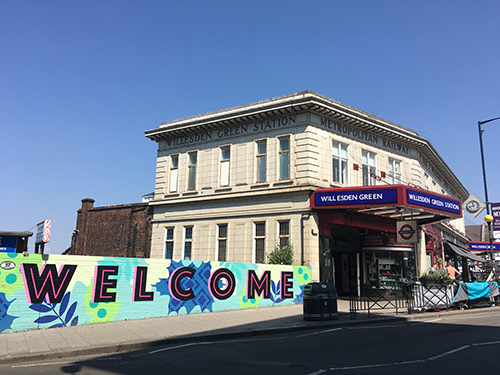
 For almost the last ten years I’ve lived in a little garret opposite Willesden Green Station. Out of my window, I’ve seen the green minaret of the Brent Central Mosque, gently glowing in the sunlight (or not, if it’s not). The garden is part of a row of gardens and has been the home to a surprising variety of birds, from parakeets and pigeons to jays, waxwings and a woodpecker. Like a lot of places in London, it has an insular feel, like a little pocket within the greater whole - and there have also been some unusual people, events and sights. I thought I’d record them for posterity.


Where I lived


When I went to see my little bedsit, it was always around 5pm. This is always a golden time, as the windows face west and the golden sunshine hits the edges of the mirrors and cause rainbows to drift around the room. 


The place is in the attic of my landlord, a former film editor who worked on films as diverse as Branagh’s Hamlet and Zombies Vs Cockneys. His brother was an assistant to George Michael, lately turned undertaker and author of Dead Ahead. He and his wife have always been good to me and when I caught covid, I was the lucky recipient of some brilliant meals.


The day I moved in, some police turned up at the house to ask questions of someone who had been a witness. A next door neighbour also came round, he’d seen the police car and decided to tell them that he’d found something in his garden he suspected to be an unexploded WWII German bomb. However, the police were busy, so he told me. I’m not sure if he ever told the police. I don’t know if he did find an unexploded bomb and, if he did, I don’t know if it’s still there.


Guard Dog Man


My little garret faces the back garden. There are a row of back gardens from the street, but the houses in the street behind also have their back gardens touching ours - this means there’s a surprisingly diverse range of birds and insects that make their homes there.


It also means that it’s a safe place for urban foxes to romance and later raise their cubs. Many evenings I’ve watched cubs play in the garden and it’s always a sweet and magical experience. Many times I’ve also heard foxes making love, that isn’t. The fox’s cry is a terrible sound at the best of time, part death-scream, part otherworldly abomination but sex cries of a fox are something else.


Somewhere in the road behind us there lived a man I designated ‘Guard Dog Man’. Whenever the foxes made noises, so did he. Presumably, he hoped the noise of him would scare them off but they never did. The sound he made was gruff, like a barking dog and he made it every time the foxes did. This meant that when I heard the foxes, it was less their noise I was concerned about, but the fact they’d set off Guard Dog Man. They’d squeal and squall and he’d bark pointlessly and that was their cycle, for years and years.


The Denim Twitcher


The next character steers me onto more delicate territory. There’s a man who haunts Willesden Green tube station every weekday morning who clearly has some difficulty or another. I’ve only spoken to him once, he’d fallen over and I helped him stand up but I don’t know his name or story. He always wears a checked rag round his head and an outfit that consists of a range of faded denim clothes. He also always wears a Lynard Skynard t-shirt. I don’t know if he always wears the same outfit exactly, but it’s always the same kind of thing.


He moves in the most extraordinary way. He twitches and lurches. He stands still and robotically strikes his hand up and down. He jolts and jerks, his walk stiff and sudden and alarming - it certainly helps me imagine what it must have seemed like to people meeting Samuel Johnson for the first time. He sometimes speaks, usually bellowed swear words but mainly he howls. I’ve heard him making sex-noises at women as they pass though. 


Like clockwork, he emerges from his house, he makes his erratic way up the street, he goes into Gails or Costa and then he goes to Willesden Green tube to shout and wail before catching a bus somewhere. If he needs a wee, he doesn’t go back to the house he emerges from but instead pisses on the street corner, his jerking body sending splashes everywhere.


I have no desire to laugh at this man, I have no knowledge of whatever it is he labours under, but he is a noticeable and fascinating feature of the environment and seems worth recording.


Mr Pimp-Tortoise


In the early years of moving in, there was another man who stood out who I designated in my head, ‘Mr Pimp-Tortoise’. 


He was an elderly man who wore a 1970s pimp suit in yellows and browns and oranges. It had huge pointed lapels, flared trousers, a hat and can - the whole shebang. This man must have been something in the 70s (or at the least, must have looked like he was). Now, however, he’d wizened and shrunk, his little head and small neck poking out of the already huge collar like a little tortoise. I always wondered about his story, who he had been and who he was now. I never saw him after covid.


Neils’ Photo Agency


Willesden Green’s biggest mystery. A photographers, presumably owned by two people called Neil. Neither Neil has ever been spotted. No one has ever entered the shop and no one has ever left it. 


What’s more, the photos that are stuck all over the windows, unmounted and frequently wonky, are always faded. Even on the rare occasion that a new photo is put up, it’s already faded. They aren’t even the kind of photo that would be taken by a photographers - there are no school photos, no portraits against a blank backdrop - instead there are holiday camera shots, photos of people a long way away, photos of people in their houses or against a bush. Many of the photos clearly date back years, most of them are poorly focused or badly framed. Why would a photographers only show off bad photos? It must be a front… for something. 


West Sussex Charcoal


There’s an Irish butchers on Willesden High Street. It’s got a good reputation and always looks very clean and appealing (if meat is your thing). There are two windows in the shop. One allows potential customers to peer at the meat counter, the other is stacked up with charcoal briquettes. These aren’t the outside-a-petrol-station kind, these look like premium charcoal. The most premium must be the ones labelled ‘West Sussex Charcoal’.


I’ve often found the attribution of place-names on products pretty funny. Is there really better quality in a Norfolk turkey to a different turkey? Would a Suffolk turkey be okay? The charcoal really tickled me, because surely, once charcoal is made, it lasts a long time and can be transported a long way. I understand why a product may seem better with British cream, you don’t really want cream that’s travelled half of Europe… but charcoal?


Even better, it has to be West Sussex charcoal, none of that East Sussex rubbish. I’d walk to work imagining a man (and it would definitely be a man) who lives out in Essex but gets a train every now and then to Willesden, just because the shop sold the West Sussex charcoal he so craved. Other places might sell East Sussex charcoal, or even worse, charcoal with no known providence at all. 


The West Sussex charcoal must be pretty popular because there are big gaps in time when the shop have run out and just display other charcoals. I imagine the man coming all the way from Essex, getting to the window of the butcher’s shop and being bitterly disappointed. 


The Book-swipe


Just inside Willesden Green Station there are is a small bookcase. On this bookcase people bring and take books. It’s called a book-swap, but for me (and it seems many others) it’s principally a book-swipe. I’ve grabbed some wonderful books from this place, discovered new authors and generally had my reading life greatly improved. I might miss it most of all.