Showing posts with label Yale Series. Show all posts

Wednesday, 19 August 2015

Review: The Unspeakable Curll

I’ve read a number of books from a series published in the 20’s and republished in the 60s and focussing on various niche aspects of eighteenth century literary culture. The ones I have read were ‘The True Genius of Oliver Goldsmith’; ‘Passionate Intelligence’, ‘The Grub Street Journal’, ‘Clubs of Augustan London’ and ‘Tom Brown of Facetious Memory’, which I have all reviewed before.

They are all brilliant books in their own way. They are meticulous, detail-orientated and tending towards the dry. I was rather put off by some of their tones, especially the Tom Brown book’s tone of a wearied headmaster. This one takes a whole different and far more enjoyable approach. Curll has a distinctly bad reputation and although Strauss will not paint him white, he presents him as a lovable rogue.

(Curll is the 2-headed man on the far right - this is the only portrait of him - I'm guessing it's not totally realistic.)

The ‘Unspeakable’ Curll was a Bookseller in the first half of the Eighteenth Century. He became notorious in his lifetime for a catalogue that included titillating compilations of divorce court proceedings and French novels about half undressed nuns. 

He was most famous for his ability to spin books out of nothing, particularly biographies. One of his particular tricks was to put an advert in the papers staking a claim in someone’s biography and appealing to readers to send letters and memories to refine the book. The book would then be hastily cobbled out of the letters received and any material about the subject that was in public domain - and their will. He was also adept at writing intriguing title pages, and would re-brand a book with a new title for adding the teensiest of extra material.

Curll also had the reputation, as many eighteenth century booksellers did, of keeping stable of cheap writers who he used to churn out product. While this was true, it also seems clear that Curll was friends with his writers and nursed one through his final illness. (Possibly unlike Newbery, who forced his into penury and locked Christopher Smart in a madhouse - if you believe that interpretation).

Curll was the subject of a hate campaign by all respectable writers, especially the Scriblerans, Pope in particular. Pope’s first sally against Curll was to feed him a vomiting drug in retribution for obtaining some old poems of his and publishing them. 

Pope’s second attack was in The Dunciad, where Curll was represented as one of the booksellers taking part in the dunce olympics and swimming through liquid sewage. The last tangle between Pope and Curll was a weird and complex plot where Pope tried to use Curll to surreptitiously release some more of his letters. Although Curll is the one with a bad rep, it’s Pope who comes across as something of an arsehole.

Curll also faced other problems, spending a year in and out of prison for obscenity charges and being stripped and spanked by Westminster schoolboys (as was his son). He also gets involved in the usual Grub Street wars of words.

As Curll is presented as a loveable rogue, so is Strauss the writer. Near the beginning, when introducing him, Strauss admits that he couldn’t be bothered to find out about Curll’s ancestors. Strauss is prone to imagining Curll, supposing that he was fond of his own voice, fond of a laugh, and meticulous in detail, from very little evidence. Near the end he decides that his book was not a ‘proper biography’, though I would disagree. 

Finally, I usually judge a biography by seeing whether I am sad when the subject dies. Curll’s death made me laugh, being told to us in the aside of, ‘he died, by the way’. The last sentence in the book is, ‘One day, I must look for his grave.’ One day, I might also. 


Incidentally, I have a Curll publication, one of those terrible lives. It's pretty spread thin.


Wednesday, 25 September 2013

Looking at some old books.


In the 30s and 40s, Harvard Unversity Press seemed to bring out a series of books about the eighteenth century and so far I haven't read a dud one. Two already discussed were The True Genius of Oliver Goldsmith, The Grub Street Journal, The Unspeakable Curll, and Passionate Intelligence (the title of which has provided me with a really useful way of looking at my own actions as well as reading Johnson's work). Here I shall talk a little about another two, Tom Brown of Facetious Memory and The Clubs of Augustin London.

The Tom Brown book is the closest to a dud so far in the series. The author begins by describing Tom Brown as 'small beer' and then proceeds from there. The whole book has the inescapable quality of a slightly disappointed headteacher who expected so much better for their pupil but will have to grudgingly make do with what they have.

Despite this, it is the fullest available life of Tom Brown, a man who was from a middle class family outside of London but who joined the literary scrum and played the game extremely well. While the writer mourns Tom Brown's lack of a masterpiece, he does show how well a writer needed to hustle in the very early days of print culture and the skill needed to stay afloat. Although I can't say I felt sad to leave Tom behind at the end of the biogaphy, I did feel a certain pride for him.

Clubs of Augustin London is one of those painfully precise works that have you wondering whether it really is that important if such and such club included such and such members and was really started in April and not in May but then you realise that it does matter. There is something to say about clear and meticulous scholarship and the pickyness of the book becomes one of it's key merits. I also wrote down more little jottings about this book then any in a long time. Normally I jot down interesting phrases or little facts I may want to incoporate into something but in this book, I was mainly noting down the names of clubs that interested me and I wanted to find more about.

I was fascinated with the idea of toasting, especially in the more political clubs like the Kit Kat, where poems about beautiful women were engraved onto their glasses with diamond points to be the toast of the club for a year. Poems and toasts seem to be the main trade in most of these clubs but the book also extended it's gaze beyond the political clubs to club dedicated to irreligion, to whiskers and to idleness. I particularly liked the clubs which celebrated the lazy.

I really enjoyed the discriptions of the different meeting places and coffee houses, their clienteles and the way they ran socially. I was able to include these ideas into my book and they enliven a few of the scenes and even give some social embaressment and jepordy to poor Sidney, who doesn't understand the rules.

As well as a discussion of these clubs, the book also talked about clubs in fiction and the use of a club to enliven a static debate. The Athenum Club were a fictional club that consisted of a series of experts who answered notes and queries for the readers. This club was originally used to give authority to the three or four people who actually ran the magazine. Later, people like Addison used fictional families and finally the fictional club of Mr Spectator to give texture and movement to their writings.

The last club talked about was a very small one, where the members wrote under one name, Martinus Scriblerus. This description of the short time that Pope, Arbuthnott, Gay, Swift and Parnell spent together was wonderfully evocative of the friendship they shared and how it permeated their writings. I'm going to a lecture about the eighteenth century ideas on friendship, in particular the Scribleran and Turk's Head clubs tomorrow and I will say how that went another time.

Till then.


Tuesday, 26 June 2012

Review: The True Genius of Oliver Goldsmith by John Hopkins


The idea of this review being part of the Goldsmith Season may seem a bit absurd as I wrote those posts many months ago; but if English weather teaches us anything, it teaches us that seasons can be as long or short as they want and can pop up at any weird time. This little moment of Goldsmith is to review the book The True Genius of Oliver Goldsmith by John Hopkins.
The aim of the book is to argue that Goldsmith is more than a gooseberry fool, writing entertaining and easy to read writing of a sentimental bent but actually a sharp and incisive satirist whose writing is written with such delicate irony that it has been misread for two-hundred odd years.
The argument goes through a number of stages. The first is to disprove the notion of Goldsmith as a Sentimentalist and early Romantic, but to establish him with the hard-nosed, rational Augustin tradition that included Swift and Johnson. He does this by quoting parts of his works and correspondence that clearly show him to be on that side of the fence. We are then taken through his early essays and his Treatise on Polite Learning in Europe to further back this point up.
Next he takes us through Goldsmith’s two big poems, The Deserted Village and The Wanderer. It is important to his argument that these poems are read as rhetoric pieces, arguments and not sentimental emotional splurges. He does this by going through The Wanderer and linking it to passages of Aristotle’s Rhetoric.
Then he looks at the Chinese Letters, published as The Man of the World, one of my favourite books. He looks at how Lien Chi Altangi is not a complete voice of reason in the book, how the satire of the book is pointed at his supposedly pure rational character as much as it is at the foolish habits of the English. He also reinterprets passages often seen as sentimental in a way that is satirical and explains that Goldsmith is often writing for a dual audience, one who see the subtle and pointed satire that is presented in a sentimental fashion, and those who merely enjoy at a sentimental novel.
Finally he gets to the crux of the argument, a complete reinterpretation of The Vicar of Goldsmith, a book I recently described as ‘where a man loses everything and learns nothing’. Hopkins argues that this anti-climax is not the result of bad writing but is the key punchline in the book. That through a very delicate layering of language, (for example ‘treasure’ being a term of endearment for his children but also his literal conception of them). He looks at how other critics may have missed the levels of irony, and then teases them out for the reader.
He concludes that satire is a spectrum, from the big bolshy satire of Swift at one end and the sly, ironic, subversive sneaky sort of Goldsmith at the other. He says that Goldsmith is a supreme satirist and finishes the book saying;
  “We will no longer think of Goldsmith as merely an amuser but second only to Chaucer as a master of the art of amiable satire”. High praise indeed.
I am one who loves Goldsmith, and have always read those sentimental moments of his writing with a lopsided smile - it is clear that Goldsmith is no Henry Mackenzie and could never have written A Man of Feeling as is view of the world if too tough for that. However, in his zeal for establishing Goldsmith as a proper writer, he forgets all the things that make Goldsmith’s writing so enjoyable. He makes a few off the cuff comments about Goldsmith’s readability but usually in a negative way, that it is his readability that has stopped people reading him closely. Goldsmith’s writing is always clear an enjoyable, not so with Hopkins, who throws terminology around the page, expecting his readers all to be up on their Aristotle and mid-twentieth century literary criticism.
Although Hopkins’s awkward writing style doesn’t detract from his argument for Goldsmith as an important writer, it does lessen the persuasive power of the book. What saves The True Genius from being a dryasdust literary quibble is the pure passion that Hopkins has for his theory. I have never read an academic point of view put forward so vigorously (if sometimes confusingly).
To me, he was preaching to the converted, but to anyone who thinks that The Vicar of Wakefield is merely a bit of fluff, I recommend you re-read it, looking for the sly smile behind the text.
Anyway, have fun. 
Yours


Saturday, 5 November 2011

Passionate Intelligence by Ariel Sachs, Review/Reflection


I bought this book after reading a blurb for it in another book in the series. This series, published by John Hopkins press in the twenties and reprinted late sixties offers some very interesting topics, and I’d like to have a few of them. (Thus far I have read and reviewed; ‘The True Genius of Oliver Goldsmith’, 'The Unspeakable Curll', ‘The Grub Street Journal’, ‘Clubs of Augustan London’ and ‘Tom Brown of Facetious Memory’.)

The book promised to shed light on Johnson’s moral thinking and writings, a promise that the book has fulfilled admirably as well as invigorating my reading of Johnson and getting me raring to reread Rasselas in the new light given by the book. The book's main claim is that all of Johnson’s utterances, but in particular his moral ones can be explained with the two forces of imagination and reason.

Imagination is defined as the force in the human mind  which pictures that which is not currently there and can be projected forward in the forms of hope and fear, but also backward in the form of memory. This causes imagined golden ages and hateful times. Imagination, according to this view of Johnson, springs from man’s temporality, and to follow the ‘choice of life’ is to follow imagination's hallucinatory, delusive and narrowing dance.

 Imagination causes the mind to latch onto earthly things, an ambition to be a successful author for example, and to picture that success until the mind narrows onto this hope for the future and it becomes a driving need, maybe even an obsession. However, when/if this fantasy is fulfilled, the fulfilment is in the temporal and imperfect world, and the mind will find something else to latch onto. The life of imagination can never be fulfilled and it is this that Johnson meant when he described life as moving not from ‘pleasure to pleasure’ but from, ‘hope to hope’. 

Reason is defined as the logical and intellectual link to ‘the choice of eternity’, unlike imagination's way of narrowing the mind and pulling it right into the pain of human drama. Reason takes the mind aloft and looks at these obsessions dispassionately. Reason can curb the imagination and when exercised can change a person from being an obsessive butterfly collector, with no interest in anything outside of butterflies, to a true agent of science. Because imagination focuses the mind on the self and the ends of the self, it is reason that inspires compassion for others and truly humanitarian ends because it sees above the petty squabbles of people.

The problem is, that to to feel that a person can be a completely rational being, or to try and be a completely rational being ourselves is itself one of the delusions of imagination. As people we are inextricably temporal beings, constantly over the precipice of death and it is the hopes, delusions and obsession of imagination that keep us waking up in the morning and living life. So it is not the eradication of imagination that Johnson wants, but the use of the rational side to keep us connected to the larger, more general and universal concerns, to stop imagination leading us down an egocentric tunnel. It is this process which is the passionate intelligence of the title. 

I’m not sure how I feel about this dichotomy, if just because like all of us in the twenty-first century, I have been brought up with the romantic notion of imagination as a positive force and as a storywriter and lover of silliness and playing, especially fond as a child of ‘let’s pretend’ games, I find Sachs' conception of imagination hard to swallow. However, the idea of their being two impulses in a human, one to the narrow and specific and one to the general and universal does seem an accurate description of the world. As does the repeated need of obtaining and remembering that humane and detached view that saves us from our own desires and obsessions. If you can find this book, I recommend to pick it up, it gets the mind thinking if nothing else.
Yours 


Saturday, 15 October 2011

The Grub Street Journal - Review

(I think this review is cursed, my computer has ‘pazowwed’ twice when writing this.)

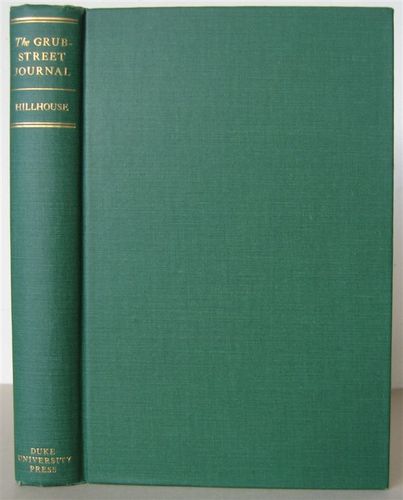
A Copy of the Journal, doesn't look like much...but not a bad read.

I was originally disappointed when I received my copy of ‘The Grub Street Journal’. I was expecting a collection of eighteenth century magazines written by members of the much maligned assortment of hack writers located in and around Grub Street. Instead I received a book about a magazine, which had written as if by hack writers in and around Grub Street, but actually written, partly at the instigation of Alexander Pope as a continuation of The Dunciad.

James Hillhouse explains that he was originally intending to publish the Journal itself, but seven years of popular and consistent publication, there is too much to publish. His second thought was edited highlights of the Journal but this highlighted a problem that would have also affected a full collection. The business of the Grub Street Journal, was to pick entertaining squabbles with other newspapers and get squabbling away. For this reason, it’s hard to simply publish it, as it is principally understood in its relation with other publications of the time. This is what this book’s about, and as such, it is very entertaining.
The first chapter is the driest, but essential to understand the rest. It details how the Journal was developed to pick literary fights on behalf of Pope and other Scribelarians and how it grew it’s own legs under it’s editor ‘Bavius’, a mask worn by a few people but most often a sharp-witted, non-juring vicar called, Richard Russell. It then provided popular entertainment, by picking fights, some literary, others medical and some religious.
The book then takes us through different categories of argument and dispute the journal involved itself in and gives examples of each. The disputes take rather similar forms, even the most abstract arguments descend into ad-hominem attacks and the Journal often finds itself using parody and fake letters from the other side, making it look stupid. They have a particular fondness of attacking other papers, I like the constant refrain of rival paper, The Register as, ‘an obscure little paper’, it seems such a modern way of niggling other publications.

Another running joke I enjoyed were the constant digs at Colley Cibber. I have a real fondness for Mr Cibber (last mentioned in my review of ‘Midnight Mirage’, but also got a mention in ‘Joseph Andrews’). The actor-manager, so popular in comic roles, unexpectedly made poet laureate to be ridiculed at least twice a year when publishing his New Year and Royal odes. The Journal had followed the contest throughout, ridiculing the possible candidates but mostly ignoring Cibber, he being such an outside possibility. When he got the role, they were ready with an epigram or two. For example;
But guessing who would have the luck
To be the birthday fibber
I thought of Dennis, Theobold, Duck
But never dreamt of Cibber
(Incidentally, during the contest, Bavius banned waterfoul puns for Mr Duck as they were being inundated with them).
Or this comment;
Court fools and poets once illustrious lived:
With different titles graced distinct they shone:
But both are now so scarce; ‘tis well contrived
To join a poet and a fool in one.
Every time one of his execrable odes was released, the Journal would look at it in it’s most mock-serious manner and tear it apart. There were frequent niggles at his plays as at his poetry. 

Colley also seems to have provided the age with a phrase used in lots of contexts, much as we would use a famous quote from a film... such as, when chopping too much veg for a curry and putting it in a pan, I remarked that we ‘needed a bigger boat’). The phrase, which I have now incorporated into my own idiolect is something Colley was reported to have said to an actress who had particularly slayed an audience one night that she had, ‘outdone your usual outdoings’. In works throughout the ‘30s, people were described as ‘outdoing their outdoings’ for many different spheres of activity. Of course, Cibber himself often outdid his outdoings as a poet.

Another regular feature was the news roundup. This was more than a mere digest of news, but also a comment on the poor newsgathering techniques of the other papers. It took conflicting reports of the same event, compared them and often a comment by Bavius/Russell. These comments are often of an acid and sardonic nature that pushes (and occasionally crosses into) cruel. Occasionally the reports were written in a rhyme form, something that seems shockingly flippant and rather amusing, for example the fairly famous;
“Yesterday, a poor woman, who I suppose got up to ride,
Fell out of a dust-cart, and immediately died.”

There are many arguments, but the one that most gripped me was the tale of their longest running feud with the quack, Joshua Ward. Ward peddled some pills and drops, supposed to be a panacea for all ills and ended up killing many people, especially the weak. The Journal opened up its pages to anyone wishing to report deaths and crippling from the pills. The pills were based on genuine 18th century medical practice of purging the body of sickness, but they worked too well, purging the body for days and days until the victim purged themselves to death. The campaign was pretty successful, and Ward had to tour the North and keep out of London. 
In all, I enjoyed this book and I feel I know, or have access to knowledge about every aspect of The Grub Street Journal that I could ever want. And that’s something to be pleased about. 


Yours