Wednesday, 11 March 2020

Review: The Strange Adventures of the Count de Vinevil and his Family by Penelope Aubin


Today’s text from the Oxford Anthology of Popular Fiction by Women 1660-1730 is a really juicy one, horribly ‘perfect’ characters, weird attitudes to women and lashings upon lashings of Islamophobia and racism, there’s something in here for everyone.

The Strange Adventures of the Count de Vinevil and his Family. was written by Penelope Aubin, who wanted to redeem the novel’s bad reputation for saucy little love stories and use the format to show people of great virtue acting in admirable ways in difficult circumstances. She’s explicit about this in her preface. She’s also explicit about setting it in a foreign setting to capitalise on the success of Robinson Crusoe and the title pages tease something more of a shipwreck story than we get. The majority of the novel is set in Turkey, making use of the same ‘Eastern’ archetypes that are examined a little more subtly in Johnson’s play, Irene. It must be said that Aubin knew who to ride trends and tailor her work to taste and she knew it, saying;
“If this trifle sells, I conclude it takes, and you may be sure to hear from me again.” She was very popular, writing another four novels that year.

We are introduced to the Count of Vinevil and his family. He is of noble blood but having been an uncorrupt official, is now rather down on his funds and decides to trade with Muslims in Constantinople. He was a daughter called Ardelisa who is beautiful and looks after a young man, the Count of Longueville.  While Ardelisa (our main character) is barely described, Longueville gets attributed an entire page of perfections, so of course I hate him instantly. The young couple are in love by default and Longueville declares that he plans to be, ‘lover, husband and father’ to Ardelisa, a declaration that surprisingly doesn’t get him banned from going anywhere near her again.

Things are instantly alarming when they enter Turkish waters, catch sight of the Haigh Sofia and Longueville warns Ardelisa that they are not in Kansas anymore but in a place full of, “odious mosques, where the vile imposter’s name is echoed through the empty choirs and vaults where cursed Mahometans profane the sacred piles.” Ecumenism hasn’t reached him yet.

Pretty much as soon as they set up shop, they wish they hadn’t, particularly due to the oppressive fondness of an important Turkish Bassa called Mahomet for Ardelisa. Hearing of a plan to have their goods stolen and innocent woman stolen for a harem, they make a plan for the Count de Longueville to sneak out of the bay and Ardelisa to stay at a friends. Before they put this into effect though, the Count de Longueville begs for marriage to Ardelisa in case the plan goes wrong. This isn’t presented as a romantic act so much as a practical one, Longueville wants to marry her so they can have sex as it would “be so wretched to lose her unenjoyed.”(I’m not sure I’ve written the word ‘yeuch’ quite so many times in my notes with any book as this one).

He also gives her a motivational talk where he encourages her to kill herself if captured as although her virtue is strong, “force does oft prevail” and he would “be completely cursed to hear you live and are debauched”. It is here we see Penelope Aubin the canny worker of the book trade, for a book dedicated to ‘honour and piety’ and is obvious she is also trying to titillate her audience, teasing a dramatic rape or escape.

When the moment does happen, it happens in dramatic fashion. Mahomet is a brute who loves the notion of killing christians declaring he means to leave nothing in the household but “speechless ghosts and murdered carcasses” and that he will capture Ardelisa and “force her to give up her treasures to me.” When he finds Count Vinevil, her father, he orders his men to, “bring her naked from her bed that I may ravish her before the dotard’s face”. But the plan has worked, Ardelisa is at a friend’s house, so he stabs the Count de Vinevil and that’s the end of the title character of this text. To be fair, that’s the best scene, it may be hammy and revels in its rapey imagery but it has the more life than the rest of the novel.

The bulk of the novel consists of Ardelisa, her maid and their servant moving about and hiding in one of the many comfortable little Christian hermitages that seem to litter the countryside. As they do this, they gather quite the retinue. For a few tense paragraphs, they are are caught and the women are put in a harem, luckily for them, the person who has captured them falls from grace with the Sultan and is imprisoned and they escape in the confusion with yet more people.


Finally they put to sea. The ship is wrecked in a storm on a deserted island in the Mediterranean. Here they have more trouble finding food and the tension builds until another ship turns up. There’s some discussion about the relationship between Violetta, a woman picked up at the harem, and the ship’s captain. The issue is, that she has had sex when she was in the harem and as a wife (though against her will) considers herself still married to him. This is quickly solved with news that he has been executed and takes them all to France along with the many gems they seem to have gathered along the way.

The last part is completely baffling. The odious Count of Longueville, who we last saw having a quick wedding and sneaking goods out of Constantinople has reached France ahead of them and is in a Monastery and about to become a monk. Instead of going straight to him and declaring that she lives, Ardelisa decides to send a message that she has died. Why? I’m not sure. Possibly for giggles, to see what he has done, or because she has a similar opinion of the Count of Longueville as I do - not sure.


It makes sense this novel ends with an act bother pointless and cruel as it sums up the experience of the rest of it. I recommend this one only to enjoy hating it.


Monday, 9 March 2020

Journal of the Plague Year 2020 (Entry Two: Eat More Garlic)


Entry Two: Eat More Garlic
(29.2.20 - 6.3.20)

It’s been over this week that coronavirus has really come to the forefront of people’s mind. There are statistics everywhere; 1% death rate, possibly 3.5. That all the residents of London have a 50% chance of catching it, possibly a 75% chance. Even 1% of 50% of 9 million is a lot.

On Tuesday, a friend was telling me how her graduation had been cancelled and that she was worried. Worried about the virus but also worried about her Easter wedding being cancelled, or a dud which no-one would come to. They’ve cut back the release of the new Bond film till November for similar realise, that film can’t catch a break. The new Bond song has already been released, it doesn’t really start until the last thirty seconds.

There’s no official word at the school about what will happen if the virus hits us. There’s no official notification (or consent) about all the cameras yet, so I’m not surprised. The rumour is that the Head has said we’ll carry on regardless, teaching whichever kids turn up with whatever teachers are left.

The biggest change in the school is that we actually have soap now. The government’s recommendation is that everyone gets in the habit of washing their hands more than five times a day, for twenty seconds a time, roughly how long it takes to sing ‘Happy Birthday’ twice. I’ve acquired a veritable jukebox of songs, mostly bits of The Beggar’s Opera and other old songs. Belting out a bit of ‘Mirie it is’ whilst washing my hands has become something of a highlight of my day. This does mean I’ve thrice forgotten to do up my flies and all this washing is making my hands feel pretty rotten.

Apparently, the government are at a stage of their plan called delaying. The hope is not to prevent a mass outbreak but to push back the inevitable until the summer. This gives more time for research and preparation but also separates the cases of normal winter flu from the coronavirus. I can’t help having the selfish hope that it hits sooner and that I get some time off work. It’d be so dispiriting to have to put up with a stressful year of work and then spend my time off sick or in quarantine.

One of the weirdest theories I’ve yet heard was expressed to me on Wednesday by someone at work. In their view, this strain of virus didn’t come from China but has been in London all this year. Her evidence for this is the fact that she had a winter cold at the beginning of February. I’m not convinced. Possibly weirder than that is the theory that coronavirus has been purposely created to kill old people and give governments cash boosts from death duty. I’m not convinced of that either. 

A friend told me that her friends would not go to an Italian restaurant because the virus has spread to Italy. How do people think illnesses are spread, through words and thoughts?

In a slight detour from coronavirus news, on Tuesday I saw a strange van on the way home from work. It looked like a police van but was labelled ‘immigration’. On Wednesday, four of these vans lurked at the end of my road. Perhaps I’m growing paranoid, what with these vans and the CCTV at work, I’m feeling watched. It’s not that I see dark forces manoeuvring against me so much as dark forces manoeuvring against someone. 

What’s more, I’ve become hyper-aware of my body. Every premonition of a headache, every slight raise in my temperature, every heaviness of limb obtains a greater significance. Am I getting sick? Have I ever been well?

There hasn’t been any panic buying as far as I’ve seen but when I went to my local chemist/health-food shop to get some interesting tea, the weird lady over the counter was speaking in hushed voices to a customer. They had no big pots of hand sanitiser themselves, but the weird lady over the counter had whipped up some of her own. She also recommended eating as much garlic as possible.

Garlic, yeah, that’ll do it.


I’m not convinced.


Entry One: A Cough in a Box (22.2.20 - 28.2.20)
(Coronavirus is a rumble among other stories but silly stories start early.)


Entry Two: Eat More Garlic (29.2.20 - 6.3.20) 
(A song and a wash, rising paranoia.)

Entry Three: A Guilty Sigh (7.3.20-13.3.20) 

(Confusion at school, a new variation on 'it' and a new chat up line.)

Entry Four: A Week as Schrödinger's cat (14.3.20-20.3.20) 


(A week at school where it's open, closed then repurposed as something else.)


Sunday, 8 March 2020

Journal of the Plague Year 2020 (Entry One: A Cough in the Box)


Entry One: A Cough in a Box
(22.2.20 - 28.2.20)

At first coronavirus was just one news story among many, mixed up with whatever political nuttiness was happening and an incoming week of storms. The thing that most impacted me was the installation of 14 CCTV cameras at the school I work, seemingly plotted to follow my every move. All talk at work was about the cameras. Year 4 were making maps of coverage, year 3 were looking up anti-camera burkhas and I was crossing my arms in a ‘hail Big Brother’ gesture as every lens.

S, the IT guy seemed rather excited by his new toys and was not keen on discussing the ethical ins and outs of plastering one small section of school in surveillance. Instead, he tried to distract me with talk about this new virus. He told me that he was suspicious of this new illness in China, that the one-child policy had fizzled out and that perhaps the Chinese government were trying to thin their population in other ways. As evidence, he cited its emergence in a busy transport hub in a densely populated city. I thought that it was less likely to be planned, coming from a dirty, dense city with transport links and it was the perfect place for a virus to emerge. He said he got the idea from a friend in American Intelligence, I was not convinced.

Another person at work showed me a video of a man looking at the back of an anti-bacterial bottle which included coronavirus, which proved that it wasn’t new and already existed. I was about to point out that the claim was not that it was a new illness but a new strain of an existing one but I didn’t have the energy to.

I first realised I might have soaked in more of the news and panic when I had a dream about it. In the dream, I and a large number of people were in a living room filled with comfy, brown, leather armchairs. Some of the people are very sick, one particular person from work was sweating very heavily and panting. I was going about helping these people as I could, putting damp towels on their head. It wasn’t a nightmare, people weren’t going to die but it wasn’t a particularly nice dream either. The only thing it revealed to me, was that I was thinking about it more than I realised.

The silliest thing I overheard was in a shop where a lady was picking up a package. She paused, and pushed the box back unopened declaring;
“I don’t want this anymore, some Chinese man might have coughed in the box and I ain’t opening it.” 

I wasn’t convinced.

Entry One: A Cough in a Box (22.2.20 - 28.2.20)
(Coronavirus is a rumble among other stories but silly stories start early.)


Entry Two: Eat More Garlic (29.2.20 - 6.3.20) 
(A song and a wash, rising paranoia.)

Entry Three: A Guilty Sigh (7.3.20-13.3.20) 

(Confusion at school, a new variation on 'it' and a new chat up line.)

Entry Four: A Week as Schrödinger's cat (14.3.20-20.3.20) 


(A week at school where it's open, closed then repurposed as something else.)

Wednesday, 4 March 2020

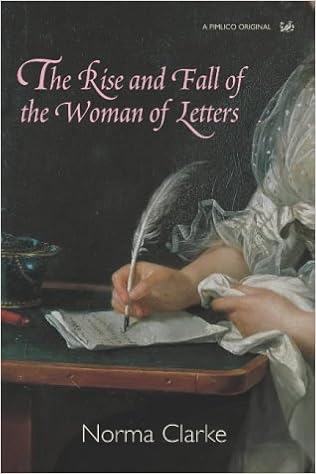
Review: The Rise and fall of the Woman of Letters by Norma Clarke


Whilst my run through the Oxford anthology, Popular Fictions by Women has been enjoyable, I did need a little something to split up the succession of novels without being too distracting or slowing the momentum. I settled on Norma Clarke’s The Rise and Fall of the Woman of Letters as I thought the information in it would supplement the novels nicely - which it did to a certain extent. 

The book started, not with the rise or the fall of a woman of letters but with a glimpse at the woman in her hey-day with the example of Anna Seward. This proved a problem for me at first, as I have already ‘met’ Anna Seward in other contexts and have found her utterly infuriating. Her judgmental biography of Erasmus Darwin I found pedantic and irritating, nor do I accept or appreciate her comments about Samuel Johnson being rude, overrated and a poor critic. I initially felt that if she was the typical example of the woman of letters, I was quite happy doing without. But Norma Clarke won me round. She highlighted the moments of joy in Seward’s writing, the dedication and love of poetry - the close reading that I had written off as pedantic could also be seen as a labour of love. That Anna Seward was seen as an inspiring figure, an arbiter of literature who operated through letters from a provincial town. What’s more, Anna Seward sacrificed much to maintain this position and when she fell in love, she bloody-mindedly and bravely celebrated that love (even if she probably never consummated it). The fact that is is irritating is as much a part of her strength as anything else - yet Anna Seward was one of the last of her breed. The rising women authors of the mid-nineteenth century wouldn’t feel they were a part of a tradition that went back to the seventeenth century, nor that people like Anna Seward were their fore-mothers in literature.


How this fall happened, I have to admit the book didn’t go into much detail. Indeed the whole rise and fall of The Rise and Fall of the Woman of Letters was probably the weakest part. The book seems to jump around in time, starting with Seward, then going to the 1730s, then the late 1600s and so back and forward throughout. If I can extrapolate, the rise of the women of letters start in the court of King Charles II. Under the King there is a network of patronage from King to Lords and Lords to others. One of the ways to show wealth and taste is to patronise writers, and eventually some of these writers are women. At first these women circulate their writings privately, much as Katherine Phillips did. However, after a while these works are published (in a way that is usually claimed to be against the author’s wishes) and the wit of the writer became more widely known. With the ‘glorious’ revolution, James II set up court in Saint Germain and some of these women writers, such as Jane Barker, went with him.

Back in England, the power of literary fame moves from the patron to the marketplace. This means that women writers have to navigate it and create authorial personas. The two broad (and I do mean broad) ways of doing this was to have the reputation of an exciting, possibly immoral but certainly entertaining woman or to adopt an almost hermit-like, virginal persona. Those who took the first, such as Delrivier Manley and Eliza Haywood managed to sell exceptionally well (out old pal Curll being involved in many of these) but as the reputation of the writer started to overshadow the reputation of the work, the memory of the work faded.

For those adopting the hermit-like persona, this developed into the bluestocking. As both male and female writers rushed to decide who was the good, moral authors and the bad, immoral ones, the notion of the hermit-like author becomes the Exceptional Woman. The trouble then, is that authors spend so long defining who is or is not an Exceptional Woman, that the whole category seems useless and those authors are forgotten (or faintly ridiculed as dowdy spinsters).

Or at least, that’s what I took from the book. Rather than telling this story, the book is far better at introducing its reader to a myriad of fascinating people, stories, attitudes and literature. 

Among those we are introduced to are; Elizabeth Elstob, an expert on the Anglo-Saxon language who found her access to raw materials blocked when her brother died and found herself stranded as a small town primary school teacher. As someone who now works in a primary school and who also tries to write a full day’s writing (and reading) when I get home, I agree with Elizabeth Elstob that; “when my school is done, my little ones leave me incapable of reading, writing and thinking, for their noise is not out of my head till I fall asleep.” She was later freed from being a teacher but at the expense of being essentially a pet. She never wrote again. (Incidentally, it’s interesting to see how important brothers were as bridges to learning and access to books, and how when they die, that access is removed.)

Other interesting people are Elizabeth Singer (later Elizabeth Singer Rowe). She wrote a poem to John Dunton’s Atheneum Mercury, the first magazine to include an agony aunt column. This poem being very popular, the magazine asked for more, building her audience up. She later wrote the extraordinarily peculiar, Friendship in Death, which I shall review portions of later.

Then we have Catherine Trotter, a playwright of such popularity that George Farquhar tries to piggyback off her fame. Her reputation was a little sketchy, as being a playwright was too connected to the theatre to be completely respectable. When she married a reverend, she stopped writing for the theatre and dedicated herself to motherhood for nearly twenty years. When her children had grown up, she went back to writing but concentrated on philosophy, especially unpacking and defending the writing of John Locke. Now, as the widow of a reverend with a different name, Catherine Cockburn rather than Trotter, her reputation was spotless and allowed her to partake in serious philosophy. 

Then we have the twin stories of Susanna Centlivre and Mary Davys. The first was a strolling player who fell into penury and became a beggar on the streets, whilst the second was a refugee from the strangulation of Ireland. Centlivre was found on the road and under patronage became one of the most successful playwrights of the eighteenth century. Mary Davys wrote about her refugee experience before marrying a reverend. When he died, she set up a coffee house in Cambridge and her writing was passed around. This built her an audience that launched a number of successful novels (one of those coming up also).

The final person I wish to mention is Katherine Phillips, known as Orinda. She started writing poems amongst her friends which were predictably published ‘against her will’. I never knew how influential she became, how every female poet for the next one-hundred years wished to be Orinda and the fact I’ve never heard of her is absolutely indicative of the fall of the women of letters. Which is an utter shame, I hate missing out.

(Also, our old pal Automathes turns up in parenthesis in a nod till his wife.)


Wednesday, 26 February 2020

Review: Love Intrigues by Jane Barker


The next on my odyssey through the Oxford collection is Love Intrigues by Jane Barker. She was the first author in the book I hadn’t heard of, though I’ve later heard a lot more about here through the book The Rise and Fall of the Woman of Letters by Norma Clarke.

Jane Barker was always fond of learning and, with support from her brother, even taught herself anatomy and medicine. In her visits to the universities, she found herself in poetic circles where she shared in discussion of poetry as well as writing poetry and passing them on to each other. When William of Orange landed, Barker, a dedicated Jacobite moved to St Germain as a part of James II’s court in exile where she continued to write. 

Later, she’d create a series of books called The Patchwork Screen, which were (what seems like) fascinating mixtures of story, poetry, essay and anything else that would work. Love Intrigues, on the other hand, and the other two short books that made up the Galesia Trilogy were largely autobiographical, which may explain how un-novel-like some of the strangeness of this book.

It starts with a sprightly eleven your old girl called Galesia being pulled out of a school in Putney because the reversal in the King’s fortunes means that the family’s are a little more precarious then they had been. This is okay because her older brother’s friend has taken a shine to her, “though he were already a man, and I but a child.” (Ick). His name is Brafort.

Galesia also has her eyes fixed on another young man called Bosvil, he isn’t into her yet as she is a child (hooray) but happens to be her cousin (ick, again). 

When she reaches fifteen she lives with an aunt in London to learn the ways of a gentlewoman, where she spends more time with Bosvil and the two start to build a friendship. Brafort also comes over to woo her but she pretends all of his romantic talk is nothing more than playful banter.

Brafort, realising that his attempts aren’t really getting anywhere and that Bosvil is moving onto his patch, gets his creepy little self over the parents and promptly arranges a wedding. However, as the wedding approaches he gets sick and he dies on the day of the wedding, sleeping in his “grave, instead of his nuptial bed.”

This should be the moment for Bosvil to make his move but he doesn’t, indeed he goes all cold. Galesia decides to dedicate herself to learning, carving a poem into a tree and deciding to learn medicine (which Jane Barker also did). 

However, when Bosvil comes around again his, “eyes darted love, his lips smiled love, his heart sighed love, his tongue was the only part silent.” Again they kindle something of a relationship but when he goes away he is cold again. This is the rest of the story, Bosvil intermittently sending signals of love and then signals of indifference. I honestly thought the book was building into a reveal of two Bosvils, one who loves Galesia and one who doesn’t, and them having to keep it hidden for some elaborate reason. It’s not that though, it’s a simple case of misreading the signs. Bosvil did love Galesia but was under the impression that she didn’t love him and had been mourning for Brafort, so he ignored her (and even eventually married) - whereas she’d loved him best all along.

The most entertaining parts of the book are when Galesia is angry. When she hears that Bosvil is getting married, she sends him horns, a symbol of cuckoldry, as a bit of a joke, which doesn’t go down too well at the wedding. She also has an elaborate page imagining murdering Bosvil and the thanks she would get from womankind for ridding the world of an inconstant lover, declaring that, “I shall delight myself to see the blood pour out of his false heart.” It’s a brilliantly over-the-top and utterly realistic depiction of an angry person having the sort of revenge fantasy that might embarrass them in a more sober mood.

Despite the flimsiness of the story, it is packaged well and is wrapped up in consistent theming, particularly when it comes to metaphors of language and the language of love. The whole story relies on the misreading of love’s language, references to love and language learning are scattered throughout the text. Although ‘the merest freshman in love’s academy could not but read and understand that language,’ of her love, Bosvil must be somewhere in nursery level. During Bosvil’s first period of coldness, Galesia decides to learn Latin so she can learn anatomy and medicine but she struggles with conjugating ‘amo, amas, amat’ just as she and he fail to conjugate. 


The plot may be flimsy but the telling is involved, the depictions of inner thought and conflict point towards later novels and the tightness of its theming ties it in a nice bow.


Wednesday, 12 February 2020

Review: The Secret History of Queen Zarah

Oxford Compilation: Second Text

The second novel in the collection is Delarivier Manley’s The Secret History of Queen Zarah, written in 1705 but more interested by events twenty years previously. After the succession of shocks and surprises that was Aphra Behn’s ‘The Nun, this was a far more expected and (if I’m honest) flat experience.

It tells the story of Zarah, an initially naïve (if never exactly innocent) young woman who lives around the edges of the court. She falls in love with a man called Hippolito because he’s attractive, well-connected and rich but he’s also the love the King’s mistress. This is pretty simply solved when Zarah finds herself in a compromising position with him and is ‘caught’ by her mother, who nudges him into marriage. The two rise in power, playing different political groups off each other, swapping alliances at the smallest benefit, teasing with sex and power – the general set of activities for the rich and dodgy. 

Finally, after weaving through the reigns of three kings, Zarah finds herself the favourite of childhood friend Atalantia. In this position she can screen her friends, punish her enemies and generally rule. This is no problem for Atalantia, who gets all the cushiness of being Queen without the hard work. The piece ends rather abruptly here.

The main reason the book doesn’t have a proper ending is that the story of Sarah Churchill, the model of Zarah, didn’t have an ending yet. As seen in the recent film, The Favourite, she would find herself and exiled, but this happened in 1711 and the book came out in 1705. It’s interesting to compare the character of Zarah in this book to the depiction of Sarah in the film to see what her enemies were saying about Sarah Churchill at the time and the (also quite slanderous) things said about her now. Zarah is a schemer in the book, she uses politics more than she uses sex and when she does use sex as a weapon, it is against men. Most interestingly, beyond her natural political cunning, Zarah seems something of a dullard, not very interesting or interested beyond the acquisition of power. Sarah Churchill in The Favourite used the with-holding of sex and affection to manipulate Queen Anne and she gains power for its own sake but also because she is good with it. Sarah Churchill in the film is manipulative but she is extremely smart and a far more interesting character in general.

The most interesting thing about this book is not the story itself, it’s the controversy over authorship. Never was it attributed to Delrivier Manley in her lifetime. Apparently it doesn’t have the same flavour of Manley’s New Atalantis, which is far more sexually explicit (and imaginative). Nor was it published by the same bookseller, the racier work being published by our old friend Edmund Curll. The current probable author of the work was a man called Joseph Browne, a man who succeeded Manley in writing for The Examiner (who had in turn taken it over from Swift). This collection was put together in 1996 and the arguments against Manley being the author of this piece were in 2001 and 2004. 


The other most interesting part of the text is the extensive preface, which turns out to be a straight translation of a piece of French criticism. The piece questions why the English are turning away from the multi-volume French Romances and in favour of shorter, more grounded works. It suggests that the English being a mercantile nation are generally more grounded but also suggests being ‘brisk and impetuous’ do not require ‘long-winded performances’ and that ‘they have no sooner begun a book, that they desire to see the end of it’. This example of an author taking a French jibe against the English and re-contextualising it in their favour was probably the funniest part of the text.


Wednesday, 5 February 2020

Review: The Nun by Aphra Behn


Oxford Compilation: First text.

In an effort to clear my writing workload and free up time to work on my exciting new novel, I came upon the most cunning of plans. One of the books on my shelves is an intriguing anthology by Oxford University Press called Popular Fiction by Women 1660-1730. It contains work by authors I’ve not heard much of such as Penelope Aubin and Jane Barker but also a few from favourites like Eliza Haywood and Aphra Behn – they should give me something to talk about for a few weeks.

The first piece in the book is called The Nun; or, The Fair Vow-breaker and is by Aphra Behn. I know she is not an eighteenth century writer but I had enjoyed Oroonoko (and thought I had written a review of it) and was expecting something well written though, from the title, a little generic. What I quickly realised was that this was anything but generic, it’s a rollercoaster of reversals and surprises.

I’m not much one for spoiler warnings but I will issue them for this, the impact of the story is in all the sudden about-faces coming along suddenly.

We start with a man of wealth who feels so depressed with the world when his beautiful wife dies, that he decides to join a monastery and have his charming two year old daughter raised by nuns, the Abbess being her auntie. There’s a lovely couple of sentences about how two is a lovely age and detailing how the nuns fall in love with her 'forward prattling', the toddler being a breath of fresh air. The nuns love playing with her and teaching her everything they know. Which seems to me to be the perfect set up to a story where  the fair innocent is seduced, runs away from the convent and dies in shame and penury.

This is not what happens though. She is encouraged to have a jaunt in the world and to make a decision about whether she would like to be a woman of the world (and have half her father’s fortune) or to stay in the convent. Despite winning the hearts of innumerable men (despite being 13 - ick), she decides the nun’s life is for her.

Of course, as soon as she does this, she meets a man who gets her attention. The wooing is slow, over a number of years (and edging her into less ick age-territory) and she decides to run away with him. They run away together, but he is no rake, they actually genuinely marry and settle down. I was then expecting them to fall out of love because of their poverty but they grow closer together. The cosmic punishment for breaking her vow that I expect from this kind of book is limited to her husband’s poor luck with farming.

That husband goes to war where he dies - this is something I expected. One of her earlier wannabe lovers returns and marries her. He’s rich and showers her with gifts. Now I’m expecting luxury to sour their pure love and tear them apart but that doesn’t happen either, they build a reasonable life of it.

One day, a bearded man turns up who happens to be the first husband who has in fact not died. This twist was a genuine shock to me, expecting that part of the story to have been forgotten now. I was genuinely stumped over what solution our fair ex-nun while arrive at - she isn’t, she smothers him without compunction. Then, when her current husband returns, she spins a lie about how he died of shock when he found she’d married again.

Then came the strangest part of the story, she surreptitiously sews her second husband to her first so that when the second throws the body of the first into a river, he falls in as well. At this point, I am giving huge style points to our protagonist. 

At this point I was utterly shocked, not only at her actions but at the way they were positioned to the reader. At no point was she racked with shame but nor did Aphra Behn ever present her as evil or wicked, if anything we admire her ingenuity. It even looks like she’ll get away with the double murder right up until the last two paragraphs in which she is arrested and then executed.

 Even then she is never destitute, she is never shamed, she maintains her strength and even (oddly) her goodness. As a prisoner waiting for the axe, she is a model prisoner, using her story to remind others to keep their vows and going to the block as unstained as she entered the story as a spritely toddler.

It’s not a long piece but crammed with so many wonderful surprises and gloriously free of that form of grimy pleasure that ‘moral’ texts can derive from degradation.  An entertaining and shocking work and I recommend digging it up.