

The Second part of the great books of the year. If you want to see all I read this year click here, and if you want to see the numbers 10-6 books, click here.
In at number 5

The Tale of Genji
I’ve written about this here.
This is a book that is already a wonderfully complex work compared to western works written at the same time but it becomes more complex as it goes on. The writer pushes the form and creates a book that is deep, complex and very interesting.
At number 4

Mr Bowling buys a Newspaper
I loved Mr Bowling buys a Newspaper, I found it funny, gripping and oddly sad.
Mr Bowling was educated to be a gentleman but graduated into the Great Depression where there weren’t enough jobs so he has to make do with much less than he was expecting. He married young to a woman who refuses to engage with him sexually or romantically (an oddly common trait amongst the wives in this book, was it a hang up of Henderson’s?). He desperately wants to die, sees death as a merciful release from the mundanity if existence but won’t kill himself - instead, he’ll kill other people, be caught and be hanged. He has one problem, with the chaos of World War Two happening, no one seems to want to catch him.
I found the character of Mr Bowling to be an extremely pathetic figure. His motivations for murder are his dissatisfaction with life, but his dissatisfaction seems to come from his own shallowness. He grandiosely thinks himself a great artist who was born for a great love, but his compositions never really took off, and he married a sexless woman and he can’t imagine a life ‘worthy’ of him. It makes him both relatable (I also graduated into a world in depression and have artistic desires that have never translated to material wealth) but also more despicable.
What’s more the book is incredibly funny. There are dozens of funny one-liners and moments. The farce of him moving a body in the manner of a three-legged-race made laugh, as did the fact that as sloppy as he was as a murderer, he simply couldn’t get caught.
This book treads some similar ground as Patrick Hamilton’s novels, especially Hangover Square, with the same smoky, pub-laced atmosphere, but it manages to do so with a lighter touch, which veers on the flippant. I found it frequently surprising and entertaining.
At number 3
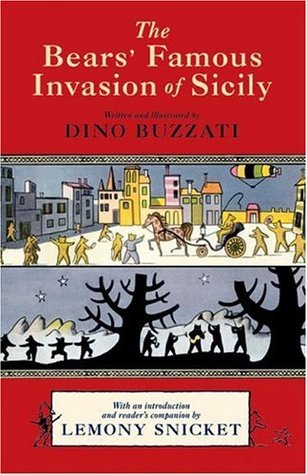
The Bear’s Famous Invasion of Sicily
I was first recommended The Bears’s Famous Invasion of Sicily by Lemony Snicket, who has an appendix in the back of the edition I read. Being on a mini Italian children’s classic kick, having just read Pinocchio, I read this. I thought it particularly sweet to include a letter from author, Dino Buzzati to translator Frances Lobb recommending her translation.
There’s a wonderfully mythic tone to this book, found in the almost Bayeux Tapestry-like illustrations to beginning with a dramatis personae and location description. I loved the silhouette portraits next to the descriptions, along with the suggestions of spoilers. It all adds up to the feeling that this really is a famous tale I should know about already. Then there’s the inclusion of the werewolf, perhaps he does appear in the book somewhere, I haven’t found him.
The book is told in a mixture of prose and doggerel, and it really is doggerel, rhyming things like ‘ramparts’ and ‘damp parts. This adds to the mythic/chronicle nature of the book, as if serious works and high flying epics have been created about the subject and are here mushed together. It’s also interesting how the most of the doggerel sections are within the part of the book that deals with the bears’ invasion, leaving just prose during their occupation and settling down, with a return to poesy with the song at the end.
The bears invade for a reason that many animals do encroach upon human territories, they are hungry but they are also lead by the noble king Leander’s secret search for his more prosaically named son, Tony. The bears are expecting to be welcomed with open arms but are fought off, thus turning their encroachment into an invasion. On element I found really interesting about the illustrations was how it is only the bears that are shown to be bleeding in the battles. There’s even the detail of a bear red cross stretchering off an injured comrade during a battle.
The illustrations are a key component of this book and I love them. I love the simple shapes of the bears, whether they are fighting, partying with ghosts, dancing in victory or indulging in gambling, drinking and suggested S&M.
I also love the mythic nature of the story. How the bears fight their way into the city like the Israelites going into the promised land, their degeneration and corruption by luxury, the tragic death of King Leander and the march back to the mountains, reminding me of the children of Hamelin or the Elves at the end of Lord of the Rings. To have that myth, along with wry humour and a big dollop of bathos (like the end of the ferocious cat, Marmoset) and it’s a unique and wonderful thing.
I enjoyed the appendix by Lemony Snicket. I found the little textual and illustration nitpicks to be fun - pointing out that all the silhouettes face right, or that an illustration could be seen as two ghosts arm in arm or a ghost of a conjoined twin. He also pokes at some deeper troubling undertones in the book, how the human and bear communities seem segregated and Saltpetre’s summary execution by Dandelion. While in no way an essential part of the text, it was an interesting appendix.
Number 2 is the highest ranked poetry book I’ve read.

A Portable Paradise
A Portable Paradise is probably the best poetry collection I’ve ever read. Easily the best one that isn’t an anthology of different authors.
Roger Robinson has a skill of finding a particular image or idea to make a poem from and then create that poem without under or overcooking it. Each one feels like an idea, plucked and presented well, without feeling like it’s complete, sealed and uninteresting, nor so open that is feels like it’s fraying at the edge. It feels whole without feeling done. It’s hard to describe.
I think a key to each poem’s success is that they are built on something specific. I think the best poems have a clarity and specificity of meaning and intention - Wordsworth’s Daffodils looked happy and made him happy - that many poems seem to lack. It also helps that he is capable of writing many different forms and lengths of poem and sequence them so it never feels samey.
The book is split into five broadly thematic chunks.
The first is about the Grenfell fire. A reviewer said it made him cry, I thought that was nonsense. Then I read the chunk, in public, on a sunny day by a duck-pond and I was very close to crying myself. I remember when it burned down, I lived not very far from it and the smell and taste on the air was something that will stay with me. The poems include one about the ‘lost’ posters being like a people’s portrait gallery, another about using sheets to climb out, another about a girl becoming her dead father and drinking cardamon coffee like him. The poems built into this full-seeming portrait of innocent lives lost to save a council a few quid. It was very moving.
The second section starts being about slavery and then about the lives of Black people in London (particularly Brixton- presumably because of the history of riots, Robinson’s from Hackney). I loved how there was a slavery limerick, I loved the one about black olives - it made me laugh. There were also some poems about racial profiling. The most impactful poem in this section was one about tension in Brixton before something kicks off. I lived in Harlesden, and there were days when you walked out the door and could just feel that energy crackling in the air and he captured it.
Section three contained poems by different citizens, bewailing and praising their London lives. To be honest, this was the weakest section for me but that’s probably more to my life experiences. I lived in the very gang-divided Harlesden, but the notion of ‘areas became ends’ didn’t ping for me because I had no part in gang life. I was very struck by the street names being named after slave owners (though the area I lived, the streets were named after naval battles).
Section four is about music and art. I can salute any poem that celebrates Sade, the Stubbs one was gruesome and John Coltrane reaching heaven on a mountain of cocaine made me laugh and wince. The darkest one was about his great grandmother.
The last section is about his premature son, and about health and sickness in general. I was a premature baby myself, and my Dad tells me about the prayers he made and how the experience of it turned him from a casual churchgoer to a believer. The disjointed poem about his prayers is heartbreaking, as is the picture of Grace, the nurse, who can thread a tiny vein like no one else. ‘Saints’ is an odd outlier, comparing prostitutes to them.
I picked the collection up from the Waterstones clearance for a pound (how I pick up most of the poetry I don’t already know) and I was blown away.
And at number 1

Beware the Cat
I’ve written more about this here.
I read this book at the beginning of the year and knew it would be a hard book for subsequent ones to topple. A peculiar melding of real people, satire on alchemy and science, and a collection of bedroom bawdy, all held together by the true secret about cats.
And that's all the best books this year, I hope next year is good.


No comments:
Post a Comment