Wednesday, 26 November 2025

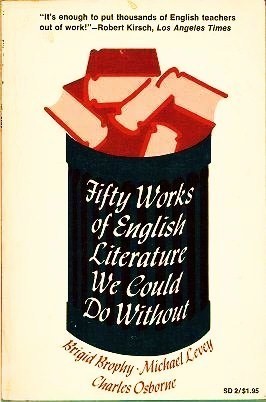
Looking at 'Fifty Works of English and American Literature we could do without' (Part One)

 Fifty Works of English and American Literature we could do without presents itself as the work of three enfant terribles, taking a sledgehammer to the self-satisfied corpus of English Literature. It caused a stir in 1969 but is mostly forgotten now. 

Written by three authors, the best known at the time was Brigid Brophy, which is how I came to this text. I remembered the quote “To my mind, the two most fascinating subjects in the universe are sex and the eighteenth century” and I looked up who said it. This led me to Brophy and her own fascinating body of work, which put her on my list of authors to keep my eye out for. This book was one of the most eye-catching titles on that list and I found a copy on the internet archive.


Skimming the contents, it’s interesting how many of the works poked at aren’t great beasts of the canon any more. I’d not even heard of The Dream of Gerontius, or The Essays of Elia, even as I am aware of the authors. Oliver Wendell Holmes is not a name I’ve ever heard of, nor his book The Autocrat at the Breakfast Table. Some of the other ‘great works’ in this book have rather lessened in stature. Of the big books in here that are still big, some are prodded just to show gutsiness. The pages on Hamlet can’t declare the play to be worthless, only to overshadow some of Shakespeare’s other work. 


The book is arranged chronologically, with a few pages being given to each dedicated work, arguing why the book can be done without, the flaws in it and (sometimes) some worthy alternatives. It’s a book I’ve mostly skimmed through, but I think it may be fun to go through the eighteenth century books mentioned and see what I think of the conclusions. I’ll start with the two novels picked out and, next week, I’ll look at the two plays.


Moll Flanders by Daniel Defoe


The first eighteenth century work given the Fifty-Works etc treatment, it starts off by comparing Defoe-Fielding-Smollett as a housing estate of red brick, solid buildings, something unexceptional but functional. Then it argues that Moll Flanders is not particularly functional, containing the “thinnest trickle of narrative”. It says that although the novel catalogues the events with nothing left out, nor does it “put anything in” with a sense of morality and characterisation that is “stunted”. It describes his prose as “clean” but “inept to novels, since it swallows all the vividness of what it recounts into itself”. The section on the book I sonly a page and a half long, given poor old Defoe short shrift.


To be honest, I’d agree with the criticisms of Moll Flanders and of Defoe in general. I’ve said myself that his journalistic training and journalist’s prose are very good at reporting processes (like Robinson Crusoe’s house, or Moll’s own stealing) but less successful at conveying emotion. In my video on the ITV drama of Moll Flanders, starring Alex Kingston, I said that the real benefit of the screen adaptation was to dramatise the emotion that a reader of the book has to imply. However, there is a case that Defoe’s emotional flatness gives space to the reader to ask what they would do in the circumstances. It also has to be remembered that one of Defoe’s big aims in his novels was verisimilitude, the flat, reporting style of them make them seem true - to such an extent that it can be hard to forget that Moll Flanders was not a real person. (I’ll be reading a very intriguing book about Moll Flanders soon).


Tom Jones by Henry Fielding


Now the iconoclastic thrupple go after my favourite novel. It starts off with a very long-winded paragraph describing a Kipling novel called Stalky & Co, in which a boy feels like something less because he isn’t sporty like the titular Stalky. It suggests that Tom Jones has been popular for years because it stands as the one example of a book that isn’t wet and weedy, “Tom Jones has become the accepted epitome of red-bloodedness.” 


They agree that the book Tom Jones is vigorous, but that Tom himself isn’t. He’s a “tom cat of remarkable passivity”, who is more flirted with than flirting. But that’s okay, his blankness is typical picaresque stuff, it must be the adventures that are vigorous. The gang argue that the adventures aren’t, just a series of bed-hopping and bonks on the head. They also say that the other characters aren’t all that interesting, that they all have their one thing, something it calls a “sandwich-flag system”, presumably that the flag allows you to know exactly what the sandwich is.


Brophy and co claim the vigour of the book all comes in the narrator, a narrator who they say doesn’t really want to narrate, writing introductory material right up to the end. They say Fielding isn’t all that bothered telling the story, presenting the actual events in a “clerk of the court way”, that is might not be “quite as dull” as Moll Flanders, but goes on twice as long. They say the book doesn’t convey the sights and smells of eighteenth century Britain, and that Fielding as narrator spends the whole time convivially slapping you on the back, leaving the reader, “as aching and bruised as they would have been had they spent the time playing rugby.”


As much as I love Tom Jones, I have to agree that he is a weaker element of the book. He does the job fine, but he is a little bit of a blank slate for the reader. I whole-heartedly disagree that the side-characters aren’t brilliant though. Squire Western might not be a complicated man, but he is a fun one to be with, enlivening any scene he is in. As is his sister, as is Honore the maid, or Partridge, or any number of the folk in the book. I think Sophia is a character that a reader can genuinely fall in love with, possessing a fascinating range of emotions and ending the book on her own terms. If they are a little simplistic, they are in the way that Dickens would later make his characters, and they are vigorous and memorable for that simplicity. 


What’s more, I think the characterisation of Fielding’s narration completely wrong. How could they describe it as “clerk of the court”? There are whole chapters written purely ironically, there’s an arch play in every part of the book and the voice is what makes it truly compelling. Even the part they quote, which is intending to show Fielding’s bloodlessness is a beautiful play of mock heroic classical allusion and quotidian truth. I’m afraid the gleesome threesome are utterly off here.


Next week I'll look at how they rate Goldsmith and Sheridan.


Wednesday, 19 November 2025

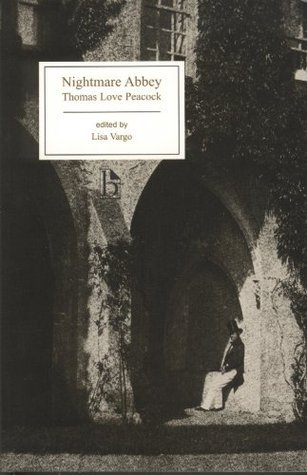
Review: Nightmare Abbey by Thomas Love Peacock

 Thomas Love Peacock’s Nightmare Abbey was published the same year as Jane Austen’s Northanger Abbey and is similarly a satire against the heightened emotions of the romantic era and the gothic novel. While both are still in print and read, I can see why the Austen book is the greater read.

Northanger Abbey is a brilliantly done romance that skews gothic tropes and features fully fleshed out characters and a genuinely interesting storyline, Nightmare Abbey is a series of in-jokes played out in scenes that are strung along from each other. If it’s inspired anything, it’s more like the Wodehouse Blandings series, a group of eccentrics hang out in an old building.


Mr Glowry married a woman who wanted him for his money. Having received it, she shrank away from all other sources of pleasure and became a very cruel woman whose death makes him a “very consolate” widower. He retreated into his Lincolnshire hall where he surrounds himself with servants with long faces and miserable names. His son, Scythrop is a self-proclaimed genius (based on Shelley) whose book of deep philosophy was only bought by seven people, who he regards as the people most likely to start a new revolution.


Mr Glowry’s brother-in-law, Mr Hilary, is the only cheerful person in the house. He’s staying there with the hopes he can get his daughter, Celestina to marry Scythrop. She loves to torment her would-be lover, alternately spurning him and luring him on.


Mr Toobad is a guest, a nutty priest who shouts about the devil owning the world, it’s a hobby-horse that he won’t get off of. He wants to wed his daughter Celinda to Scythrop, but she’s gone missing on being told what to do. (It turns out the place she hides is Nightmare Abbey, because she was one of Scythrop’s seven readers and doesn’t know he was the person intended for her…Scythrop flits between these too loves.)


Then there’s Mr Flosky, a visitor based on Coleridge, who loves gloomy things, declaring that the world isn’t as good as it used to be and refuses to have any thoughts or ideas that make sense. He prefers his philosophies to be mysterious and murky and at one point stops talking because, he finds himself “unintentionally trespassing within the limits of common sense”. That’s the only time he stops talking. There’s also Mr Listless, a man too posh and lazy to do anything, he even uses his servant as many people use AI, to do tasks and remember things he could probably remember himself.


For a brief time there’s a Byron analogue, Mr Cypress and there’s Mr Asterias, my favourite character, a scientist on fish who is obsessed by mer-people and determined to catch one.


These strange characters bumble about and have conversations which reveal their various idiosyncrasies and ridiculousness. There’s a slight plot about Scythrop hiding his loves from each other which has a good comic pay-off at the end.


The main pleasure of the book is the way the characters rub up against Rach other and the way the book is told. It has a prissy, self-satisfied tine with long pseudo-philosophical sentences filled with unusual turns of phrase. I love the “consolate widower”, a character’s “atrabilarian temperament” and some one else who is “jerremitaylorically pathetic”. My spell check hates this review.


Essentially the author is having fun. He’s having fun with poking at people he knows and likes, at exaggerating their fondness for melancholy and mystery and he’s also having fun with words. That fun does come across still, but it is dulled over time as the immediate objects of ridicule are thoughts and people of the (increasingly distant) past. Because the book pokes fun at universal human frailties, such as taking confusing for deep, it is still funny - but because those frailties are expressed in extremely time-specific ways, the fun is blunted. 


It’s not for everybody, and I’m glad it was short but it was an enjoyable little nugget and I shall read some more Thomas Love Peacock at some point.


Wednesday, 12 November 2025

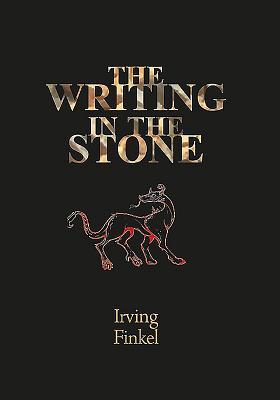
Review: The Writing in the Stone by Irving Finkel


The Writing in the Stone is a wonderfully odd beast. Essentially a gothic novel but set in ancient Assyria and written by Irving Finkel, an Assyriologist who looks exactly as an Assyriologist should look.

It reminded me most of William Beckford’s Vathek. On the surface level, both novels are eastern tales surrounding strange (and often quite gooey) religious practices - though Finkel’s engagement with his setting is far more deeply felt than Beckford’s orientalist fantasy. Both books also share a similarish plot. A stranger enters with a strange, delightful and intriguing object which ends up in the hands of a cruel and powerful psychopath with access to the demonic. These characters are then led by their curiosity, must leave their homes, travel to new places and screw over the people they meet until they find themselves in a hell they fought to get to.


The object in The Writing in the Stone is a stone. A wandering healer dies in a small town and has it in his position. The healer had a dodgy reputation, like most healers he had a skill at summoning demons and pulling them out of sick people but unlike the reputable ones, he was known to let the demons hang around. The local priest immediately sees the value of the stone. It’s full of writing but even he, as the most learned man in the town, can’t read most of them. He decides to take it to King Ashurbanipal in Nineveh.  


The King gives it to his head exorcist, who can’t read it either. The exorcist knows he cannot admit this, but also that the rock must be of great power. He fools the king, has a servant kill the priest and takes another servant to find where the rock came from. He is not a nice man. There are memories where he blinded another student, memories of past murders and hopes for murders to come. He does some very icky necromancy on the original dead healer to point him in the right direction and sets off.


His servant is a mute giant with three testicles, who brings attention to himself by being too overt in his rapes and murders - particularly one where the woman’s rigor-mortis sticks herself to him. The exorcist might have to dispose of him eventually. There’s an incidental nature to the violence in this book that make it disturbing.


The note at the end reveals that the stone is a freak geological formation, that the cracks and crystals of a particular geological concoction make wedge shapes that look like cuneiform writing. This is why the stone includes some words along with unknown shapes that look like words - however, the book is not only set in a time and place where magic is believed in, but where it actually exists.


There are demons and ghosts that pop up and, when the exorcist finds the cave, it’s an actual sacred cave where words are stored by the Gods until they are needed. The the exorcist remembers, mortal man is not supposed to be in such places and they tend to have guardians… then he sees something.


This is a grim, nasty little story swimming in atmosphere and presented beautifully with decorated capital letters at the beginning of each chapter. One such letter depicts ‘The Game of Ur’, I have a recreation of it, it’s fun to play.


Wednesday, 5 November 2025

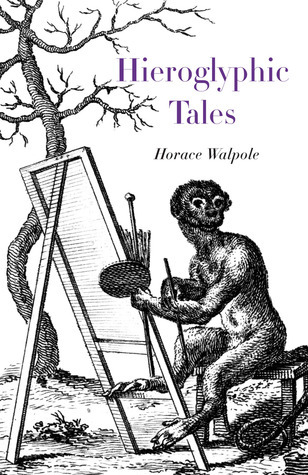
Review: Hieroglyphic Tales.by Horace Walpole

 Horry Walpole was a peculiar man, wasn’t he? Before I read The Castle of Otranto, or Selected Letters, I read Hieroglyphic Tales, which I bought after a trip to his fake castle, Strawberry Hill. I thought it worth a re-read.

It starts with a preface where he (of course) pretends to be a Grub Street hack who lives up the top of a rented building, because the air up there helps his asthma, naturally. He says he’s printing thousands of copies of these tales so that they will survive the inevitable death of print culture which will go the same way as creating new religions, teaching elephants to walk a slack rope and writing readable epics. In truth, Walpole printed seven copies, though he wrote some of the tales as letters to friends.


The fake Grub Street author claims that the stories in the book pre-date the creation of the world, or were created last week, or whatever. He says the original author may have been Kemanrlegurpikos, son of Quat, but it may not have been. (That joke reminded me of the Nu-Who planet of Raxicoricophallapatorius and it’s sister planet, Clom). We are told these tales contain all the great secrets of history, originally written in hieroglyphics. A claim no dafter than Athanasius Kircher’s attempts. 


While many of Walpole’s activities have a dilettantish quality, these tales are truly just him cutting lose, created extempore, the best ones are daft, camp riffs on fairy-tales, politics and silliness. The lesser ones are a little grating.


The first is about a princess out collecting goat eggs who finds a kingdom on the other side of the mountain. She’s captured and taken to the emperor, who has a new wife every night who tells him tales before being killed in the morning. Our intrepid Scheherazade bores the emperor to death with a history of church politics and becomes empress herself. This is a fun one, from the geographical absurdities at the beginning to the sheer irritation the emperor has with the ridiculousness of church schisms.


The second is about a king with three daughters who wants to marry them off sequentially. The problem is that the first daughter doesn’t exist but this is solved when a prince-suitor arrives because he’s dead. Complications ensue. One particularly silly detail is that the dead man has three legs, so the third daughter (who only has one) pines out of love because she feels he could complete her. The prince is also from a country with a brilliantly vulgar name, Quifferiquimini. One of my favourites.


The third tale is my favourite and starts with another brilliantly silly name. She is the princess Pissimissi, the Lady of the Jordan (a Jordan being nickname for a toilet). Her father dies leaving her a carriage made out of a pistachio shell pulled by an elephant and a ladybird, she whips them both and they perform equal pulling duty. In the course of her travels, they accidentally suffocate a tower full of husbands owned by a witch. She sets demons after them which a dispelled by the elephant’s fart. They collect all sorts of objects before being taken up by a hummingbird to the court of King Solomon the Wise who declares Pissimissi to be his favourite wife, thus upsetting the Queen of Sheba.


What makes the third tale my favourite, aside from the string of ludicrous incidents, is the level of detail. The witch has 17,000 husbands and releases 2,000 devils. They travel for three months, a day and an evening, are able to travel 500 miles a day, collect 15 dollhouses and 35 sugarplums &c. &c. These plums are also described as “dragging on the floor like the Duchess of Kingston’s breasts.”


The fourth tale is about a five year old girl becoming a queen in Ireland. However, her mother miscarries twins, one being a boy, and it starts a civil war. The civil war ends when a bishop accidentally swallows the pickled foetus, thinking it’s a medicinal plum in brandy. He then becomes pope and has bastard children who become the Fitzpatricks. 


This story was sent to a Fitzpatrick (and so calls him a bastard.. though to be fair, ‘Fitz’ d


oes mean ‘illegitimate son of’. More insensitively, he sent this to the Fitzpatricks (and their five year old daughter) just about the time that Fitzpatrick’s wife had a miscarriage. Was he trying to cheer them up? Seems bad form any which way.


The fifth story is about a Chinese prince whose very impossible and specific fortune is achieved because of the ridiculousness of English gardening, it had a tidy ending but outstayed its welcome. The Sixth irritated me even more, being a pretty bog-standard amatory tale, but with the last line revealing the main characters were dogs.


There’s a bonus story, set in ‘Serendip’ where a woman goes on a dream journey where she’s ogled by a baboon who is also the patriarch Abraham. It has a strange, woozy tone, which is at odds with the rest of the tales.


All in all, I love these camp little monstrosities that show a man writing nonsense just for the fun of it. I should do that more often (though I guess some people would say I already do).