Wednesday, 30 October 2019

Trip - Hogarth: Place and Progress at Sir John Soane's Museum


‘Hogarth: Place and Progress’ is an exhibition running at Sir John Soane’s Museum in Lincoln’s Inn fields. It’s done well for them, with queues running down the street and timed tickets being picked up in hours. In some ways, the exhibition isn’t offering much, half the paintings are available during a normal visit to the museum and the other half can usually be seen at the National Gallery. It’s not so much what’s on display, but how it’s displayed.

For the first time in my memory, the pictures are at face height. You can get right up to them, peer them in the eyes, read the writing on the various pieces of paper littering the mis-en-scene and catch details you may have heard about but never seen.

There’s a real thrill at getting so close to them and that makes it utterly worthwhile grabbing a (free) ticket for. I saw the tiny details, like a pair of glasses hanging up to suggest the main character’s short-sightedness. Now I can see that music being played in one scene is about the rape of the Sabines (‘Sobbin’ Women) and in the background there’s a woman needlessly setting fire to a world map.

Some of the details are really peculiar, there’s an old woman in the first ‘Rake’s Progress’. She stands by the fireplace but the fireplace can still be seen through her. Is she a second thought? Unfinished? I never knew that the ‘Rake’s Progress’ scene in the gambling house includes a failed attempt at making Icarus wings. Nor did I realise that the gambling den is being burnt down - it’s amazing to catch these peculiar moments in the paintings.

Something I’d never seen before were the aborted attempts at creating woodcuts of the ‘Stages of Cruelty’. There’s something brilliantly stark about the harder lines and I wish they’d completed the sequence.


I am appallingly bad at analysing pictures, there’s not much I can say about the exhibition except to say that’s it’s a wonderfully unique and enjoyable experience and I urge anyone to go.


Wednesday, 23 October 2019

My own thoughts re-reading 'Joseph Andrews'


I thought I’d write my own personal reaction to reading ‘Joseph Andrews’ for the Dr Johnson House Reading Circle as it is, for me, a very important book. It’s the one that had me fall in love with the eighteenth century and its writings and so changed my life a little. 

I picked my copy up for free from a box of novels being released from their service as part of Middlesex University, where I was doing my masters. At the time, I was a huge Kurt Vonnegut fan, had read everything he had written at least three times, some of them many more but was a little unmoored in my reading life. In ‘Joseph Adams’ I found the same qualities of an intrusive narrator, and a sympathetic mocking of the human race. It was also the first review on this blog.

I was surprised by the lukewarm reaction the book received in the reading group because, while it is no ‘Tom Jones’, it’s still a corker of a book. Henry Fielding hasn’t quite reached the skill and fun in that later work but still is wonderfully playful. He has moments where he tries to emulate what he pretends to perceive as ‘great writing’ by creating elaborate classical metaphors - at one point he goes on one of these highfalutin rants about vanity only to declare he’s done it “for no other purpose than to lengthen out a short chapter.”

I also love the running joke about Colley Cibber and his newly published ‘Apology’ (which I really must get round to one day). The book starts with such gushing praise for the man that it can only be ironic, declaring that it seems he’s lived such a good and moral life for the purposes of being able t write it up and disseminate it. What I like best is that the joke runs throughout the book and we never know when a sly bit of faux-praise is going to be slipped in for that most ridiculed of poet laureates. This was something that tickled me in that first reading but as I know more about the man and the debates about his appointment, I find it funnier still.

Another element of the book I picked up on more, were the elements of pastiche and parody. Although I knew the story of the good Samaritan, I hadn’t realised that the scene where the people in the coach bicker about helping the naked Joseph was a parody of it. I particularly liked how they decided they should help him, as they might be legally liable if they left him to die- very good and holy indeed.

Then there were the Quixote references, the Squire being like the rich couple in the second book, or like Parson Adams speed at picking up his crab stick and laying into some fools. Some of the fight scenes are actually well described, particularly the one between him and Fanny’s first attacker. There was a part when Adams goes all Glaswegian and uses his head  “as a battering ram”.

Parson Adams is every bit as good as I remembered but he entered the story far earlier. There’s still the feeling that he’s a second idea that takes over the initial one, but it’s so entertaining, I’m fine with that. I love how he is absolutely terrible at reading people, even people as transparent as Joseph and Fanny. I like how his vanity has him wish he had his best sermon to read so he can show it off, a sermon against vanity. I also love how Parson Adams claims to have “not much travelled in the history of modern times, that is to say the last two thousand years” - thus missing all the Christian Centuries - and the chapter where he thinks his son has drowned is still comic gold.

I find Henry Fielding quite a quotable writer. Some of the things he says are fitting, such as; “kissing is a prologue to a play” others are so inventive and daft I can’t help smiling. Fielding really  has a way with the simile, I particularly enjoyed how he started a sentence with; “As a person who is struck through the heart with a thunderbolt looks extremely surprised…” He also reminds us that there are some people without need of brains who have heads ‘for the sake of conformity’ - and to put their hats on.

He also hits on a number of characters and moments which I have met often in my life now. Joseph Adams bemoans how; “London is a bad place and there is so little direct fellowship that the next door neighbours don’t know each other.” I live in a small flat hewn into a townhouse, not only do I not know my neighbours, I don’t know people who live in the same building as me. This is even more pronounced as my landlord has a habit of creating new little flats out of nowhere. 

Fielding’s description of drunken ‘lads’ conversation is also spot on; “Their best conversation was nothing but noise: singing, helloing, wrangling, drinking, toasting, spewing, smoking.” He then goes on to say that when they do talk to each other, they spend their whole time arguing violently about trivial things. As someone who’s been on a few stag-dos, this is utterly correct.

I also disagreed with the people who said there was no emotional moments in the book. I found the moment where Wilson proposes to his wife in the (admittedly very long) digression to be full of genuine passion and remorse - I got quite invested.


While ‘Joseph Andrews’ is no ‘Tom Jones’, I found it an extremely enjoyable book on re-reading it and I still recommend it as a good introduction to eighteenth century fiction.




Wednesday, 16 October 2019

'Joseph Andrews' at the Dr Johnson Reading Circle

When the Dr Johnson’s House Reading Circle met for the first session of its fifth year, battle lines were drawn. On one side were those favouring internal characterisation and on the other, those favouring a story told from the outside of a character. Pikes were sharpened, muskets primed, horses saddled and… I might be exaggerating a little - but our discussion of Henry Fielding’s ‘Joseph Andrews’ was one of the more polarising discussions we’ve had.

The first comment was that the book was “Laugh a minute,” which was quickly responded to with a number of comments saying, “I’m not so sure.”

The book tells the story of Joseph Andrews’ journey home after being unfairly dismissed by the Lady Booby for not becoming her toy-boy. He meets up with the love of his life, Fanny Goodwill and his childhood mentor, Parson Adams. The parson quickly becomes the main character as the three regularly fall into scrapes which reveal both his small faults and his large virtues. He’s not an aloof, spiritual man but warm blooded and emotional, his Christianity being tied deeply with human life rather than doctrine, even as he preaches something more rarified.

The problem many had with the book is the same that Samuel Johnson had when comparing Fielding with Samuel Richardson; “There was as great a difference between them as between a man who knew how a watch was made, and a man who could tell the hour by looking on the dialplate.” Whereas Richardson takes exhaustive pains to get under the skin of the characters, Fielding sketches them out and shows them in action.

There was a great deal of discussion that circled why ‘Joseph Andrews’ has this surface level, dialplate quality. One idea was linked to this being Fielding’s second novel after a successful career as a stage writer. A stage writer must write principally for surfaces and it's the job of the actors and production team to flesh out and exemplify the play. Though there have been a great many scriptwriters who have explored the inner lives of their characters to great effect.

There are many theatrical conventions in the novel with coincidences galore, physically staged fighting and bed-swapping, asides and overlapping patter. It’s also very possible that Fielding’s intrusive narration could have evolved from stage directions, or even the curtain-piece before a performance. Like a curtain-piece, Fielding places his text in context, teaches the audience how to enjoy and interpret it and makes silly jokes.

Another idea we kept returning to, was Fielding’s background in humour and satire and his influences from that tradition, particularly ‘Don Quixote’. Fielding had a long relationship with the novel, with one of his plays being ‘Don Quixote in England’. Parson Adams is definitely a Quixotic character, quick to fight, somehow both ridiculous and oddly noble. There are definite lifts from Quixote, particularly a scene where Parson Adams is entertained by a villainous Squire. The Quixote influence is probably the source of much of the violence that turned many of the readers off. Quixote is regularly beaten - painfully beaten in ways that effect him for the rest of the book - and while Parson Adams, Joseph Andrews and company regularly shrug off heavy beatings, they grow more dishevelled as they proceed through the book.

So, while some readers found the style too shallow, discursive and impossible to get lost in, others enjoyed the artificiality of the tale and found it good fun. Later authors took elements of this much further, Sterne pulled ‘Tristram Shandy’ inside out with its digressions and authorial playacting. Sterne also included many emotional scenes in the book, expanding this element into his ‘Sentimental Journey’. Dickens was also mentioned a lot. Like Fielding, Dickens also tends to see characters from the outside in, sketching them in broad strokes and catchphrases, rarely getting under the skin of many of them but like Sterne, Dickens also included emotional scenes and used his characters to explore ideas and expose injustices.

There are a few moments of social commentary in ‘Joseph Andrews’, much of the book is taken up with exposing Parson Adams in his flawed good-heartedness, an idea later taken up with more vigour in the character of Tom Jones. Adams’s interactions with various stingy, mean characters reveal the difference between charity and charitable intentions. Perhaps if these elements were heightened, there would have seemed more point to the knockabout stuff. 

Ultimately such questions are up to the reader and their own negotiations with the text. ‘Joseph Andrews’ is a particularly artificial book, but whether that artificiality is a source of fun or frustration depends on what the reader brings to it. What is certain though, is that ‘Joseph Andrews’ produced an entertaining night of discussion for the Dr Johnson’s House Reading Circle.


Wednesday, 9 October 2019

I've Started Volunteering at Dr Johnson's House


Last Saturday I started my first shift as a volunteer at Dr Johnson’s House. It’s something I’ve wanted to do for a while, to give my weekend a little more structure, spend some time with different people, have the chance to welcome people to a place that’s important to me and have a glimpse at what it’s like behind the scenes.

My position is at the front desk. Visitors enter through the side door into the old parlour, which is where they pay a little to enter (£7, cheaper than most) and can buy books, postcards and various doodads. My job is to be welcoming, handle the transactions and give visitors the information they need to navigate the rest of the house. 

One of the biggest surprises, sitting at the desk, was how well I could hear people outside. The building had always seemed so solid to me but listening to people point out the house as they passed, discuss whether they wanted to visit, tell each other a little about Samuel Johnson - it felt like there was only a thin film separating me from the outside world.

The other delight was the different reasons people entered. Some wanted directions to other places, some wanted to suggest future events, some came just to catch up and browse the bookshop. Even with the people who actually came in, there was huge variety. There was a couple most interested in Hodge the Cat, whose statue lies just over the square. Another man was making a return visit, having been in the house forty-nine years before. There were some Johnson-a-philes and quite a few newbies. It was funny, as deep and long as I’ve steeped myself in Johnson to found myself completely stumped by a question about when he moved out (1759).

When there weren’t visitors to welcome, I had a good chance to read. One of the leaflets for sale is a copy of Tetty’s funeral service, written by Johnson but not read. For all Boswell’s implications that she was a drunk, irritant and no suitable for Johnson, his own description of her personality was very touching, he praised; “the extent of her knowledge, the acuteness of her wit, the accuracy of her judgment, the force of her sentiments and the elegance of her expression.” It’s a far warmer portrait of her than he even gave in most of his anecdotes. (Though I love the one where she reads one of his works and is proud of him).

I also drank a lot of tea. Books, conversation and tea - Johnson would be proud.

As for behind-the-scenes, my favourite little titbit was a look at the document created for firefighters which lists which items are priorities to save in each room. I was also surprised by the fact that official instructions are to hurl the books out of the library window as it is easier to fix bindings than to restore burnt or flooded books. I also read a bunch of policy documents, which reminded me a lot of similar ones at school and it was encouraging to see the importance of sharing Johnson’s story to as many people as possible, overcoming as many barriers to it as possible. The chief aim of the museum is to hold and share that story with as many as possible.


Wednesday, 2 October 2019

Review: Charlotte Temple by Susanna Rowson


It’s not encouraging when the historical introduction to the book describes it as ‘almost illiterate”, yet ‘Charlotte Temple’ was the bestselling work in America until the publication of ‘Uncle Tom’s Cabin’. 

It was written by Susanna Rowson, a woman who had been born in Portsmouth, moved with her father to the American Colonies, fled after the revolution and returned as an actress and playwright. 

‘Charlotte Temple’ was her third novel which she had written whilst in England. It had not sold particularly well nor drawn any notices until it was republished in the new United States. Then it started to sell. Rowson channeled the success into other novels, some plays and a number of textbooks which she wrote for the Girl’s school she ran. She may have had an interrupted education herself but she believed in it, making that the prime passion of her later years.

The novel is one of seduction. Charlotte is in her last year of school. She is kind, innocent and utterly beloved of her own family (who still choose to board her even though they live in the same town.) Her tutor is the rascally French coquette Mademoiselle La Rue who encourages her to flirt with the soldier Montraville because she fancies his friend Belcour. Montraville is himself a bit of an innocent but is pressured by Belcour to court Charlotte, largely because he is evil and likes encouraging people to do nasty things.

On the day of her birthday, Charlotte agrees to run away with Montraville and the four of them run off together to Portsmouth and then off to America. On the ship over, Mademoiselle La Rue ensnares a rich officer and marries him, while Montraville impregnates Charlotte and sets her up in a small house. Montraville then falls in love with another woman and marries her, leaving some cash to help Charlotte with Belcour who (obviously) doesn’t pass it on.

Heavily pregnant and kicked out of her house, she walks through the snow to find the married Mademoiselle La Rue who kicks her out, where she is taken in by some nice people, gives birth and promptly dies. The moral of the story is pretty clear.

I have no idea why this book was a better seller then ‘The Coquette’, a similar tale of teenage pregnancy and destitution but with a far more interesting dilemma in the heroine's marriage choices and a far more interesting heroine herself. Charlotte only makes one choice in the whole book, to run off with Montraville and she seems to put no thought into deciding it, being goaded into it by Mademoiselle La Rue and regretting it instantly. She is so very passive, even her flight to get help at the end of the book is prompted by getting kicked out of her house. She has little personality nor thought at all.

Montraville is slightly more interesting, he is at least well-intentioned if utterly feckless. Mademoiselle La Rue and Belcour are the most interesting, but largely because they are evil for no particular reason, it makes them stand out at least.

The dialogue is particularly awful. While melodrama is not known for its natural conversation, the characters declaim their parts with stiff, awkward sentences. I praised ‘The Coquette’ for having  a letter that read like an actual letter but this book doesn’t even have characters that talk like normal people - not even slightly. 

Yet there is something peculiarly charming about the book. The strange, puppet-like characters and the high emotion have something of a gauche sincerity to them. There’s a feeling that this is a story the author wants to tell and despite the flaws in telling it, it makes the reader want to read them. 

Rowson also has a very direct and engaging authorial presence. It reminds me of Tristram Shandy in a way, similarly to how Sterne addresses members of his audience, referring to them as ‘sir’ and ‘madam’. Rowson addresses the reader as if we are a maiden aunt, a bluff man or even a ‘young, innocent, girl’. She informs us what she thinks about the story so far, warns us of our choices and informs us that although it may seem that the bad characters are in the ascendancy, they’ll be found out eventually.


This refreshingly plain way of addressing the audience is the book’s saving grace for me and I suspect a large element of its great success. There really is a feeling that we are sitting down with a well-meaning friend who is telling us the story as well as she can and it makes me like her, and her book, a little more then I may otherwise had. 


Wednesday, 25 September 2019

Trip: A Visit to Keats House


I have an odd relationship with poetry. As a child I enjoyed poems for their playfulness but as I grew into my teenage years, I began to feel that poetry put such unfortunate restrictions on the expression and exploration of ideas that most things would be better expressed in other ways. Nowadays, I enjoy some individual poems but still find I like poetry in theory more than I do in practice. 

Even odder is my relationship to romantics and romanticism. I discovered the idea as a teenager while reading ‘Sophie’s World’ and fell in love with the idea of the subjective and introverted search for meaning. Studying philosophy at university, I began to find romantic tendencies to be loose and baseless, producing statements that often sound like they mean more than they do. As I got older and further into Samuel Johnson and the earlier eighteenth century, I find myself gravitating to enlightenment ideals more than romantic ones. That said, I’ve enjoyed a lot of romantic poetry I’ve read and I really enjoyed the ‘Lyrical Ballads’.

With all this in place, I’ve had a particularly prejudicial view of John Keats. My image of him was of a fey, affected wan youth, quietly dying and pretending to feel things. I pictured him as a drip. My visit to Keats’ House changed that view utterly. 


I went on a glorious day in the now usual late September sun, having wandered there through Hampstead Heath. There were people flopped all over the lawn, relaxing in the beautiful weather which created the perfect mood to get into the heightened emotions of Keats’s poetry. 

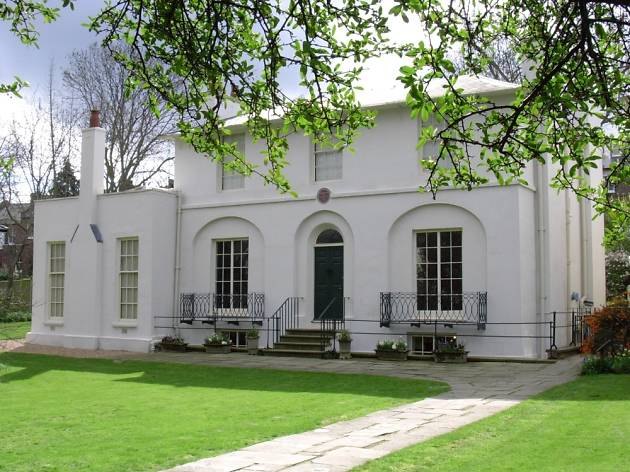
The visit starts downstairs with a video. This was projected on a screen that looked like a summer’s window and gave a quick run-through of Keats’s life and the house’s part in that. Despite the name, the house was never actually Keats’s. He lived there for a while, wrote some of his most popular poetry and met the love of his life. This was also the house when he discovered he was dying.

The leaflet then suggested going back up the stairs, going through those rooms, back down to the basement and then up two pair of stairs to the top floor. This sounded stupid to me, so I went round the basement rooms first. They contained a number of kitchens which looked like many of the same kitchens I have seen in most other historic houses. It didn’t help that these kitchens had the same pots, pans and fake food as every other historic house (there must be a catalogue somewhere). The downstairs also had the obligatory dress up section, though this was quite a weak-sauce version of the idea, with the same naff tricorn hat I wear for my youtube videos.


The rest of the of the house was more distinctive, with the different rooms dealing with a different aspect of Keats’s life, related to the original function of the room. The room he used as a study contains many of his books. One thing I particularly liked was an annotated copy of ‘An Anatomy of Melancholy’, there was also a set of ‘Orlando Furioso’ books on a shelf. I didn’t feel the same shiver I would have felt standing in a room of one of my favourite writers (or even as I did standing in the room where Newton formulated the rules of gravity) but it was a lovely room to write in and I appreciated his reading habits.

His friend’s study dealt with his ability to make friends. Keats was not a fragile introvert who kept himself to himself. He was fond of bodily pleasure and friendship, describing a great life as being full of ‘women, wine and snuff’. His ability to make people feel at ease was described by one contemporary as ‘like a spell’. In his short lifetime, Keats published three books of poetry and the first two did very poorly but were fondly received by those friends.

Upstairs, there was a room dedicated to his relationship with Fanny Brawne. He gave her an engagement ring, which is in a case with some of their love-letters. They would never actually marry, as Keats could never gain a solid wage with his poetry but the love was strong. When he died, Fanny Brawne wore the ring for the rest of her life. 

Another room included a selection of paintings inspired by subjects that also inspired Keats. I had a chat with a volunteer in this room, who told me the story of ‘The Pot of Basil’ in a very entertaining way. A line in this poem was the one that surprisingly caught me. The poem includes a description of how the woman ignores the world to wallow in grief, one of the things she stops noticing is, ‘The blue above the trees.’ I’m not sure what it is I love about the line - something about the way the line captures the pleasure of suddenly noticing an everyday beauty like the sky.

The last room was the one Keats was staying in when he realised he was going to die. In the hallway before that room, there is the unusual exhibit of a life mask and a death mask. Morbidly, the visitor is asked to guess which one is which. 

While my previous image of Keats had him as permanently weak and ailing, he was extremely active most of his life, including a walk of 700 miles that took in Ben Nevis. Keats had studied hard to obtain a medical licence, a training that involved physical dexterity and strength but he gave this up to write poetry. It was in the bedroom in Keats House that he had a coughing fit. When he looked at his handkerchief, his medical training kicked in, he knew the colour of the blood meant that he only had months to live. There’s something extremely poignant and chilling about a medical person who knows exactly how terrible the next few months will be - and their ultimate end.  

One of the things Keats House does especially well, is exposing the visitor to snippets of his poetry. There are lines painted onto the walls and each card describing the room also has a quote. I knew I would recognise some (‘A thing of beauty is a joy forever’ - something the volunteer at the shop also said to a customer) but there were many I didn’t. Some I very much liked but others were self aggrandising. Keats definitely liked writing about how great writers are, the example I chose to write down being; ‘A fine writer is the most genuine being in the world.’

I arrived at Keats House with a rather dismissive view if the man but now, I see him as a vigorous and energetic person. The man did far more in his first (and only) twenty-five years than I did with mine and I will definitely be checking more out about him.


Wednesday, 18 September 2019

Review: Beau Nash by William Harrison Ainsworth


As soon as I decided to spend a few days in Bath, I knew which book I wanted to take with me. William Harrison Ainsworth has been a (frequently nutty) pleasure every other time I’ve spent time with him and to share eighteenth century Bath seemed a great idea. What craziness could he conjure up in those serpentine streets?

It turns out, not much. Ainsworth is not playing with his full deck of cards, where his great skill is delightfully improbable action and melodrama, here the melodrama is kept safe within the genre and the improbabilities are not greater than other novels. He’s being relatively subdued, a tale of adultery, duelling and young love. 

We start of with a love triangle. Both Sir Thomas Carew and Reginald Grey fall immediately for the beautiful Mrs Mallet, who has traveled to Bath with her husband. Mr Mallet is a country beast, full of solid virtues and considers that his wife can never be won over by Grey’s sleek politeness of Carew’s glitz. He’s wrong and his wife runs off with Carew, regretting it instantly. A duel between Mallet and Carew ends in Mallet’s death, Mrs Mallet’s self-imposed exile into a sisterhood and Carew’s temporary banishment from Bath.

Later, Mr Mallet’s nephew, the inheritor of the estate, comes to Bath to settle an annuity on Mrs Mallet. While there, he falls in love with a woman that whose mother doesn’t trust him, and whom his own mother doesn’t trust. Also, Carew returns newly wealthy and plots to steal Mrs Mallet away. The young couple end up together and the penitent adulteress pines away in the approved manner. 


Yet the book was enjoyable, and it showed up another aspect of William Harrison Ainsworth that draws me to him. He’s a goofball. While this comes across most when he’s being utterly mental, it comes across in a more subdued work, and comes across enchantingly. My Mum watches Neighbours, she started to watch it because the script was dumb and the acting laughably bad but she grew attached to it anyway - or even because of those qualities. That’s how I feel about Ainsworth.

The man couldn’t write natural dialogue even if he were living with people who spoke it his whole life. At one point a man tells his fiancée that he doesn’t love another woman because that other woman is too beautiful and clever and makes him feel threatened, that he chose his fiancée because she was neither too clever or beautiful. Her response to this sucker-punch of a compliment is to smile and declare that he flatters her too much. The characters are always given each other awkward, stiff complements, thanking each other for those compliments and flushing with pleasure at receiving them.

The prose is also stiff and awkward. Occasionally, Yoda takes charge and we get sentences like ‘remarkably well, he looked’. Frequently characters ejaculate rather than talk. There’s a part describing a garden where the text says;
“The head gardener, whose name appeared to be Markham”
How did the gardener appear to be someone called Markham? Was there a particular birthmarkham on his face? Did he have it written into his clothes?

Such silliness is sort of charming - and the man did his research - the Princess Amelia appears in this book as bolshy and bossy as she apparently was in real life. Fielding turns up ill for a cameo, Ralph Allen is the picture of kindness and practicality. I also appreciate this book for introducing me to Reverend Grace who is so very nice and peculiar that his book, ‘The Spiritual Quixote’ has been bumped up my reading list.

As for Beau Nash, he doesn’t appear in this work very often, he is mainly a messenger - even his role of advice-giver is taken by Grace and Allen. I expect that is how Nash would have appeared to a visitor, always smiling and welcoming, always going off to welcome someone else, like a bride at a wedding reception.

So, while this book is definitely not the one I would introduce to people if I wanted to share William Harrison Ainsworth, for someone who has a blind spot for him, it was a perfectly entertaining and pleasurable few hours.