Sunday, 1 June 2014

Here it comes!


Much of the eighteenth century emphasis of this blog is going to be on the back burner for a little bit as we prepare for a proper Grub Street party to celebrate the publication of my mystery/thriller 'Death of a Dreamonger'.

But that is not all, the possibility of the book's publication will rely on securing 250 pre-orders, so head over to britain's next bestseller and get pre-ordering.

Here is a little video about the main characters in the book. New videos will be uploaded each week.


Happy pre-ordering.

https://britainsnextbestseller.co.uk/index.php/book/index/DeathofaDreamonger

Monday, 19 May 2014

Review: Pompey the Little


I recently read ‘Down and Out in 18th Century London’ by Tim Hitchcock and although I was sometimes lurched about by the anecdotal style, I enjoyed it and was pointed to a number of other interesting works.

One of these was ‘Pompey the Little’ by Francis Coventry. How could I resist a book centring on a Bologna lapdog?

Coventry makes his allegiances clear, dedicating the book to Henry Fielding. Although he doesn’t have the same delicious and all pervading irony as Fielding, nor does he have Fielding’s ability with an understatement, a similar spirit runs through this book.


Pompey is a Bologna lapdog who finds his way from owner to owner, sometimes by luck and sometimes by his own actions and as such is not dissimilar to Fanny Hill (who gets a walk on part). Owners include people in the high-life with such wonderful names as Lady Harriden and the Lord Marmozet; children who play a little too rough, a Cambridge fellow, a few shopkeepers, a destitute poet and a blind beggar.

The pattern of owner, satyrical gibes, new owner should have become boring but Coventry nails the different characters and situations so well that each change is a delight. I pretty much galloped through the book and enjoyed it throughout. 

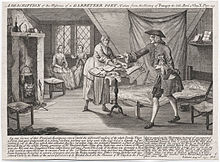
Naturally my favourite owner was the impecunious scribbler Mr Rhymer. The chapters featuring him are the perfect representation of a Grub Street life I have yet read in print and I reckon it should be as well known as Hogarth’s famous image of the distressed poet.

‘In one corner of these poetical apartments stood a flock-bed and underneath it, a green jordan presented itself to the eye, which had collected the nocturnal urine of the whole family...Three rotten chairs and a half seemed to stand like traps in various parts of the room, threatening downfalls to weary strangers; and one solitary table in the middle of this aerial garrett, served to hold the different treasures of the whole family.’ Needless to say, the treasures are meagre indeed.

Mr Rhymer’s wife is not happy to see that he has had a useless lapdog foisted on him by a Lord as a ‘gift’ and berates him for selling his chandlers’ business to take up writing. He argues that she should be pleased to have married a man so above the petty mechanics of life. We get the feeling this is an argument the two have had a number of times. After a dinner of weak broth, Mr Rhymer untroubled by ‘any of fumes of indigestion’ works on an ‘epic poem which was then on the anvil,’ before going out to a meeting of other writers, accompanied by Pompey.

The meeting of writers is torn apart by argument and Mr Rhymer walks home ‘in a pensive solitary mood, wrapped up in contemplation on the stars of heaven, and perhaps forgetting for a few moments that he had three-pence half-penny in his pocket.’ I find this a wonderfully poetic moment and typical of little character moments in the book.

Pompey’s fortunes change again when a couple of hooligans spy Mr Rhymer, ‘smoked him for a queer fish’ and duff him up. Pompey is quite pleased with this reversal as he was afraid he may ‘have fallen sacrifice to hunger, and been served up on Mr Rhymer’s poetical table’.


‘Pompey the Little’ is obviously a first novel and doesn’t reach the heights of a ‘Tom Jones’ or a ‘Tristram Shandy’ but there is much good about it. I think the success of the book lies in a statement made right at the beginning in the dedication to Henry Fielding. ‘The characters of a novel principally determine its merit’. I believe this is the case today and was the case then, and on those merits ‘Pompey the Little’ succeeds admirably.


Sunday, 18 May 2014

Review: Dear Mr Spectator

Last year I went to Florida with some of my family and we had the misfortune of attending the Pirate’s Dinner Adventure, a food and pirate extravaganza with live floor show. It had been my idea for I am a sucker for pirate-y things but we truly were suckers, the food being cheap and nasty and the show being poorly acted through a PA system so distorted that not one word could be made out, even though every line was screamed.

So, it was with some trepidation that I took my sister to Dear Mr Spectator! a dinner/show revolving around the characters and letters found in Addison and Steele’s initial run of the Spectator magazine of 1711.

First impressions were a little uncertain, a hipster cafe in New Cross not seeming the ideal location for a clubbable early eighteenth-century man. Mr Spectator himself was in a slightly cobbled together justacorps and a black fright wig which my sister thought looked like Brian May. He was, however genial and welcoming and although more voluble than I expected, did well to mingle as people entered. We sat down a little apprehensively.

The start was a little shaky, Mr Spectator leaning a little too heavily on his script and his interactions with Ralph rather uncomfortable. The exhortations to ‘huzzah’ frequently were a bit awkward for this very British audience. 

Then came the first course. It started with a meagre sort of watery mushroom soup, we slurped politely while music from the period was played on a viola. Then came the first course proper. The informative booklet we received on arrival said that the first course was the primary savoury one and there was all sorts. A very tasty rabbit stew; some stewed beef, chicken fricasse, bean stew, stuffed mushrooms, a light wallet and possibly more. Much of it was nice and on my part was he'd down with red beer brewed in nearby Brockley. I thought what Henry Fielding, writer of ‘roast beef of old England’ would make of us eating the ragouts and ‘slip-slops’ of France but I enjoyed it. 

After the first course we had the introduction of Sir Roger de Coverly, he was rotundly played and the introduction of his character and the increased use of the ensemble; together with the audience having settled and enjoyed the first course, meant that everything flowed together well. I began to notice how well the writer had taken parts of the Spectator Magazine and threaded them together. The use of all the ludicrous clubs was a particularly enjoyable running gag, with people joining fat clubs, widows clubs, rake clubs and begging clubs.

The next course was the strangest, consisting of sweet and savoury parts. This included gruel and rice pudding; heavily nutmegged sweet potato cakes, roast pork, a huge beef and sausage pie, a veg pie, spinachy things and weirdest of all, peas in a garlic sauce that had been chilled into a solid pyramid. I was loving all the strange combinations I could create, my sister less so.

The next part of the performance was extremely comfortable, with more ad-libs and little moments being introduced as everyone was very comfortable with each other. It could be the wine but I reckon it was the ease of company, but the laughs grew louder and more numerous that by the time the last course arrived, people were talking with ease.

That last course consisted of small cakes, cheese and biscuits and a cream with cinnamon apple. After eating all this, my sister and I said goodbye to everyone on our table and rolled our way to the  tube station.


In summary, the evening was not a Pirate’s Dinner Adventure sized disaster but was a very enjoyable evening featuring some great food and entertaining performance.


Thursday, 15 May 2014

Review: Gin Lane Gazette


Last time I talked about subscription and a book I helped crowdfund called the Gin Lane Gazette. It was written by Adrian Teal, a political cartoonist who also worked on Spitting Image and a number of newspapers. 

He was funding the book through Unbound, one of the new crowdfunding publishing outlets that are starting up to fill the gaps in the popular market. Adrian Teal is a very entertaining presence on Twitter and I was very keen to sign up. When the pre-order time was over and the book successfully funded, I waited a few months and was extremely excited to receive my copy of the Gin Lane Gazette (lucky copy number 13) and read it straight through, and have dipped into it many time since.

It takes the form of a compendium of articles from an imaginary magazine published between 1750-1800 under the watchful and increasingly jaded eyes of Nathaniel Crowquill. 


The jokes are frequently brilliant, from the in-your-face bawdy to the subtle. My favourite subtle joke takes place on the title page. The compendium was published by ‘A Cully’, a name that mixes both the notion of a cully; defined by ‘The Dictionary of the Canting Crew‘  defines as ‘a man that is easily drawn in and Cheated by Whores or Rogues’ but it also plays with the name of Edmund Curll - the ultimate Dunce publisher. 

Sort of like a grown-up Horrible Histories (in the best possible way) the book is absolutely crammed with as many fascinating anecdotes and stories from the latter half of the eighteenth century, liberally loaded with brilliantly observed caricature. Johnson turns up a number of times, William Beckford and loads of Charles Fox. The level of detail is brilliant. The text makes extensive use of the long s, the costuming and style of the characters change as the years go on.


A Cartoon about Johnson's review of Hanway.


What I most enjoy is the running soap throughout the book, just behind the text is the life of Nathaniel Crowquill, his frequently drunk etcher, his spy on the ground and all the other people who help create the magazine. This ties everything together and makes it more than a selection of fragments and hints at an almost lovely muppet show element that I love.

Of course the Gin Lane Gazette is about intriguing the reader and making them laugh, it’s not the place to look in any depth at the stories within it but to enjoy them and maybe go off and find the sources of the stories. There is a bibliography at the back to do this.

It is now available of all good bookshops and indeed, it is possible to tell if it is a good bookshop if it has some copies. Put it on your shelves between TH White's 'Age of Scandal' and Vic Gatrell's 'City of Laughter'.

Check Adrian Teal out on www.tealcartoons.com


Tuesday, 13 May 2014

Review: Oliver Goldsmith, a Georgian Study by Ricardo Quintana


While it is possible to read nothing but Samuel Johnson biographies for a whole year, Goldsmith biographies are in less plentiful supply. This may be partly because Goldsmith is a less monumental writer than Johnson, that his works are not as readily available but it may have something to do with an inherent difficulty in Goldsmith’s character.

The problem of Goldsmith is especially relevant to this book and takes it as a specific and particular issue. Quintana’s main aim is to explain the origins of what he calls the Legend and to compare it with a thorough examination of his work. The trouble is, in trying to separate the legend from the man, the legend does not get much airing and the anecdotes that make a Goldsmith biography fun to read are nearly completely omitted. 

Unfortunately, the ‘man’ side of Goldsmith is not fleshed out either. The weight of literary criticism obscures the character and pattern of the human and the individual and so this book failed my ultimate test of a biography, I was not sad when he died.

I feel that when presenting Goldsmith, the legend is as important as the man because the legend grew and proliferated in his own life, so the legend shaped the man. Especially a man like Goldsmith, who seemed to live up to and play with his public image. There is also the fact that I believe the legend had a secure basis in truth. Many of his friends, including his closest like Joshua Reynolds said that Goldsmith was socially awkward and at times inept. The reports of his gauchery were most likely exaggerated but to say that he didn’t stick out seems hasty. 

That said, the handling of Goldsmith’s work and processes is done very well. Quintana is very clear in presenting Goldsmith as a thoughtful and careful writer who uses his head as well as his intuition. He takes the same line as John Hopkins in ‘The True Genius of Oliver Goldsmith’, by presenting his work, especially ‘The Vicar of Goldsmith’ as a work of discreet but extreme irony with a subtle satire that bypassed many previous writers. The argument is well made and I really enjoyed the writing on my favourite of Goldsmith’s works, ‘The Citizen of the World’.

Recently I bought a copy of Forster’s life of Goldsmith, a very heavy book which I think will give me the opposite view, a Goldsmith that is all legend and little careful craftsman. It’ll be interesting to compare.


Friday, 9 May 2014

Subscription: Then and Now.


“I see, cried he, you are unacquainted with the town, I'll teach you a part of it. Look at these proposals, upon these very proposals I have subsisted very comfortably for twelve years. The moment a nobleman returns from his travels, a Creolian arrives from Jamaica, or a dowager from her country seat, I strike for a subscription.”

...And so George, the Philosophic Vagabond in Goldsmith’s ‘The Vicar of Wakefield’ was introduced to the idea of subscription and the ways to abuse it. 

Subscription was a solution to a problem that faced writers in the early to mid eighteenth century, how to make money from writing without a system of court patronage in a time when the buying public was not yet robust enough to support the massive (over) abundance of people wishing to write.

In a lecture by Jerry White (author of ‘London: A Great and Monstrous Thing) one of the key points was that although literacy was surprisingly high, especially in urban centres, and although books were becoming an important topic of polite conversation, the number of writers outstripped the number of readers and that the key for a writer was to be a varied and enterprising as possible.  

One of the eighteenth century’s most enterprising writers, Alexander Pope, created his secure foundation (and cool grotto) by the publication of a translation of ‘The Iliad’ by subscription. Instead of creating the work under the auspices of one patron or on spec for potential buyers, he sent a proposal for the work to a large number of people who pre-ordered copies. They would pay part now and part on receiving the book and the first part of money secured the author in his position and paid for the creation of the book. In this way, Pope gained about £9,000 which gave him an autonomy to write what he wished and how he wished it. 

Of course, this system was open to the abuse that Goldsmith mentioned. It was possible to have a wonderful proposal, occasionally reprinted to keep it fresh and to go about securing that first sum of money without having to put the graft in to finish the book. Johnson was accused in print of playing the same trick, it taking nine years between his proposal of the plays of Shakespeare and its completion. 
Charles Churchill ribbed him with the words, “He for Subscribers baits his hook, and takes their cash—But where’s the Book?” 

Johnson is interesting because although his his Shakespeare did have an element of subscription, he was more often commissioned to write (especially his larger works) by conglomerations of booksellers. Goldsmith too was given most of his projects by Newbery, a bookseller and it was only for his poems (like ‘The Traveller’ and ‘The Deserted Village’ that he presented off his own initiative.

One writer who started his writing life by writing on commission to a bookseller but ended it by selling almost wholly by subscription was Christopher Smart. As a young, hip writer he was commissioned to write for ‘The Student’ his own ‘Midwife’ and later for the absurd 99 years contract for the Universal Visitor. Shortly afterwards he was committed for eight years in various mental asylums where he emerged with a number of works and a burning wish to write.

In his collected poems by Norman Callan, the book of poems after his incarceration far exceeds the one from before. In that time he published his ‘Song of David’; ‘Psalms of David’, ‘Hymns and Spiritual Songs’, ‘Parables,’ ‘Verse Horace’, ‘Phaedrus’ and the ‘Hymns for the Amusement of Children’ - each by subscription. Smart died imprisoned for debt. 

Obviously then, subscription had it’s flaws for both writer and reader but it did prove an invaluably flexible and potentially lucrative way to fund books and new work, especially when combined with other methods.

In some ways the position of the writer today is similar to how it was in the early and mid eighteenth century. The patronage system of grants and arts funding is being savagely diminished and although there are many readers available, the demand is outstripped by those with something to write. More recent media formats have edged the book (and particularly the novel) from the centre of popular discussion and debate. In response the publishers are falling back on the safe option of a number of relied upon authors and famous names. 

No wonder subscription is back but this time it’s called crowdfunding.

I am not normally on the forefront of modern technology or process but I’ve been a big fan of crowdfunding, having been involved in the funding of a play; two CD’s and a book. I have had great pleasure in participating in a small way to the creation of things and I feel some measure of satisfaction when I hold those things in my hand.

The book is particularly special. About a year ago I took part in crowdfunding a book called ‘The Gin Lane Gazette’ through the company Unbound. It’s a joyful ride through the mid to late eighteenth century through the lens of a Grub Street journal. One of my favourite pages was not written by the author, it’s a list of names from those who subscribed and near the bottom (with a long s) is the name Adam Stevenfon, and I smile whenever I see that.

It’s about time I reviewed that book - coming soon.


Tuesday, 15 April 2014

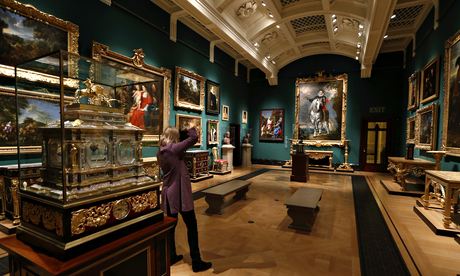
Trip to The First Georgians at the Queen's Gallery, Buckingham Palace.


I went to the Queen's Gallery with some trepidation. For a start, a resident of London just does not feel comfortable going near the palace, even the Queen doesn’t like it, Buckingham Palace is for the tourists and nobody else. Second, I wasn’t sure I would enjoy the exhibition when I got there.

The early Georgian age in my mind is the world of the coffeehouses, the raucous conversations and arguments, the hacks of Grub Street trawling the streets of London for another gin. My imagination was the world of Hogarth, Pope, Swift and Gay - none of which were supported by Georges I or II.

In some ways my fears were realised. There were a lot of bulky console tables with heavy marble tops and overelaborate gilded legs. There was a monumental example of the stolid, dull console table, two gild candlesticks and mirror affair that has a name beginning with ‘Tri’ and is utterly dull...but there was a lot more. 

The first room introduced our characters. George, Elector of Hanover and 50th in line for the throne of Great Britain, invited by parliament for his protestant religion. His son, also George who said he hated ‘boetry and bainting’ and was the last British King to lead an army into battle. George’s wife Caroline, who ended up something of a revelation and their children, including Frederick, a Prince of Wales who never became King. 

That first room had two very striking items. The first was a letter from Frederick to his son, the future George III in which he talked of his ideas of kingship. The striking thing about the letter was the personal tone, the directness in which the prince wrote to his son. The second were a trio of portraits of Frederick’s children, the youngest daughter appearing so lifelike you could almost hear her gabble.

The next room was about the palaces and made the interesting point that the early Hanoverian monarchs only made alterations to existing palaces in an effort to maintain a sense of modesty and link with the English monarchs of the past. The room after that was about the wars, at home and abroad and including the Duke of Cumberland’s plans for Culloden. To be honest I couldn’t understand most of the maps and although I understood the politics of the time, the implication of those wars to the politics of now were rather glossed over.

After that we got a Hogarth room, which is a very good thing for a room to be. It included a run of prints from the Harlot’s Progress, which seemed almost 3D compared to the blurry and splodgy knockoffs of the Industrious and Idle Apprentices on my wall (I aim elastic bands at the smug face of Francis Goodchild). There were also subscription tickets, rough sketches and a rare red printing of A Modern Midnight Conversation.

I was a bit confused after that room because the next was one which obviously featured pre-eighteenth century works. It turned out the room was to showcase the kind of collecting that was popular among the early Georgians and how it was displayed. I found out that symmetrical patterns were favoured and the collectors were prepared to add or cut parts of the paintings to create the required symmetry. This is also where Caroline came to the front, she was a very keen collector and had Holbein’s sketches taken out of a dusty drawer and displayed properly. She also had a fondness for Tudor portraiture and was building up a gallery of past British monarchs from King Alfred to herself.


Subsequent rooms seemed to have less focus but had a whole bunch of highlights; including porcelain soup tureens in the shape of cauliflowers, a harpsichord that was just aching for me to touch it and a stunning Canaletto of the Thames from Somerset House that felt as if you could step into it like Mary Poppins. I particularly liked the man playing/stealing the ducklings.

At the end of that room was a ludicrous silver gilt dinner service with a fishy theme. Then a few more pictures, including a great one of all the people/cows mingling in St James’s Park and then on a consciously low key note, a conversation piece of Prince Frederick and his sisters playing music.

So, what I worried would be a little dull and ugly was a very absorbing three hours. I recommend the audio-guide, it wasn’t too intrusive and the extra information is genuinely absorbing and some of the musical extras were lovely, I recommend track 119. 

Also, if you get the ticket stamped you get a free year’s pass to the gallery so I may very well go back some time before October to see my favourite parts again. 

-Oh, and there is a TV programme on the subject on BBC4 soon.

As for this site, I haven’t written much this year so far but expect me to be in force over the next few months for reasons that will become clear.