Wednesday, 7 November 2018

Review: The Elixir of Life by William Harrison Ainsworth


I picked this book up after reading Dickens and it is painfully clear how poor a writer Harrison Ainsworth is in comparison. Where Dickens can’t help describing things in surprising ways, Ainsworth is painfully bogged down by cliché, especially when he tries to make the writing soar.

A few pages in and this doesn’t matter. What Ainsworth does have is a delight in drama and story. After three pages, we have already had a man half-killed for trying to remove severed heads from London Bridge and a miracle recovery. By the sixth page, the man has discovered that the alchemist who made him better is his grandfather, by the eighth the alchemist has created the elixir of life and by the ninth he has had a sudden heart attack and his grandson has stolen the elixir of life rather than heal his Grandfather, taken it and stepped out into an eternal life… What Ainsworth lacks in skill at words, he makes up for in skill of action.


The writing is so by-the-numbers, an alchemical chamber is simply described by what it has in it and the people speak to themselves in a peculiar stagey dialect that no-one would ever use but this is because they are the simple tools needed to convey the happening in the story, which never lets up.

The dialogue is particularly awful. I’d noticed, but not hated the clunky nature of it in other Ainsworth books but here it really sticks out. The shady characters speak in a pinfull inwented speach vat grates on the eyes. I might have liked the character of Ginger, the dognapper with a couple of Charleys in his pockets, if he hadn’t been so painful to read. (I also thought it weird that in this, of all books, there was an attempt at a message against the law’s indifference to dognapping).

The book has a weird structure. There’s the prologue with the young man, Auriol, his alchemist grandfather and his drinking of the elixir. The next part is about Auriol’s secrets being found out and exploited by ruffians, details his falling in love with Ebba Thorneycroft and his bargain with a mysterious man in a black cloak who demands a woman Auriol loves every ten years. Then there was an interlude set thirty years earlier where the man in the cloak discovers his powers and makes his deal with Auriol. Then the next part, involves a group of people going to rescue Ebba and being trapped in a fiendish house of death before the end of the book when Auriol wakes up and discovers he’s been mad and has dreamed the last three-hundred years.


I didn’t understand why Auriol made a deal with the man in black after he’d been alive for two-hundred years already. My assumption was that the elixir’s downside is that the person would live forever but have no financial luck and the man in black promised to take this downside away for the price of a soul every ten years - but I had no confirmation. 

We never find out what happens to the intrepid rescuers trapped in the house of death, nor the fate of Ebba Thorneycroft and the other women. I was not convinced as a reader that the whole story had been a result of Auriol’s madness, the details of his imagined future were too accurate to not have taken place.

That’s not to mention the chapter in the barber’s that takes four pages describing a barber’s shop to only lead to a character gaining a new master called Loftus, which doesn’t really go anywhere because a few chapters later he is working for the man in black. That’s not to mention the mysterious figure in a mask who helps the rescuers whose identity is revealed in the following deft piece of exposition; “Is it you, Gerard Paston, the brother of Clara, my second victim?” We hadn’t even heard of Gerard or Clara before this moment.


All this moaning is not to say I didn’t love the book - I did. Any book where a man turns a key in a lock, pushes the door and the whole thing falls down is one I want to read. Any book with a bizarre trap with self-imprisoning chairs that give immobilising electric shocks and then huge helmets come from the ceiling to suffocate the sitters, is one worth reading. There was also a moment in the book where an immortal character complained that he’d been drowning for three days because it took that long to untie the stone from him. I loved the book, but it feels threadbare.

Essentially, it feels unfinished, and perhaps it was, although I can’t find any authoritative source to say so. The Dickens I was reading before this was ‘The Mystery of Edwin Drood’, which has had people writing endings for it since Dickens died half-way through. This similarly feels like half a book, ending on the cliff-hanger of Auriol ‘waking up’ and it would be enormous fun to Drood it up, try and work out the relationships and bring it to a satisfying conclusion. If I had the time, I’d do it myself.


Wednesday, 31 October 2018

Review: The Mystery of Edwin Drood by Charles Dickens and completed by Leon Garfield


Spooks, corpses and other creepy things - maybe it's Halloween.


I come to one of the most curious artefacts in my three-year long search through Leon Garfield’s work, one of his only books specifically marketed for adults, and a book that he didn’t even begin.


‘The Mystery of Edwin Drood’ was started by Dickens in 1870 who wrote six of a proposed twelve serials before suddenly dying from a stroke. The proposed novel is shorter than many Dickens books and seems to be more focused on a mystery than usual for him. For me, the biggest part of the mystery is, ‘how would Dickens have made a surprise from a solution so obviously telegraphed to the reader?’ Although he didn’t leave many notes, he did send someone a letter where he confirmed that the obvious reading of the clues was the correct one…so how was he going to sustain interest to the end? And how does Garfield manage it?


We open with a very striking image of Cloisterham Cathedral that reveals itself to be a vision undergone by Jack Jasper, the lay precentor, as he lays befuddled in a London opium den. As the chapters proceed, we learn that Jasper is uncle to Edwin Drood, who is only a few years younger than him. Drood is an orphan who will shortly be taking his place in his father’s company and become an engineer in Egypt. He is engaged with Rosa Budd, another orphan of rich inheritance, the engagement was decided by both sets of parents before they die and Drood seems to regard her as another good thing he has coming to him. Rosa is less keen on the arrangement, not because she doesn’t like the young man, but because she resents not being given options. The complicating factor is that Jasper has his own obsession with Rosa, signified by a poorly drawn picture of her he has on the wall.

To be honest, I can’t see why everyone is so hot for Rosa. She is constantly referred to as childlike, she has immature strops, she has been coddled for most of her life in pity of her orphaned status (and in honour of her coming wealth). She is cute but she is also silly and stupid, putting her apron over her head to hide her face like a shy child and only being tempted out by ‘lumps-of-delight’ - a far better name for Turkish delight which I am certainly going to include in my vocabulary.


We then spend some time meeting other delightful Dickens characters like Mr Sapsea, a man so vain he creates an epitaph to his wife that celebrates him; Crisparkle, a kindly clergyman with a good heart, a light touch and a rather too close attachment to his mother; and Durdles, a dusty stonemason who hires a small boy to throw stones at him if he stays out after ten at night.


Then enters Honeythunder, another very apt named character, a do-gooder with no good in his heart who drops Neville and Helena Landless at the Crisparkles. They are also orphans but have had a harder time and are fiercer because of it. Neville also instantly falls in love with Rosa (why?) and finds Drood’s lack of appreciation for her disgusting. They have a huge argument.


The next few chapters follow the life of Cloisterham, with Drood and Rosa’s awkward not-really-courtship but they mainly follow Jasper. Jasper makes great pains to be friends with Sapsea, who becomes mayor. He hangs out with Durdles who knows the secret ways of the Cathedral and he confides his fears of Neville to Crisparkle. Then, during a storm, Edwin Drood disappears. Jasper quickly blames Neville and although not enough evidence is found, the town blame him and he has to run to London.


Jasper confesses his obsession for Rosa, who is already terrified of Jasper and goes straight to her guardian in London, Mr Grewgious. Incidentally, I loved Grewgious, he is often (very often) described as ‘angular’, he is so socially awkward he uses prompt cards to get him through ordinary conversation but he clearly has a good heart. He also has Donald Trump’s hair, “He had a scanty, flat crop of hair, in colour and consistency of some mangy yellow fur tippet; it was so unlike hair, that it must have been a wig, but for the stupendous improbability of anybody sporting such a head.”


In London, Rosa meets Tartar, a retired sailor who makes an almost magical roof garden and who Dickens is obviously very fond of (but doesn’t particularly know what to do with). Also a ‘harmless old buffer’ with a secret agenda called Mr Datchery who moves into Cloisterham… then Dickens died.


SPOILER: (Sort of). It is patently obvious at this point that Jasper is the killer, he’s made friends with Sapsea to smooth the way through court and has buried him somewhere secret in the Cathedral, probably Mrs Sapsea’s tomb. This was also confirmed by Dickens. The big question then, is why is it so obvious? While it’s true that the characters aren’t sure who killed Edwin Drood, it’s blatantly clear to the reader.

His daughter thought that the book was more interested in the mindset of Jasper and exploring his nature than a straight-up mystery. Dickens wrote that the anchor of the text was the Bible verse; “When the wicked man turneth away from his wickedness…he shall save his soul alive.” Perhaps the redemption of Jasper was the point of the second half.


There have been many continuations of the story - some where Drood isn’t dead but is Datchery, some where Neville killed Drood and implicated Jasper and many where it was Jasper and he is found out by various means. One continuation was even written by Charles Dickens himself with the aid of a medium. Being a ghost, it wasn’t his best work and the medium’s Americanisms crept in.


Garfield goes the least resistance, Jasper did it route. He makes the drama of the second half less about how Jasper is redeemed and more to do with how he is captured.


Garfield’s style is a pretty good match for Dickens. They share a fondness for odd simile and his comic set-pieces stand up quite nicely with Dickens own. The reading of a play written by Grewgious’s dour clerk, Mr Bazzard is a particular standout, with the clerk’s high opinion of how the event is turning out being wonderfully set against what we actually see. There’s a brilliant joke about the SnakeBite tribe, who only have sixty-five words in their language because they are much higher minded than things like ‘hansom-cabs’ and ‘street-lights’, a fact that most of the characters regard as more inconvenient than noble. There’s a description of a maid who has second sight which is ‘greatly aided by the application of a keyhole’, very Dickensian in its wryness. Garfield also creates a character, Mrs MacSiddons, a retired actress who now runs a lodging house for the profession and regards all excuses to get out of paying rent, even death, as ‘just acting’.


He feels less at home with some of Dickens’ actual characters. His Grewgious is not as angular, his sentences shorter and less awkward and his mode more expressive. Rosa is backgrounded for the (admittedly more interesting) Helena and is not described as the most beautiful woman in a room. He isn’t as in love with Tartar as Dickens seemed to be and the character also fades into the background.


He does love Datchery though. There are some completions of this book where he is really Mr Bazzard, or even Edwin Drood in disguise but in Garfield’s, he is a former-actor turned detective and lives with Mrs MacSiddons when he isn’t investigating. I liked the characterisation, especially the idea that he was tremendously winning actor who can’t remember lines and keeps the name of his alias in the brim of his hat. The inclusion of the stage element, together with some of Dickens’ own Macbeth chapter titles allow for a plan which is telegraphed a little too clearly but convincingly manages to catch Jasper.


Garfield’s Jasper sees (what he thinks) is the ghost of Neville, murdered in a previous chapter. He follows this ghost when he can and realises that it is a real person of flesh and blood. Delighted that Neville is not dead, he feels himself waking up from a bad dream, convinced all the other terrible acts that he has performed were also hideous dreams occasioned by opium. Going to Mrs Sapsea’s sarcophagus, he opens it up with the key he had stolen from Durdles, convinced that there’ll be nothing in it to distress him. Instead he find the mouldering, quick-lime-eaten body of Drood and is arrested.


When Crisparkle goes to visit him in the condemned hold, Jaspers wits are completely gone. He is physically awkward, subject to weird tremors and a double vision. He has psychologically split himself in two; the evil Jasper and the good Jasper. He feels a little sad that he, as good Jasper, will be hanged for evil Jasper’s crimes but hopes for that good part of him to reach heaven. The moment when the noose and bag go over his head are truly moving and we feel very sorry for confused Jasper as he drops. The other characters pair up as they will and it ends with a (mostly) happy Christmas dinner at Mr Grewgious house. The last character is Datchery, who sneaks out of his London house and sets up permanently in Cloisterham as the ‘old buffer’ he was pretending to be.


While I would have liked a bit more of the proposed Dickens plan of focusing on Jasper and his possible redemption, Garfield’s ‘to catch a killer’ second half manages to fit nicely with what goes before it. Garfield’s style is not quite Dickens, it feels alternatively cramped and puffed up - never quite slipping into the ease or ebullience that Dickens possesses. It is, however, a good enough version of Dickens and means that a reader can enjoy the whole story in a far more satisfying way than if they read only the Dickens portion. Perhaps one day I’ll try more Drood continuations to see other ways to end it but for now I’d like to focus on more Dickens, and maybe get another William Ainsworth Harrison fix.


Wednesday, 24 October 2018

Johnson and Boswell's Scottish Books at the Dr Johnson Reading Circle

In 1773, a sixty-two-year-old Johnson and a thirty-odd-year-old Boswell went on a trip they had been playfully imagining for ten years. They travelled up to the Hebrides in an effort to see what was left of the old Highland way of life. Both of them wrote a book –  and Dr Johnson’s Reading Circle read both of them.
Walking.jpg
Johnson’s A Journey to the Western Islands of Scotland was published first. In many ways, it’s a traditional travel book, with Johnson describing the key features on the way and often measuring them. He then makes his conclusions and opinions on what he sees and hears. The book is arranged by location, with the odd gallimaufry of discussion and opinion in various parts.

Coming out after Johnson’s death was Boswell’s The Journal of a Tour to the Hebrides. Whereas Johnson talked about Scotland, Boswell talked about Johnson. Written up from his journal of the trip, Bozzy published the book to test the waters and try out the style of his proposed Johnson biography. There’s lots of conversation and little details that would have been lost to time.
Boswell's tour whole book.jpg
Of the two, the group overwhelmingly preferred Johnson’s account and even found it easier to read than Boswell. Discussing things as inconsequential as scenery with Johnson makes his quite a relaxing book to read but there is a wellspring of anger just underneath. Famous for being disparaging to Scots and Scotland, he quickly finds himself warmed (if not always inspired) by the people’s company and flattered by their welcome. What shines through is his disgust at how parts of Scotland were not looked after or developed – not a disgust at the people, but in how they are being let down by their leaders. This disgust comes through his frequent astonishment at the lack of trees, the poor quality of the housing and the huge swathes of people emigrating to America. There is many a deserted village.
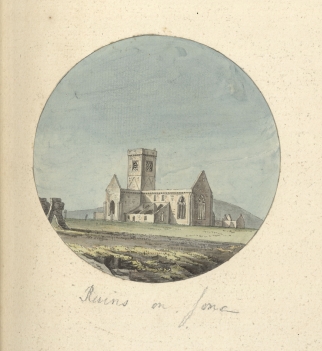
Iona Ruins - cropped
There is also the quality that has him called a ‘secret papist’: his dismayed reaction to the seemingly endless array of destroyed churches that he sarcastically describes as ‘a triumph of reformation.’ This is not, I think, out of any real Catholic sensibility, but more from a general reverence for churches and land deemed sacred. His paragraphs about the ruined abbey on Iona are worthy of the praise Boswell gave them in his own book.

Turning to Boswell, there is a problem with his seemingly compromised Scottish identity. Proud of his ‘old blood’ and deeply in love with the romantic ideal of the Highlands as he is, he is also a Lowland Scot and a member of the modern, forward-looking Scotland. Where he has to shift between identities throughout the journey, Johnson can just be himself.  There’s also the element of him ‘auditioning’ his ideas and style for Johnson’s biography to fellow Johnsonians. Boswell sees himself as made greater by this adventure which ties him closer to Johnson’s ‘brand’. There are moments in the book that are painfully, toe-curlingly, embarrassingly, Boswellian.
Imitations at Drury-Lane Theatre crop.jpg
Despite this, we learn a lot we would never have found out otherwise. We learn that Johnson has read Castiglione’s The Courtier; that Johnson has ‘often’ imagined what sort of seraglio he might run and has considered how he would fight a big dog; that Boswell was once encored for his cow impression in Drury Lane, and that Johnson is pretty good on a horse – if it’s a decent size.
We also enjoyed the amount of teasing in the book. Boswell teases Johnson about old lady who thinks Johnson’s question of ‘where do you sleep?’ is a come-on. Johnson teases Boswell for staying up sharing six bowls of punch. They take turns teasing each other over which of them is the wenching ‘young buck’ and which the civilising influence. At night they often share a room and have private conversations in Latin so their discussion can’t be understood through thin walls.
Dr Johnson and Flora MacDonald DJH_142.JPG
Then there is the full description of their visit to Flora MacDonald and the narrative of Prince Charles’ escape from Culloden. This part is worth reading the book for itself.

Taken together, the books present a fading existence with compassion and anger, but also present a long road trip in all of its highs and lows. Whether it is Boswell feeling superior as Johnson is seasick, or Johnson riding the prow of the boat as Boswell is seasick, this journey cemented the friendship of the two men, gave them quality time together and laid the seeds for Boswell’s later biography.

There was a lot of Scottish travel experience amongst the group, with many having been on parts of the journey and one member having undertaken the whole lot. Even in the modern era, roads flood, ferries are cancelled, island supermarkets run out of food and the mizzle, drizzle and rain pour constantly.
Thomas Pennant, A Tour in Scotland in 1772 (3).JPG
Our boys didn’t make their journey alone. As well as meeting helpful lairds, old women, reverends and servants on the way, they were accompanied by a trusty guidebook, Thomas Pennant’s  A Tour in Scotland and Voyage to the Hebrides (1772) Johnson admired his guide and frequently leaves the descriptions of geographical to him. Currently Dr Johnson’s House have an exhibition, free with entry, that explores the relationship between Pennant and Johnson and includes copies of their books and numerous contemporary artworks of the places visited.

I recommend anyone to give these books a go and to see the accompanying exhibition: there’s much to enjoy as we discovered for ourselves.


Wednesday, 17 October 2018

Review: Hogarth's Progress at the Rose Theatre, Kingston


Recently, I took a jaunt to the Rose Theatre in Kingston to see the double bill of ‘The Art of Success’ and ‘The Taste of the Town’ known collectively as ‘Hogarth’s Progress’. 


The first play was a revival of one performed in 1986. It stars Bryan Dick as Young Hogarth, just married and completing his first big success with ‘The Harlot’s Progress’. He goes on a big night (afternoon?) out, paints a killer in Newgate Jail, is thrown mostly naked out of a prostitute’s house and returns home to his own home to be terrorised by the escaped killer who doesn’t like her portrait. 

My principal note for the play was ‘that spun in some strange directions.’  I was expecting something of a biopic but this was something far stranger. Most strange was the flashes of nightmare, mostly shown on projections around the set. These included Hogarth’s wife with a pair of shears about to emasculate him, nightmare versions of creepy women, a poxed prostitute and -  most strangely - the male characters trying to rape Hogarth while taking selfies with a smartphone. 

There’s an obsession with filth in the play, or at least an obsession with shocking the audience with filth. A Lord enjoys some sexual act that involves him caked in blood (his own?); Queen Charlotte enjoys humiliating de-facto Prime Minister, Walpole and humping at his naked bottom; and Hogarth loves being farted on, shat on and pissed on. I find the whole ‘tee-hee prostitutes, pox and dirt’ eighteenth century to be something of a cliché, though maybe it hadn’t been as played out in 1987.

It’s clear that the play is not interested in telling Hogarth’s life but in using his life to say…something. What? I could never decide. There’s stuff about censorship, one of the sub-plots being about Walpole’s pushing of a censor’s bill, especially to silence Fielding. There’s a theme of who owns an image, with the criminal hunting Hogarth for his picture and Hogarth trying to convince Walpole to create a copyright act. There are themes of artistic integrity and selling out, whether an audience should be charmed or shocked. Finally, there were themes of the eighteenth century’s simple views of women - represented by a virginal wife, a prostitute and an unhinged murderer.

I enjoyed Bryan Dick’s Hogarth. He was fierce, pathetic and interesting, though less a battling pug at this moment and more a weasel. I was less keen on his wife Jane. The real Jane Hogarth ran off with him against her family’s wishes and so can’t have been as prim as she is portrayed here. Robert Walpole is a played as gibbering idiot who has the ability to walk into people’s houses in a strange, almost dream-like manner. I was most disappointed with the portrayal of Henry Fielding, played as an idealistic, naïve bumpkin, hardly the writer of ‘Pasquin’ , ‘Tom Jones’ and the founder of the Bow Street Runners. He was mainly there to be the idealism to Hogarth’s cynicism but both seems to have been equally idealistic and realistic.

I enjoyed parts of the first play but had no real notion of what it is supposed to be about and found it chaotically determined to shock more than entertain. I also didn’t realise it was supposed to be a comedy.


The second play is a gentler affair, even if Hogarth himself is less gentle. Where the first was a slightly histrionic, overplayed attempt to shock, the second is essentially a sitcom episode . Welcome to Chiswick where poor Jane Hogarth has to put up with her grumpy husband, please her demanding mother and entertain quirky neighbours like David Garrick. 

In this episode Hogarth is reeling over bad criticism, especially a sharp comment by former antagonist, Robert Walpole’s son, Horace. Hogarth and Garrick go for a drink and insult a war veteran. Hogarth then goes alone, breaks into Strawberry Hill and confronts Horace Walpole over his comment. Returning home he is distracted by a prostitute and beaten up.  Meanwhile, Jane has to take her Lady Bracknell/Lady Crawley-esque mother on a shopping trip. There they are laughed at by bluestockings and Jane’s mother dies.  

Keith Allen looks like old Hogarth and I he clearly enjoyed playing the disappointed full-mouthed old man that came across in Jenny Uglow’s wonderful biography of him. I also enjoyed the gags where no-one had read ‘The Analysis of Beauty’ or appreciated his Sigismunda picture. Jane was probably the centre of this play, she was tired and put upon which had us feeling for her wasted life. I loved the portrayal of Garrick, it was a little obvious to have him vain but he was also as likeable as his contemporaries described and I loved his death of Macbeth sequence. The extremely mannered and bitchy Walpole was also exactly as I imagine him and it was gratifying that his best laughs came from lines in his letters.

This second play was more contained than the first and the comedy had space to breathe. However, the time went a little slower and I wished for the energy of the first. Similarly, it had some very entertaining moments but they never built to much more. 

As a double bill, this was less Hogarth’s Progress but more Hogarth’s Peregrination - a meander round scenes, some enjoyable and some less but with no real point at the end. This is not to say I didn’t enjoy myself, I did but I was hoping for more. It was, however, a better fictional representation of Hogarth than the very limp novel ‘I, Hogarth’ which I don’t hesitate to not recommend. If you want your Hogarth fix, you should probably go to his house and see some prints, go to Sir John Soane’s to see some paintings or read Jenny Uglow’s huge but involving biography. There’s also a pretty decent fictional Hogarth in a Channel Four mini-drama called ‘The Harlot’s Progress’ where William is played by Toby Jones.


Wednesday, 10 October 2018

The Return of Leon Garfield (Part Two)

Following on from my initial Leon Garfield roundup and its subsequent sequel, here his 'The Return of Leon Garfield - part two. Again, I am reviewing these in the order I read them.


The Strange Affair of Adelaide Harris

Leon Garfield books have a tendency toward the dark and the uncanny. But this, the first of the two Bostock and Harris novels, is a comedy of errors. In this book, a small(ish) act by two schoolboys escalates through the personal failings of the characters around them before coming to an improbable yet satisfying ending.

Harris and Bostock are two schoolboy best friends. Harris is all brains and Bostock all brawn and after hearing about the Spartan tradition of leaving babies on hills to die, they link it to the Romulus and Remus myth and decide to try it on Harris’ baby sister. The stranded baby is found by the headteacher’s dashing son Ralph, and the arithmetic master’s daughter Tizzy, who takes it back to the school where the arithmetic master challenges Ralph to a duel. The baby is taken to the poorhouse.

The trouble finding the baby involves the creepy pseudo-private investigator Selwyn Raven, who meddles and complicates things by drawing up his own (false) idea of the baby’s disappearance. He’s my favourite character in the book and has an impulsive need to see the worst sides of everyone whilst telling himself he is really after the best.

As characters try and wriggle in and out of the duel, Bostock and Harris try and get Adelaide from the poorhouse and all the other characters try to pair up with those they love…things get confusing, then very confusing, then tie themselves up.

The key to all the characters is that each one knows they are honourable and good but only by consistently lying to themselves. 

There’s no point trying to run through the plot, it ticks beautifully and ties up well. What’s more, Garfield is at his best in terms of style. I didn’t pick any lines in particular but there are plenty of fantastic ones. The insanity of the characters and the way they justify their own selfish actions are gleefully portrayed. Also, Brighton comes out well.


The Night of the Comet


It’s interesting that although Bostock and Harris instigate the farce in each novel, they don’t appear much in it. 

This is even lighter-hearted than ‘The Strange Affair of Adelaide Harris’. Where that book had frequent (if comically inflated) musings on guilt and dark secrets, ‘The Night of the Comet’ is pure romantic farce. There are no dark secrets (or even guessed-at dark secrets) but instead has people talking at crossed purposes.

Each chapter is short and sparky, and each causes the plot to take a sharp left turn - enough of these left-turns lead the characters where they should be. It’s fun, would make a very enjoyable stage-play or a great mini-series. It’s a joyful marriage of sharp plotting and sparky writing but as such is quite hard to review, it works well, achieves its purpose and that’s it.

The best character was the Irish glazier, whom love has turned into an angel. He’s been searching England from Liverpool down until being washed up in Brighton in search of his runaway love. She’s there of course, but his fondness for all women, and a few misunderstandings make their renunion a little more shaky then it could be. 

A fun slice of provincial eighteenth century romance, a tight farce and probably Garfield’s most airy and fun book.


The December Rose

This book follows the general formula of Garfield’s novels. A boy of poor means accidentally falls into a larger mystery. As the secretive net tightens, he finds allies, avoids enemies and eventually brings all the secrets into the light. The book also follows Garfield’s interest in morally grey or misguided villains and Inspector Creaker in this book is one of the best.

Barnacle is our young man, he is an animalistic chimney sweep, who overhears a secretive conversation when lurking up a chimney. Falling into the room he grabs at objects to throw and ends up running away with important evidence in his pocket. The book has the interesting (and slightly odd) notion that once he has the property he accidentally steals, he starts to move from animal to human - a function of property itself.

Barnacle bumps into a big man - not big exactly, it’s as if if what you see of him is the visible sign of a much larger person. This is Mr Gosling (again with the bird names) and he is the rentee of a barge. Taking in Barnacle leads him and the other bargees into danger.

The rest of the book is a thrilling affair, delving into the notions of spies and secret policeman. Seemingly innocent actions like peeling an apple or humming a song are imbued with special and eery significance. The thriller element is tighter in this book than most other Garfield works and I was pulled along at a breakneck pace. 

The book not only thrills but it makes interesting points about class and the importance of the everyman. A conspiracy of lords and government is infiltrated by chimney-sweeps and people who barge manure down the Thames. There are also points about servants and masters. Creaker and Barnacle are the servants of unfair, weak masters but Barnacle rises above it by running into Gosling - the question is whether Creaker will let morality overcome his own loyalty.

Of course, the writing is always brilliant. There were many examples but I’ve picked out the description of a low-dive pub which ‘poured light into the night like a disease.’

It’s another solid book in Garfield’s work.

I shall be looking at his completion of 'Edwin Drood' soonish.