Monday, 31 October 2011

Let me take you down to...

Strawberry Hill

I’m sitting on a chair, basking in the warm October sunshine on a lawn outside an eccentric eighteenth century vision on a mediaeval gothic castle, drinking a pot of tea and listening to the chatter some coach party. Life does throw up the odd surprise now and again.

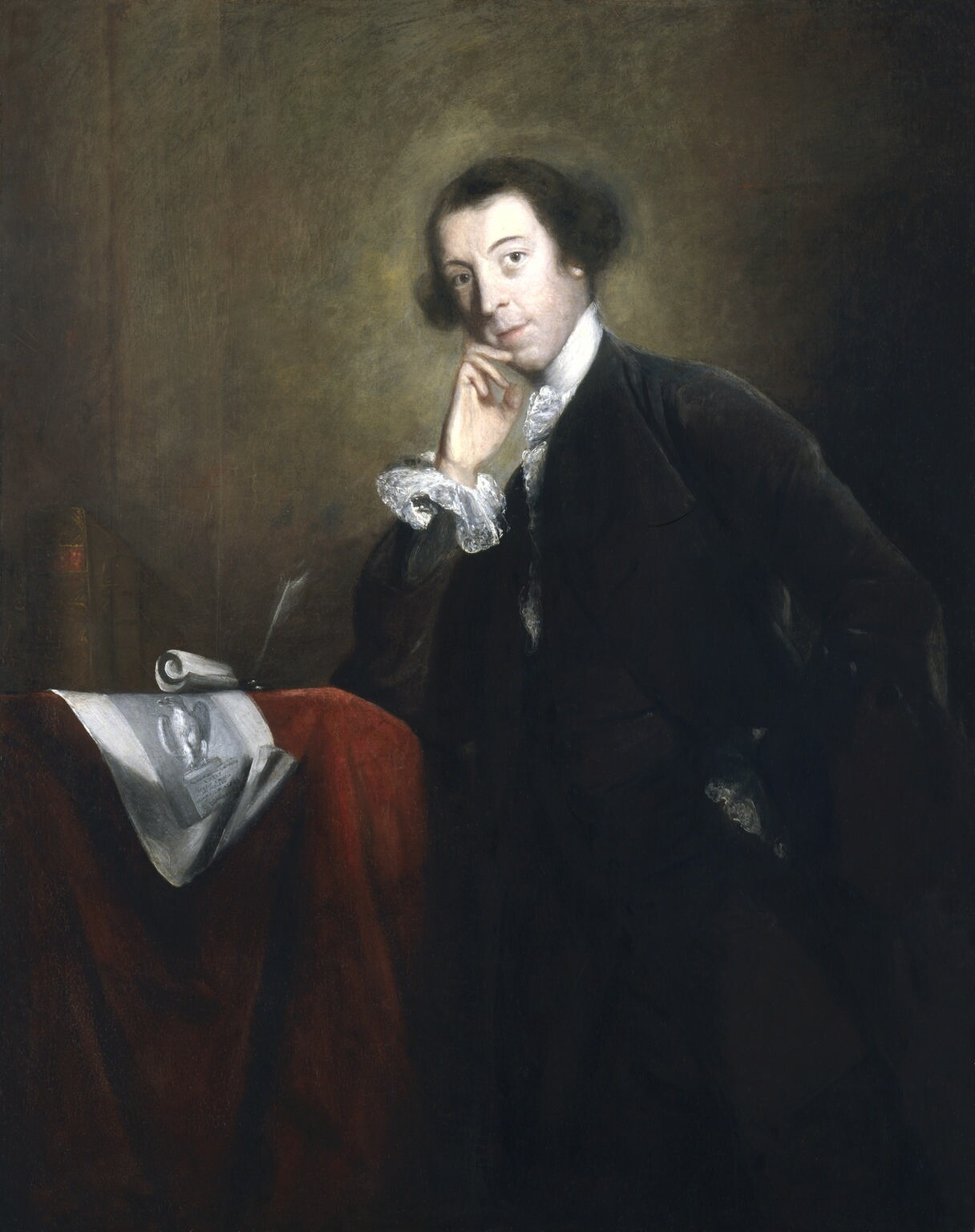
I am at Strawberry Hill, the building adapted and built by Horace Walpole, leader of fashion, writer of very bitchy letters and son of the first prime minister. It’s a nutty place, built according to his whims and fantasies, a fake ancestral castle utilising as many details from gothic architecture, at that point a very unpopular style compared to the Augustin style with its clean lines and symmetry. The house is a study of unsymmetry and it stands, beautiful and ludicrous in Twickenham, just on the south-western outskirts of London. In building this strange hobby, Walpole prompted the gothic revival and in writing about it, he wrote The Castle of Otranto the first gothic novel (and a very odd book indeed). So I have come to visit it.


I still have time before I go in, so I take a wander around the garden where I am attracted to a bench in the shape of a shell, a reconstruction of one of Walpole’s own creations and a famous piece of design in it’s own right. I sit on it and find it a bit of a let down, carved in cheap wood and smearily painted, it looks like something Laurence Llewellyn-Bowen would have built in changing rooms. The fact that it is stained in bird crap and covered in ladybirds makes it a little unnerving, but I sit there anyway.


Despite this, sitting on a clean part of the bench and looking back at the bench I am left with   a feeling of utter pleasure. The details of the house are castle-esque, There is a round tower and a conical one, there are cloisters and crenellations, but the scale is wrong. Looking at the trees towering over the castle or the size of the people against it’s arched windows reveal that it is not much taller than a typical London townhouse, although takes up rather more space. It is a large villa, but a teensy castle and the clearly designed nature of the place reminds me of a building in a theme park, a sort of ‘King Arthur Land’ or something, although with much more charm. Strawberry Hill is not a corporate place (I had to remind them to charge me for my tea), what’s more it still feels what it originally was, the whimsy of a creative man of extensive means having a bit of a muckabout.


When it’s my turn to go in, I am led into a room with a video explaining the background of the house and I am given a little booklet, that reproduces an abridged version of Walpole’s own description of the house, allowing the man himself to lead you through. There are also guides in every room who are very enthusiastic and informative. Indeed, the guides were great, pointing out details I might have missed, like the elaborate Queen Anne lock in the blue room and explaining the tasks of the ongoing and extensive restoration continuing on the house. Some of the previous owners made odd choices, covering eighteenth century painted tromp-l’oeil wallpaper with 80s pink patterns and anaglypta.
The first room is the hallway, it is dark and dingy, there is a staircase going up and a single large lantern hanging from the top. The lantern is decorated in stained-glass, as are a lot of the windows. The stained glass is one of my favourite elements in the building, partly because of the way the glass dapples the light and partly because of the way the glass was obtained. Walpole ordered a job lot from Holland, and they arrived, assorted bits of mismatched stained glass dating back to the 1500s and depicting all sorts from trading to saints. Walpole then went around, arranging the glass in different ways until it fit his wish. There is one room where the corners all featured birds, another features King Charles the first and second. All the glass in the house is worth a closer look.


At the top of the stairs, where Walpole dreamed of a giant fist, a dream that started his novel, there is his library. It is wonderful, the closest thing to The Beast’s library it might be possible to have in a suburban villa and has grand arched bookcases. Impressively the bookcases open, so the books behind the arches can be retrieved. Unimpressively, the collection was sold off and there are actually no books in the library. There is a huge painting on the ceiling, not touched since it was first painted but bright and vivid and a special locked bookcase where Wapole kept the books he printed in his own private press in Strawberry Hill. 


After the library, there is this wonderful dark corridor, lined in ridges of wood to make it feel like you are in a drum and left into the long gallery. A beautiful room in red damask and loads and loads of gilt. Indeed, gilt and grandeur summarise the other rooms in the house.


In summary, I highly recommend a visit to anyone with a few hours to spend enjoying the details and humour of the building, and learning a little about a very odd and wonderfully creative man....he also had an extra overspill library, and I can't help but love a man with one of those.

All yours


Saturday, 15 October 2011

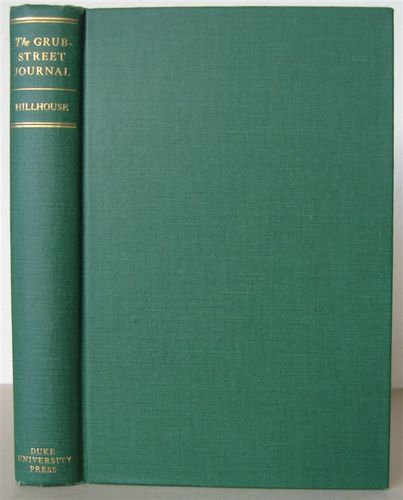
The Grub Street Journal - Review

(I think this review is cursed, my computer has ‘pazowwed’ twice when writing this.)

A Copy of the Journal, doesn't look like much...but not a bad read.

I was originally disappointed when I received my copy of ‘The Grub Street Journal’. I was expecting a collection of eighteenth century magazines written by members of the much maligned assortment of hack writers located in and around Grub Street. Instead I received a book about a magazine, which had written as if by hack writers in and around Grub Street, but actually written, partly at the instigation of Alexander Pope as a continuation of The Dunciad.

James Hillhouse explains that he was originally intending to publish the Journal itself, but seven years of popular and consistent publication, there is too much to publish. His second thought was edited highlights of the Journal but this highlighted a problem that would have also affected a full collection. The business of the Grub Street Journal, was to pick entertaining squabbles with other newspapers and get squabbling away. For this reason, it’s hard to simply publish it, as it is principally understood in its relation with other publications of the time. This is what this book’s about, and as such, it is very entertaining.
The first chapter is the driest, but essential to understand the rest. It details how the Journal was developed to pick literary fights on behalf of Pope and other Scribelarians and how it grew it’s own legs under it’s editor ‘Bavius’, a mask worn by a few people but most often a sharp-witted, non-juring vicar called, Richard Russell. It then provided popular entertainment, by picking fights, some literary, others medical and some religious.
The book then takes us through different categories of argument and dispute the journal involved itself in and gives examples of each. The disputes take rather similar forms, even the most abstract arguments descend into ad-hominem attacks and the Journal often finds itself using parody and fake letters from the other side, making it look stupid. They have a particular fondness of attacking other papers, I like the constant refrain of rival paper, The Register as, ‘an obscure little paper’, it seems such a modern way of niggling other publications.

Another running joke I enjoyed were the constant digs at Colley Cibber. I have a real fondness for Mr Cibber (last mentioned in my review of ‘Midnight Mirage’, but also got a mention in ‘Joseph Andrews’). The actor-manager, so popular in comic roles, unexpectedly made poet laureate to be ridiculed at least twice a year when publishing his New Year and Royal odes. The Journal had followed the contest throughout, ridiculing the possible candidates but mostly ignoring Cibber, he being such an outside possibility. When he got the role, they were ready with an epigram or two. For example;
But guessing who would have the luck
To be the birthday fibber
I thought of Dennis, Theobold, Duck
But never dreamt of Cibber
(Incidentally, during the contest, Bavius banned waterfoul puns for Mr Duck as they were being inundated with them).
Or this comment;
Court fools and poets once illustrious lived:
With different titles graced distinct they shone:
But both are now so scarce; ‘tis well contrived
To join a poet and a fool in one.
Every time one of his execrable odes was released, the Journal would look at it in it’s most mock-serious manner and tear it apart. There were frequent niggles at his plays as at his poetry. 

Colley also seems to have provided the age with a phrase used in lots of contexts, much as we would use a famous quote from a film... such as, when chopping too much veg for a curry and putting it in a pan, I remarked that we ‘needed a bigger boat’). The phrase, which I have now incorporated into my own idiolect is something Colley was reported to have said to an actress who had particularly slayed an audience one night that she had, ‘outdone your usual outdoings’. In works throughout the ‘30s, people were described as ‘outdoing their outdoings’ for many different spheres of activity. Of course, Cibber himself often outdid his outdoings as a poet.

Another regular feature was the news roundup. This was more than a mere digest of news, but also a comment on the poor newsgathering techniques of the other papers. It took conflicting reports of the same event, compared them and often a comment by Bavius/Russell. These comments are often of an acid and sardonic nature that pushes (and occasionally crosses into) cruel. Occasionally the reports were written in a rhyme form, something that seems shockingly flippant and rather amusing, for example the fairly famous;
“Yesterday, a poor woman, who I suppose got up to ride,
Fell out of a dust-cart, and immediately died.”

There are many arguments, but the one that most gripped me was the tale of their longest running feud with the quack, Joshua Ward. Ward peddled some pills and drops, supposed to be a panacea for all ills and ended up killing many people, especially the weak. The Journal opened up its pages to anyone wishing to report deaths and crippling from the pills. The pills were based on genuine 18th century medical practice of purging the body of sickness, but they worked too well, purging the body for days and days until the victim purged themselves to death. The campaign was pretty successful, and Ward had to tour the North and keep out of London. 
In all, I enjoyed this book and I feel I know, or have access to knowledge about every aspect of The Grub Street Journal that I could ever want. And that’s something to be pleased about. 


Yours


Monday, 12 September 2011

Grub Street

There is a wonderful free online map of late eighteenth century London here.

In that, is of course grub street, (5 across and 1 down).

Here it is, out of the context of the rest of the map.


I have just read a book on 'The Grub Street Journal' and will be condensing that and picking out some good bits soon, and am now on 2 books about Grub Street itself, so that will be forthcoming.

When I am not knackered after going back from work anyway.

All yours


Tuesday, 6 September 2011

Doctor Who meets the C18th

I am not only a big fan of the eighteenth century, I am also a fan of Doctor Who.

So, imagine my delight when I saw an eighteenth century-esque dress that is also a representation of the Tardis.


Monday, 5 September 2011

Haiku Diaries

5/9/11
Back to school again
Learning and putting up boards
Then cooked lasagne.


6/9/11
The rain, it raineth
We huddle in the school hall
And teachers are taught


7/9/11
The children return
New class, yet all seems the same
New housemates also.


8/9/11
A calm day at work
Fell asleep with the light on
So tired was I.


9/9/11
A day working hard
Followed by drinking hard too
Karaoke shame.


10/9/11
Restocked my wardrobe
Recognised by pawnbrokers
Not fans of my song.


11/9/11

The Thames Festival
Skeletal Horses ride proud
Fireworks sing loud.


12/9/11
Two and a half hours
Far to long to work unpaid
Feed me and leave me.


13/9/11
Another long day
Fuck work and yaay lasagne
Reading old humour.


14/9/11
Most fed up today
Someone ditched my red post card
I can't get my book.


15/9/11
Out of work on time
So off to the pub again
And curry after.


16/9/11
Safe, warm and cosy
Soft bed with just a few fleas
Living like a king.


17/9/11
British Museum
For laughter with my sister
Then, Samuel Johnson's.


Sunday, 4 September 2011

Review of the play, 'A Dish of Tea With Dr Johnson'.


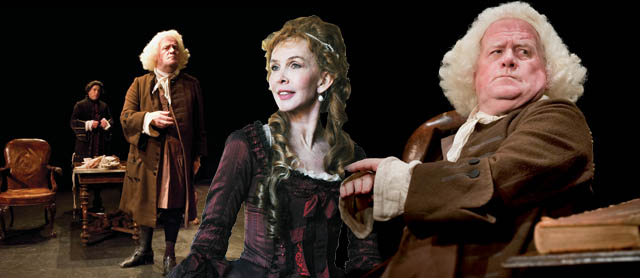
Last night I went to see ‘A Dish of Tea with Dr Johnson’, a two man and one woman show that uses material from Boswell’s Johnson writings (and a tiny snippet from his London journal).
For those expecting action, they would have been disappointed because A Dish of Tea is not really a play, it’s ‘An Audience With...’ There are no real dramatised scenes, just lots of fascinating people telling their stories in character. This is a good thing. It focusses the attention onto the people on the stage, what they are saying and how they are saying it. Although it could be regarded a dramatic failure, in terms of involvement of the audience into the characters on stage it is highly successful.


Unfortunately, co-creator and player of many parts Russell Barr is ‘seriously ill’ and his part was taken by Luke Griffin. The play is very word heavy and the part not only includes Boswell, but also Goldsmith, Lady Flora MacDonald and a whole host of other characters. This meant that the night didn’t have the snap that it could have, the ebb and flow of two actors fully comfortable in roles they have been playing pretty constantly since 2009. It also meant that Kate, Barr’s dog who usually played Hodge, Johnson’s cat, was unable to appear. Instead they mimed the cat. This sadly means I can’t do the jibe about a dog playing a cat is ‘not done well, but surprised to see it done at all’.
Luke Griffin did well as last minute replacement, giving a range of different characters, adopting different mannerism and accents for each one and doing his very best to spar with Johnson and feed him for his best lines. His Boswell was the right mixture of cocky, weeningly flattering and deep down miserable, conveying Boswell’s shifts between pride and self hatred well. His female characters were not so on the nail, his Mrs Williams lacked the factor of intimidation that all the characters attributed to her, though his Flora MacDonald delivered some very funny lines with understated grace. There was also the benefit that Griffin is (or appears) younger than Barr and so provides a starker vision of the age gap between he and Redford’s Johnson.
As for the other members of Johnson’s friends (also played by Griffin); poor Joshua Reynold’s got to be the butt of most of the ‘fool’ gags, made to look little more than a simpleton. David Garrick was much discussed but not represented (indeed, it was amusing on the way out to hear two people talking about how they had never heard of Garrick when they were a spits distance from Garrick Street, the Garrick Bar and the Garrick Theatre). Goldsmith got off pretty well considering his representation in Boswell’s writings. To be sure, Griffin is from Ireland and seemed comfortable in the character, twisting his face to give that over-arching top lip that characterises Goldy’s face. I also found it gratifying that my pal Nolly, in the 3 minute segment devoted to him, managed to get a number of really good laughs. 


What I did miss though, was a dramatisation of the short conversation when Goldsmith and Johnson about fables and fairy tales, where Goldsmith is saying how hard they are to write and Johnson arguing how easy. Goldsmith tells Johnson they are hard because you have to accurately present the characters of the animals, the tortoises have to read like tortoises and the little fishes like little fishes; when Johnson says that he could do it easily, Goldsmith replies that Johnson would make the little fishes sound like whales. I’d have liked that, just to see the look on Johnson’s face. 

One of the things I loved most about the performance was the confidence it had in presenting Johnson and his friends, enemies and acquaintances. There was little or no introduction, the audience were supposed to understand who was who (and what baggage they had brought with them) straightaway. This made it very enjoyable for me, as the show didn’t get bogged down in all that elementary stuff but was done in a way that must have been clear to Johnson neophytes as when I was leaving, nobody was complaining about not being able to follow it but were instead exalting in all the new and interesting people they could now get to know.

The only character other than Johnson who was not played by Luke Griffin was Hester Thrale, a part originally played in 2009 by Barr, but has for some time been played by Trudie Styler (who I discovered was Sting’s second wife, the wonders of research eh?). This is very much a performance of Boswell’s life of Johnson, and Mrs Thrale is not presented with much sympathy at all. She is sharp but flighty, teasing the doctor and flirting with him, even (controversially) allowing him a kiss and then skipping off giggling at her own naughtiness while Johnson dies inside. This is Boswell’s, Yoko Ono version of Hester and he gets to have the last word, calling her a ‘little, artful, impudent, malignant, devil’. I read a review where her introduction was disliked but I found the entrance in the last ten minutes of a beautiful, though very odd looking woman in a rustling red dress to be a real invigorator. (Also due to research, I have learnt the thing that I found so unsettling about her was the superabundant use of botox).

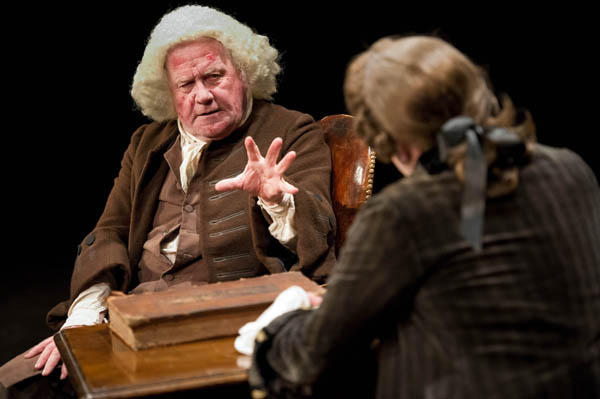
Finally there was the character of Samuel Johnson himself. There was a moment of confusion when Samuel Johnson started to speak, over half the audience wondered why this man, second only to Shakespeare in OED’s list of quotations was speaking in a thick Midlands accent. This is not the first time in the night that the audience are confronted with elements of Johnson that have largely been removed from the public consciousness of him. That accent is used with great effect, giving Johnson that air of grounded genius.
Redford makes a tremendous Johnson; coarsely humourous and eruditely witty, able to pull off the ‘tempests and gales’ of anger and frustration but also the slightly pathetic need for company and distraction, full of wisdom but also full of sadness. 
Be warned! This is definitely Boswell’s Johnson we are meeting. For example, there is liberal use of Johnson’s wife gags and some of his rather less enlightened conversations with Mrs Thrale about the role of women, but no mention of his enthusiastic support for women of letters; mention of the time spent chatting with women, his interest in trying to get inside the role of woman to see how it fit (a role he professed to envy at times). This is Boswell’s Johnson, masculine and direct. However, Boswell’s Johnson is the Johnson we most often see and he is presented with a great amount of verve and humanity. It is hard to take your eyes aways from him, always moving, playing with his hands, rocking slightly, and with a good line in his mouth. This Johnson knows how to enjoy an audience and make an audience enjoy him, yet we don’t forget the desperate need for company and distraction behind that enjoyment.
A perfect representation of Johnson is impossible though, and for Redford the main barrier to him being a perfect Johnson is the obvious love and respect the actor has for the man. In the programme, he thanks member of his family for ‘putting up with his obsession’, and it clearly is an obsession. If anything shows more clearly, it is Redford’s love for Samuel Johnson, both as a legend and as a man and this gets in the way of his portrayal, because although Johnson said he was ‘willing to love all mankind, except an American’ there is one man Johnson clearly did not love, and that was himself.
I will have to one day come to terms with the fact that I will never be able to sit and listen to Johnson’s conversation, nor have him savage me in conversation or slurp tea in my face. I am also now resigned to the fact that no actor will ever be able to fully conjure up the Samuel Johnson that lives in my head, but in ‘A dish of tea with Dr Johnson’, Ian Redford has come the closest so far.
Yours