Wednesday, 10 January 2024

Top Ten Books of 2023 (10-6)

 2023 was the year I finally finished Clarissa but may be no surprise that it’s not included in top ten favourite books. It’s a very varied list this year, with a number of books that came out this year and even a rare appearance of some non-fiction. So, out of the nearly hundred books I read, which were my top ten favourites?


So, without further ado….


Number 10

Anna Karenina by Leo Tolstoy


The second longest book I read this year, it was well paced and well observed.


Anna Karenina’s opening line is one of the most famous in literature. It’s easy to see why, it has an aphoristic certainty that put’s it up there with Pride and Prejudice’s more ironic take. I don’t agree with it though, happy families are just as varied (and potentially interesting) as unhappy ones. It does set up the arena of the plot though, the book follows three couples in particular, the choices they make (or are driven to make) and the results thereof.


The first couple is Dolly and Stiva Oblonsky. They’ve been together for several years and Dolly has subsumed herself into motherhood, yet she’s shocked when she discovers that Stiva has been having an affair with the nanny. It’s revealed throughout the book that Stiva has affairs with lots of people. What’s more, he doesn’t see them as affairs because his matrimonial heart is still with his wife, even if his having fun body is with someone else. He’ll never learn and she either has to accept it or not. He’s also getting the family into debt by trying to live the high life without the income. Yet he’s also utterly loveable, to the other characters and (to this reader) and his faults come from the same openness that make him loveable. 


Then there’s the titular Anna Karenina, her husband Alexei and the Count Vronksy. Anna is Stiva’s sister and seems to share his traits of being immediately likeable to everyone, indeed, she’s loveable to everyone. Vronsky is one of those who is sucked into her orbit by her charisma and can’t help himself. She also can’t help being drawn to him, it’s not that her husband is a bad person, but he’s not a passionate one and it’s stifling her. That she must choose between her lover and her son is a huge strain for her.


The final couple is Levin and Kitty. She was initially after Vronsky, and so turned Levin down. This sends him into a spiral and, when Vronksy ghosts her, sends Kitty in one also. They emerge from their spirals and start to spiral together. Despite clearly being Tolstoy’s favourite character, Levin is the prickliest and most awkward person in the book who other thinks everything. (Also, I don’t think Tolstoy liked children very much, they are always described as screaming, shrieking or snotty).


This is a book where everyone is an idiot. Levin is clearly so, as is Stiva - but Anna could choose a happier resolution for her predicament, Vronsky could get out before he was sucked in, Alexei could have shown Anna more love. Everyone’s an idiot. Everyone’s human. It’s a wonderfully observed book, told often through micro-expressions and small fluctuations of character’s eyes. Also, the characters are envisioned that the things that make them idiots and the things that are good and noble about them come from the same springs. Whether it’s Stiva’s openness, Anna’s passion, Levin’s neuroticism, Alexei’s caution - they are the sources of both their joy and despair, it’s very human.


The most famous tragedy in the book, is frequently foreshadowed in such a way to make it seem inevitable, but even as a reader aware of the tragedy, it came suddenly. There was this very immersive part, where Anna is distraught, hardly aware of where she is going or what she doing, only that everyone she sees irritates the hell out of her - then it happens and it’s still shocking. Then you realise it’s just Levin chapters for the next hundred-odd pages.


To be fair those Levin chapters are pretty good. They show him growing up a little and connecting to something worth living for. Anna Karenina is a book which happens largely at balls, dinners, nightclubs and family gatherings, but it ends quite cosmically, with Levin realising his place in the wide universe and accepting it. 


Most impressively, especially for a book of 900 pages, its phenomenally well paced. There aren’t the languors of Clarissa, or the sense that all the stuff in the book is cancelling out the other suff, like Les Miserables. Anna Karenina knows when to put its foot down and when to ease up. It takes time to establish the cast, giving them small trials to attempt. It teases parallels between getting married and having a divorce. There’s a very cunning break between the moment Anna tells her husband about the affair and the resolution of that. It uses its length to make the world feel lived in and handles plot and pacing impeccably.


No surprise, but it is very good.


Number 9

Studies in the Art of Rat-Catching by H.C Barkley


Odd that a rat-catching handbook should be one of the most charming books of the year, but there we are.


Charm may not be the first word evoked by a guidebook for catching rats, but Studies in the Art of Rat-catching by Henry Barkley is surprisingly charming.


While it’s true that the subject is primarily rat catching, and there are chapters about what is needed to do the job, it’s not a simple, no-frills guide.


For a start, the author pretends to be the character of Bill Joy, a warm-hearted old fella with a warm-hearted honesty and a weakness for pipe tobacco. He’s a tough man, believing that leather gloves are for wusses and that a proper rat-catcher should expect being bitten by a rat a few times. Yet he shows many examples of being a softie, especially when it comes to his dogs. Insult him all you want but don’t be mean about those mutts. While he says he’s not a ‘sentimental, fat pug on a string’ kind of person and wouldn’t have a dog in the house, but don’t believe that. ‘Bill’ says that he can talk to his dogs, and that one mutt had snitched on a ‘prigging policeman’, who was actually jailed several years for theft. 


While this is not much of a book for rat lovers (or rabbit fans, 650 of them are killed in a weekend in this book), it is a book for dog lovers. The book exudes love for them, with ‘Bill’ having a chat with a little child about if dogs go to heaven, concludes that of course they will and imagining the many wagging tails he can’t wait to see when he gets there. Of the dogs he describes, I particularly took to Grindum, a big-faced, vicious looking bulldog with a habit of slow blinking and a temperament so gentle that the rats sometimes get the better of him. 


The introduction of Grindum also allows Barkley to pursue what (might) be the book’s real purpose, to tell a sentimental story. A family turn up in an empty shack near the village; mother, father and two children. The man doesn’t work but he does drink and one day a crime is committed he is suspected of it. He bumps into the narrator and says that he is going to hand himself in to the police for a shorter sentence, that his children are cared for and that he just wants to sell his dog. The narrator receives the dog, Grindum, takes him home, only to find the two children have followed the dog to his house and that the older boy in particular won’t be parted from him. It’s revealed that they’ve seen their mum murdered and their dad ran away.. of course ‘Bill’ takes them in.


The anecdote is beautifully written though, and the pathos built up well. There’s a moment when he describes how the little girl had a face with “a sad, careworn old look which I pray I may never see on a child’s face again” as she silently comforts her brother, which is very affecting. He describes how the children have grown up and that some people say the boy, Jack, is a bit off, a bit cracked. His response, “If Jack is cracked, then I like cracked boys”. He’s also very generous about his wife in this section.


Jack is then included in the next anecdotes, where they have a good and bad day’s ratting and then a rabbitting holiday by the sea. This leads to a series of sentimental anecdotes about the lives of sailors, and a poor little ‘crippled’ boy with the ‘beauty of a girl’. The descriptions of the storms are very evocative and the danger and heroism of the fishermen conveyed well.  - Though this does make the book a ‘hodge-podge’, as he says.


While Studies in the Art of Rat-catching does contain advice and information, what tools to use, how to look after ferrets and how to train a dog - but it’s not a straight up rat-catching handbook. This is clear from the way the book contains more scenes of anecdote and sentiment than rat-catching. It’s also clear from the use of a character, ‘Bill Joy’ - how many of the events in the book are true?


What’s more, the book pretends to be a textbook for use in upper-class schools. The introduction talks about how he knows the children would rather be doing fun things like conjugating Latin verbs, but they need to learn the noble arts of rat-catching so they don’t fail and have a pointless career like politician. However, by the end of the book, it’s clear the rich kids won’t make it as rat-catchers, it’s  “too much above their intellect”.


Number 8

The Island of Doctor Moreau by H.G Wells


H.G Wells is not an author I’ve ever thought as my favourites, but I’ve yet to read one by him that I didn’t enjoy.


I thought it was one of those books where the one thing everyone knows about it is the secret, like Dr Jekyll and Mr Hyde or The String of Pearls. It turned out I was a little wrong though, having assumed the beast-men (and women) were devolved people, not evolved(?) creatures. 


HG Wells uses both belt and braces in making sure that Prendick, and the reader, are trapped on the island. First there’s a shipwreck, starvation on a dinghy, rescue and then being kicked off that boat onto Moreau’s island. Once there, the mystery is solved fairly quickly, the main issue is how to live with that mystery. Moreau has control over his creatures due to ‘the law’, a collection of demands and threats. With each of them having fearful memories of their time in Moreau’s hands, they obey in fear. It’s strangely, viscerally horrible and hasn’t lost that impact.


The creatures themselves seem like parodies of human forms and types such as the philosopher ape-man’s big and little thoughts, the dog man’s loyalty or the grotesquely obsequious sloth man. Of course man is the true monster and we are left with a very Swiftian ending (which Prendick even recognises) that, like Gulliver, he can never look at people the same way again.


Also, this seems to be a book bands like, or at least House of Pain and Devo.


Number 7

To The Chapel Perilous by Naomi Mitchison


Considering I read ten Naomi Mitchison books in 2023, this is the only of her books to enter the top ten.


There are two central conceits to the book: What if there were newspaper journalists around to record the stories of the Round Table? And, what if every knight who has won a grail in the centuries of tradition actually did?


These two what-ifs come together really well. Leanors is a broadsheet journalist under the editorship of Merlin and Dalyn is a tabloid journalist under the editorship of Lord Horny (aka, The Devil). Both newspapers are utterly against the notion of many grails, a multitude of grails would weaken the whole idea of a grail quest and a grail knight. It’s only special if there’s one. So, both newspapers declare Galahad’s quest and grail the ‘true’ one, mainly because his is the simplest story. However, this doesn’t stop there being a whole bunch of other grails and the two reporters go to the different headquarters of the various knights to report. 


As much as I’ve enjoyed the Mitchison books I’ve read, I haven’t found her as funny as I was expecting, this book is funny. There’s fun to be had with Merlin and the Devil as newspaper editors. There’s a lovely running gag about the ‘subs’, who are sub-editors, but also implied to be monstrous troglodyte-esque sub-humans. There are the mythological animals who serve as photographers in this world, including the Chad. The Chad confused me at first, not being a mythological creature I had heard of, but he’s the Chad of the old ‘Wot no…’ cartoons (known as Kilroy in the US).


There were also numerous references and gags to Arthurian legend. They mention that Taliesin is too high-brow to include the blue collar grail quest stuff. Sir Dinadan is referenced as a humour columnist. The different knights at grails are wonderfully characterised, whether it’s the pre-christian wildness of Peredur/Percival’s grail in the Forêt Sauvage, or the messianic version found at Joyous Garde. It became a little more serious when the whole Lancelot/Guinevere thing came out and the characters were catapulted to the end of Arthur’s reign - though there were still some fun bits about how Modred had buffed up.


A quote in the book says, “if you can keep it light, you can say a lot more”, and I wish Mitchison had followed that rule a bit more in her other books. To The Chapel Perilous manages to be both light and dense, like a satisfying cake. I’m not sure what someone unaware of various grail stories and general Arthurian Lore would get out of this book, it has the potential to be quite confusing but as someone who likes that stuff, this is a fun time. What’s more, it actually has points to make about the validity of lots of small truths rather than a single authorised Truth - and that’s a message that appeals to me.


Number 6

Reynard the Fox by Anne Louise Avery


Not my first Reynard the Fox - the one I read in 2019 didn’t reach my top ten, this version did.


In 2019, I read a 2015 translation of Reynard the Fox that declared it was the first in over a century. In 2023 I read this 2020 translation. It would seem Reynard the Fox’s are like buses, wait a hundred years and two turn up at once. As such, it’s hard for me not to read Anne Louise Avery’s translation without comparing it to James Simpson’s.


One thing that is striking, is it’s clear they are both translating the same Caxton original. Not only are all the events the same, but really odd little details (like a particular villager that is described as having ‘long fingers’) are the same. The other striking thing is that Avery’s is twice as long as Simpson’s. While he went with plain sentences that matched the line drawings that illustrated his version, Avery goes maximalist. 


Where Simpson might have a chapter that’s a paragraph in length, Avery will make it six or seven pages. Where something may be a line in Simpson, it’ll be several paragraphs in Avery. There’s much here that could be cut out, the two page description of the different mice Tybert likes to eat, the invented gossip given to each minor character, the many lengthy descriptions of food. If lengthy lists of food were cut out this book, it’d be a hundred pages shorter - but then it wouldn’t be itself. If Simpson is offering a clear translation to simply put across Caxton’s take on the story, Avery wants you to roll and languish in that story. Which is to say, it’s longer, and far more verbose but it feels richer and more lived in. Even the descriptions of food serve a purpose, food is the primary motor behind most of the animal’s actions. They may be anthropomorphised, but they are wild animals at heart.


None is more wild than Reynard. He’s something of an anti-hero, he may make the rich, the powerful and the bullies look silly but he also preys ceaselessly on the weak. “A fox can only ever be a fox…and those who disagree deserve all the obfuscation and trickery a tod can throw at them.” Avery’s excess of description really helps with the characterisation of Reynard. Here he is cool, suave, dressed to the nines. He is a domestic homebody who loves playing with the children and revere’s his wife’s intellectualism. He’s convincing and flattering, and when things get really bad and he finds himself lost for words, we really feel for him. This is despite Reynard’s completely amoral attitude to everyone around him.


It also helps the characterisation of the other animals. King Noble the lion is a bit of an upper class twit, a comfortable toff who’d rather be at a joust then ruling Ghent. Tybert the cat is a scholar of Boethius and completely regrets being drawn into the whole sorry story. Bruin the bear, for all his strength, is kind of loveable because all he really wants to do is eat nice food and be left alone. Isengrim the wolf is painted truly odiously, and Avery wants to remind us how rank he smells whenever he crosses the reader’s path. He’s terrible to his wife, Lady Erswinde (who is called Lady Arsewind in the Simpson version) and we enjoy seeing his comeuppance.


One of the odd results of this maximalist interpretation is the strange anthropomorphises in the animal kingdom of Ghent. At once, it’s truly sad that Reynard decapitates Lapreel the Hare, or preys on the family of Chanticleer the chicken, but then it’s not a tragedy when the royal court have a feast where they eat dozens of capons, swans and geese. Sometimes it’s played as hypocrisy, King Noble castigates Reynard for his little predations yet gorges on half his subjects, but mostly it’s not mentioned.


Another odd result of the maximalist telling is that the moments of violence and gore are less stark. Bruin having his skin and ears ripped off, the priest losing his testicle, the fight between Reynard and Isengrim are all less visceral because they are couched in so many words. 


That said, I think it’s a brilliant retelling and both work well in different ways. Avery’s is a more inviting, luxurious place to be, and if she scaled back a little we wouldn’t get the detail of the gibbet with the rattling bones of a squirrel, “a notorious nut thief from Limoges”. And that would be a loss indeed.


If you want to look at all the books I read last year, they can be found on my list here.


Next week for the top five.


Wednesday, 3 January 2024

Hannibal and the elephant-gooseberries

 I thought I’d start this year with a joke.


What did Hannibal say when he saw the elephants?

"Oh no! Gooseberries."

(Hannibal was colour blind.)


I first read this joke in 2020 in a book called Silly Jokes; a Pocketful of Jokes, attributed to an author called Anonymouse. The jokes in the book were pretty bad, many of them baffling but this one was so bad, it stuck deep in my head and I chose to highlight it in my review.


Generally, you can understand a bad joke. You can at least see which space the joke is supposed to occupy, the intention of it but the Hannibal/elephant/gooseberry joke doesn’t reward from any angle. It’s not just a case of not getting it, there’s no 'it' to get. It’s a complete non-joke. What is the relationship between elephants and gooseberries? What has colour blindness to do with it? 


I went about telling people this joke and getting baffled reactions. Nobody could work out what the joke was, or what it was even supposed to be. I told this joke to old people, young people, people from four different continents… no one, not one person could even parse the vague intention of this joke. I concluded it must simply be an anti-joke and tried to move on with my life.


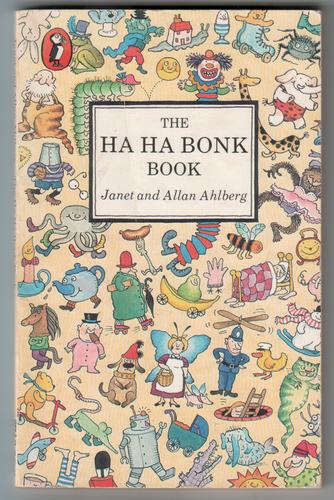
However, the joke wouldn’t leave me alone. I was looking through the book-corner in the class at work, weeding out the books that had got old hat and replacing them, when I found The Ha Ha Bonk Book by Janet and Allan Ahlberg. Unlike Silly Jokes, The Ha Ha Bonk Book is not an anonymous, cheap cash-grab but about as prestigious as a joke book can get - and it had a variation of the incomprehensible joke. But there was a twist. There were two parts to it.


What did Tarzan say when the elephants went up the hill?

“Oh look, elephants.”

What did Jane say when the elephants went up the hill?

“Oh look, grapes.” 

(She was colourblind.)


The Tarzan part of the joke even makes sense, in a bathetic, anti-climax sort of way. It sets up a ‘wacky’ answer but Tarzan simply states the obvious. The second part is essentially the same as the earlier Hannibal joke, but here, the speaker is  Jane, and the elephants are confused for grapes and not gooseberries. This would suggest the speaker and the fruit aren’t essential to the joke, but the parenthesis about colour-blindness is. 


The Ha Ha Bonk Book was published in 1982, whereas Silly Jokes came out in 2005. Somewhere in those twenty-three years, the second part of the joke had become detached from the first. Not that it makes much difference,  the second part still makes no sense, even with the information of the first part.


The answer came, as it often does, on Wikipedia. There is an entry for elephant jokes, which were a fad in the 1960s, especially after a card company released a set of elephant joke trading cards. The entry features a range of elephant jokes, emphasising how they pull at the logical edges of what elephants are, revelling in their own absurdities. It also illustrates how they work best in runs, with their absurdities building on each other. 


The first example of the Hannibal/elephant/plum gooseberry joke was told by an amateur comedian known as Mike Elephant on a programme called The Gonk Show. His version involves Tarzan and Jane but the fruit, this time, are plums. There’s also a third, and most important element.


“What’s the difference between an elephant and a plum?”

“Their colour.”

“What did Tarzan say when he saw the elephants coming?

“Here come the elephants.”

What did Jane say when she saw the elephants coming?

“Here come the plums.”  She was colourblind.


The whole colourblind element is not a joke in itself, it’s a callback. If the only difference between elephants and plums is the colour, then a colourblind person wouldn’t know the difference between them. Its absurdity built on absurdity - a cumulative effect that is less funny for each little prod but for the overwhelming avalanche of silliness. However, the joke now actually makes sense. 


What must have happened is, that the original joke run was included in joke books in the 60s. Somehow, as joke books plundered other joke books, the joke run (which makes sense of the colourblindness section) was separated into parts. So, by the time The Ha Ha Bonk books comes out, the Tarzan and Jane part exists together, but the essential ‘what’s the difference between an elephant and -fruit-?’ has disappeared. The fruit has changed to a grape, presumably because of a different elephant joke;


“What happened when the elephant stepped on the grape?”

“I don’t know.”

“It let out a little wine.”


When we get to Silly Jokes, it’s so removed from context to be utterly incomprehensible. The author/compiler/hack has obviously found the joke in another book, not understood it but decided someone must find it funny because it’s in joke books. They probably changed the fruit to gooseberry because it’s a fruit with a funny name, and to change Jane to Hannibal because he has a historic link with elephants.This especially makes sense if the author/compiler/hack found the joke about some ‘Jane’ without the Tarzan part. 


…And so, a joke that works was abstracted and separated into a brick wall of sense and meaning, and it only took 40 years. 


No wonder jokes from 4,000 years ago make no sense to us. There’s a famous Sumerian joke that’s been doing the rounds, it says;


"A dog entered into a tavern and said, 'I cannot see anything. I shall open this.”


It makes no sense. Academics have bashed at the text and tried to make something from it, but if the Tarzan/Jane/colourblind joke can become nonsense so soon, there’s nothing that can be done with the dog in a bar joke. It's funny what a fragile thing meaning is, and how little it seems to matter to publishers


Wednesday, 27 December 2023

My Experience of Reading Clarissa


 I finally wrote up (some of) my thoughts about the novel, Clarissa but I’d like to write just a little about the experience of doing it. 


I was extremely nervous. Clarissa may well be the last book I failed to finish and I remembered the quagmire that the book becomes after it’s initial burst of energy. That first reading was supported by the same group of people that read Evelina with me the first time, but even that support could not get me through that long stretch of tedium.

However, this time I knew what I was getting into. What’s more, I had a plan, to read the letters when they were written. As the book takes place over a whole year, this behemoth of a book would be split up evenly over twelve months. This meant that even as Clarissa was going nowhere slowly, I could enjoy other books. 

It didn’t quite work out like that. The letter as a physical element is an important part of the book. Letters are forged, lost and held, so some come after others despite being written before them. Then there’s the fact that the letters aren’t paced evenly. During the few moments of the book when something is happening, there can be pages and pages and pages of letters, while at other times, there are hardly any.

This meant that there were times when I had to put down something compelling and plough through hours of Clarissa to keep on track. What’s more, given the size of my copy (the penguin single volume edition) and given the tininess of the writing (good thing I read it while I can still see the thing) each page of Clarissa was the same as a page-and-a-half, even two pages, of another book. This meant that twenty pages reading was closer to forty and the book felt even more interminable.

What’s more, the book felt like a millstone around my neck. There it sat, looming on my bedside table, for the best part of a year. The little blue ribbon which marked my place inching along. I’d be in the middle of something fun and engrossing and I’d have to return to Clarissa and slog. During my summer holiday, I had to take my kindle and read things on that because there was only room for one book in my suitcase, and that was Clarissa. 

On the plus side, if there’d been a gap in letters and I hadn’t read the book for a while, it wasn’t hard to get back into the book to understand what was going on, because invariably, nothing was.  There’s also the fact that sometimes the book is genuinely gripping, the characters deep and interesting and there are a few points in my notes where I wrote, ‘Am I enjoying this?’… those notes were often followed by a, ‘nope, dull again’.

What’s more, finishing the book is a let-down. Clarissa herself dies in September. She’s been leading up to it for some time, installing her custom-made coffin into her bedroom and writing goodbye notes. We get the return of her body to the family, her burial, the last wrangling over her last wishes and will. Then a pause. Then Lovelace’s comeuppance. Then a pause. Then a final wrap-up. It fizzles out, ending with the merest of whimpers and without any feeling of satisfaction. The book is ostensibly a tragedy but there’s no catharsis. 

So, my experience of reading Clarissa was ultimately not a positive one and it’ll take wild buffalo to drag me into reading Sir Charles Grandison. Yet, I could appreciate the complexity of Richardson’s understanding of his characters, and can see how other writers took that and melded it into something more.. well.. enjoyable. But to people intrigued about reading for Clarissa for themselves, I’d advise them to leave it alone and just read Tom Jones again, that’s far more fun.


Wednesday, 20 December 2023

(Finally) Review: Clarissa by Samuel Richarson

 I tried to read Clarissa eleven years ago when I joined a readathon. I barely got a quarter way through before giving up, overwhelmed by the circular, repetitive nature of it. So when I heard of another readathon this year, I thought I’d get on board. The difference this time (except for my eleven years worth of reading experience) was that this readathon was split over a year. Clarissa itself takes place throughout a year, and we’d simply read the letters when they were dated, easy. This turned out to not quite be the case but I’ll write another piece about that next week.

Spoilers: the whole plot of Clarissa can be summed up in one sentence. Hester Thrale described it as this. “A man gets a Girl from her Parents—violates her Free Will, & She dies of a broken heart.” Samuel Johnson said that ‘If you were to read Richardson for the story, your impatience would be so much fretted that you would hang yourself.’. He wasn’t wrong. Essentially, how the book works is that something happens, the book then spends 500 pages, breaking apart, digesting and regurgitating that something before moving onto something else. (As a note, 500 pages in my copy, is probably about 750 pages of an ‘ordinary’ book).


So, there’s almost no plot, what else is there? Sometimes, it feels nothing, but that’s not fair.


Someone picking up the book for the first time will probably feel surprised at how alive it feels at the beginning, how realistic. Starting in media res after Lovelace and James Harlowe have had a duel over his interest in Clarissa, it delves into the events running up to the duel. I was pulled in despite myself, even with a clear memory of the stagnation that is to come, I found those early parts gripping, and had trouble resisting the urge to read ahead. 


One of the elements that grip most at the beginning, are the clear and complex family dynamics that are a main theme of the book. Clarissa is the youngest of three siblings. She’s long been the favourite, of the parents, of their father’s unmarried uncles and of everyone in general. Her older sister, Arabella is jealous of her, something which is hyped up when the handsome and rich Lovelace appears to court her but switches to Clarissa. (We later found out that Lovelace had heard of the Harlowe’s perfect daughter and had accidentally first alighted on the first one).


What’s more, Clarissa has recently inherited property. When her grandfather fell ill, she went to become his nurse, not out of monetary desire but out of love. Before he died, he changed his will, leaving everything to Clarissa, thanking her for her care but also reasoning that as the youngest child, the other two will get the bulk of their parents’ estate. This ramps up James’s jealousy. He’s acutely aware of his family status as nouveaux riche, and he feels insulted not to be left the property. His insecurities also fuel a personal hatred for Lovelace.


These two jealous siblings manage to spin events, manipulating the tyrannical father, the pathetically weak mother and the cold, mercantile uncles to turn their view of Clarissa from an altruistic angel into an inheritance-grabbing devil. What makes it magic, is the level of detail on how Clarissa sees and expresses all this. She sees how her siblings are turning her always fragile family against her but she won’t recognise their faults or acknowledge how imperfect that family are. 


…This, and more, is expressed in the first twenty pages or so. The trouble is, it’s also expressed for the next five-hundred pages or so, with a little variation.


Probably Richardson’s greatest success in the book is his creation of character and his attention to detail, subtlety and nuance to how each person in the novel, large or small, will react. This success has a huge positive and negative effect on Clarissa, it’s innovative and incisive but it’s also a large part of what causes its narrative stultification. We spend so long revisiting the same points, sometimes from different perspectives, but often with only minor changes so the book becomes a grind.


The worst part of the book, is after the initial rush, when the family have introduced Mr Solmes as her husband-to-be and Clarissa rails against it. Unfortunate that this should be in the first third of the book, because after she is tricked into running away with Lovelace, it never quite sinks into those doldrums again.  This section has no doubt turned away many readers. I know it did me, the first time I tried.


Once with Lovelace, things pick up a little. There still isn’t much in the way of ‘things happening’ but where Clarissa and her family are prepared to have the same argument ad nauseam, Lovelace likes to try different approaches. He begs, he wheedles, he charms, he tricks, he bullies, he threatens. He goes to extraordinary lengths to confuse Clarissa, involving a whole cast of characters to act out his little charades. It even begins to work until a small fire, which slightly threatens Clarissa’s life provokes his honest reaction. I can’t see how any reader can really see him as a sexy figure, he’s so incredibly weird and needy but at least his interesting and larger than life, and that does a lot in the drab world of this book.


Strangely, it’s the truthfulness, the lack of artificiality that undoes Clarissa while simultaneously making it something very odd and remarkable. I can’t ever define it as an enjoyable work, but it is an immensely impressive one.


Wednesday, 13 December 2023

Review: Doctor Johnson in Cambridge by S.C Roberts


Saturday the 2nd of December at Dr Johnson’s House. The temperature has dropped rapidly, everyone has discovered their hats and scarves and Gough’s Square is full of people hunting down the twelve snowman statues of Christmas. As busy as the square is, none of them are coming into the museum. It’s a little too cold to sit and read so I go into the parlour where the powder closet is open.

The powder closest was originally built as a place to powder a wig but may never have been used for that purpose. Certainly, Samuel Johnson wasn’t known for the upkeep of his wig. Now the museum uses it as storage for books, prints and items for the shop. However, there are two plastic tubs on the top shelves labelled ‘LB1’ and ‘LB2’. With nothing better to do, I decide to get them down and have a look.


The boxes consist of library overspill. Second copies of things the museum’s library already has mixed with doctoral dissertations and other odds and ends. There’s a copy of the wonderful Samuel Johnson; Detector, the first in a series of four collections of detective stories starring Boswell and Johnson. The library has a copy signed by the author, this is just a spare. There’s a Samuel Johnson edition of the Bookseller magazine from 1903, there are monographs of various quibbles and details, and there is Doctor Johnson in Cambridge, a true oddity.


I pick the books I most fancy reading at some point and put them in the cellarette, a small cupboard designed for storing tea and coffee which now sits behind the desk I sit at when welcoming visitors (and taking their entrance fee). This cupboard is already full of modern books that have accumulated but I feel that it’d be a better ‘look’ to have the Johnson books behind me, plus I can read the ones that have caught my attention.


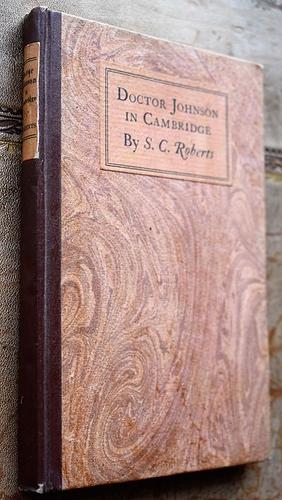
For the rest of the morning I read Doctor Johnson in Cambridge. It was written by an Sydney Castle Roberts and published in 1922. In 1923, this copy was given to someone called ‘The Hol Punch’ by someone called ‘Thomas Blue Bell’ in memory of the 34th anniversary of their Charterhouse days. 


Describing itself as ‘essays in Boswellian imitation’, the book consists of eight little sketches, with five of them having previously been published in The Cambridge Review. The book is small, the font is large and there are only sixty roughly cut pages. The premise of the sketches are to imagine that Johnson, Boswell and a number of other figures from Johnson’s life find themselves visiting Cambridge for various reasons, giving Johnson a chance to satirically assess Cambridge university of the modern day (or at least the 1920s).


Johnson in the modern day is an idea that pops up a fair amount. Julian Barnes gives him a cameo in England England, it’s sort of the premise of Marcel Theroux’s Strange Bodies and I even had a whack at it on my website, where Johnson became a couch potato and binged episodes of Top Gear. Here, Johnson opines about Cambridge Universities debates about allowing women to receive degrees (something they didn’t until 1944), watches a rag week and a modern game of cricket and even meets a major who’d gained renown due to his action in the First World War (in which the author himself fought at Ypres).


Like most depictions of Johnson (According to Queeney excepted) he is mainly created by taking various famous quotations and stitching them together in different ways. The ‘young dogs’ he wishes to frolick with are the Cambridge students, the Labour party are ‘the last refuge of an idler’ and he calls for student beer to see ‘what makes an undergraduate happy’.


Roberts shows himself to have a pretty deep knowledge of Johnson, especially the Johnson of Boswell’s Life. He remarks to a market stall bookseller that he once refused to man a similar stall. From this bookseller, he also buys a copy of Burton’s Anatomy of Melancholy and announces it as the only book that’s ever prompted him to get out of bed two hours earlier. (I’ve often wondered about that, why couldn’t he just read it in bed? I know I did.) 


Roberts also characterises Boswell pretty well, from his giddiness at seeing Johnson in different situations to his own sense of ego at being Johnson’s confidant. He rather over-eggs Johnson’s jokey antipathy to the Scots, with most of the sketches bringing up something or someone Scottish for Johnson to rag on. There’s also a running joke about how Johnson sees himself as an Oxford man and rather runs down the Cambridge students for being less rigorous in their studies and generally more into boozing and partying.


What is most interesting/needling, is what Roberts imagines Johnson’s view of the modern day would be. In some aspect we are in agreement. If he’d seen a Cambridge rag week, I’m sure he would have been won over by the high-spirits eventually - he was always a sucker for youthful hi-jinks. Similarly, I agree that would have enjoyed a modern (well ‘20s) cricket match for its formal as well as athletic elements. However, I do find it hard to believe that Johnson, who was a big arguer for women’s education and helped designed curricula for Hester Thrale’s daughters, would have argued against women gaining a degree. Still less would I imagine he’d have had an instinctive ‘yuck’ reaction to women as he seems to in this book. Nor can I imagine Johnson arguing against the idea of liberty as he does in the chapter on the Cambridge Union. Roberts reuses the ‘yelps for liberty’ line from Taxation No Tyranny many times in odd contexts. 


I think this book, short as it is shows two particularly interesting things. One is how the scholarship around Johnson has changed since the 1920s, biographies and studies pull from a wider pool than just Boswell and as a result, Johnson is a more fragile, thoughtful man. Not just the blustering rhinoceros (as seen in Blackadder for example) but a man with a warm, if sometimes needy or self-pitying heart. There’s also the interesting way people use Johnson to reflect their own times. The Johnson we promote in the house was a supporter of intelligent women, an early anti-abolitionist and a holder of frequently liberal views - for Roberts he was a stalwart, not only of old Toryism, but the conservative party of the 20th century.


It’s interesting and a reminder that while the real Johnson was only himself, the image of Johnson is one that can revived, refreshed and refracted in many different ways.


Wednesday, 6 December 2023

Review: The Storm by Daniel Defoe

I read The Storm during storm Brenda or Bethel or Bertha or something. As much as these named storms get a dramatic build-up, they’re never as dramatic as they promise to be, certainly compared to the Great Storm of 1703. Even the storm that barrelled past my childhood house in 1987 was nothing compared to the Great Storm of 1703. This storm was a real doozy and was the subject of Daniel Defoe’s first fall length work.

He wrote this piece at a difficult time. Long a writer under William III, he’d lost his patron and stumbled into dangerous territory with his satirical piece The Shortest Way With The Dissenters, where head aped the vicious rhetoric of anti-dissenters with such accuracy that there are still discussions over whether it was meant or not. (Personally, I feel that as a dissenter, Defoe was probably taking the piss). As a result he’d been put in prison while awaiting his punishment by being put in the pillory. This was a serious punishment, people had died from the injuries sustained but he managed to spin the PR in such a way that he was crowned with flowers and released. Most damaging to him, was that his time in prison unravelled his wavering business and sent him bankrupt - most galling, the business made roof tiles, something people needed a lot of after The Great Storm.


It must be this recent run in with the law that gives the book so nervous a tone. The Preface, addressed from ‘The Ages Humble Servant’ takes great pains in stating the methodology of the book and the importance of truth. He talks about how producing a book that’ll reach thousands has a greater duty to truth than a sermon that reaches hundreds. He says how the public were asked for their experiences of the storm and how he, as editor pored through each communication, selecting the ones that support each other and come from the most reputable sources. Compared to the narrator of The Plague Year, which happily mixes fiction and truth, and of his other novels which confidently present the imaginary as history, it’s a really tip-toeing tone, which is maintained throughout.


The book proper begins with a discussion of weather, and what is known about wind in particular. He cites theories, both classical and modern but concludes that ultimately, not much is known. Even the people who have “rifled Nature by the Torch-Light of Reason, even to her very nudities” have no definitive answer. As such, studying natural phenomena like storms always leads a person back to God, his immensity, his power and his unknowability. 


The book then goes on to describe his own experiences with the storm in London. I particularly liked the detail of how his barometer dropped so low and so quickly he’d assumed his children had broken it playing. He would also have recorded the wind direction but his weather-vane had been blown off the roof of the house. I found it interesting he had such things, perhaps The Storm was partly written because Defoe had a previous interest in the weather.


The book then includes a large number of accounts from people in different parts of the country about how the storm had effected their local area. There are many tiles blown off, chimneys blown down - sometimes crushing those on beds in rooms below, sometimes missing them. In the countryside there are reports of barns being blown down and hay-ricks blown up, some of them landing fully formed but in a different place. A Somerset correspondent mourns the ‘apples without number’ that have been blown off trees. Bits of churches were blown off and many lead roofs were described as being peeled off or rolled up ‘like parchment’. There was a particularly striking description of windmills being blown so hard, the friction of their gears set them alight.


The drama is higher in costal places and at sea. The Eddystone Lighthouse collapsed with the designer and builder inside, a man is crushed by a ship. Whole fleets were blown as far as Sweden and the descriptions of sailors include huge panic, fear and a little bit of heroism.


To be frank, this information would probably have been presented better as tables or graphs. The repetition of details becomes quite tiresome. There’s a bit more interest when a correspondent is from a place you know, I was particularly interested in the storm’s impact on Grimsby (where I will soon be moving to) and Brighton (where I was born). It’s an interesting snapshot of ‘Brighthelmstone’ before it became a popular holiday destination.


The biggest controversy in the book is probably the differing accounts relating to the seaside town of Deal, where some accounts stated that the townspeople refused to help those in trouble in ships near the town. The Mayor very indignantly tries to argue that the people of Deal simply could not help because his town had been woefully underfunded. 


Defoe’s nervous tone doesn’t help the book much. While the introduction suggests that he probably did rewrite many of the letters to shape it, the appearance is one where he simply mediates what was sent to him. He planned to make a sequel of the book by getting correspondence of the storm’s effect over the wider European area, but he never did. The book reminds me of the programme 999, which ran for ten years on the BBC. It used to show dramatic reconstructions of rescues, and even had a special in 1997 about the Great storm of ’87. I have to say, I hated that programme as a child and found it very dull. The Storm was, however, going to be the next step in Defoe’s career, where he’d gain confidence again and become one of the progenitors of the English novel.


Incidentally, the Great Storm of 1703 took place on the 26th of November, and I was going to post this last week as the closest date to that. However, that date was in the old style calendar and actually took place on the 7th of December on our calendar, so I’ve posted it on the nearest Wednesday to that.