Wednesday, 13 December 2023

Review: Doctor Johnson in Cambridge by S.C Roberts


Saturday the 2nd of December at Dr Johnson’s House. The temperature has dropped rapidly, everyone has discovered their hats and scarves and Gough’s Square is full of people hunting down the twelve snowman statues of Christmas. As busy as the square is, none of them are coming into the museum. It’s a little too cold to sit and read so I go into the parlour where the powder closet is open.

The powder closest was originally built as a place to powder a wig but may never have been used for that purpose. Certainly, Samuel Johnson wasn’t known for the upkeep of his wig. Now the museum uses it as storage for books, prints and items for the shop. However, there are two plastic tubs on the top shelves labelled ‘LB1’ and ‘LB2’. With nothing better to do, I decide to get them down and have a look.


The boxes consist of library overspill. Second copies of things the museum’s library already has mixed with doctoral dissertations and other odds and ends. There’s a copy of the wonderful Samuel Johnson; Detector, the first in a series of four collections of detective stories starring Boswell and Johnson. The library has a copy signed by the author, this is just a spare. There’s a Samuel Johnson edition of the Bookseller magazine from 1903, there are monographs of various quibbles and details, and there is Doctor Johnson in Cambridge, a true oddity.


I pick the books I most fancy reading at some point and put them in the cellarette, a small cupboard designed for storing tea and coffee which now sits behind the desk I sit at when welcoming visitors (and taking their entrance fee). This cupboard is already full of modern books that have accumulated but I feel that it’d be a better ‘look’ to have the Johnson books behind me, plus I can read the ones that have caught my attention.


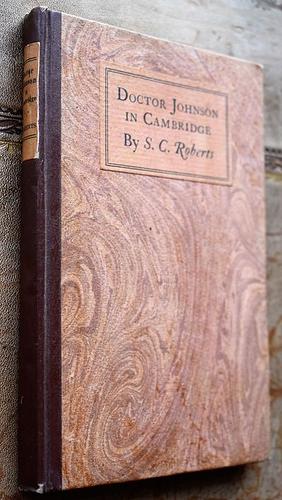
For the rest of the morning I read Doctor Johnson in Cambridge. It was written by an Sydney Castle Roberts and published in 1922. In 1923, this copy was given to someone called ‘The Hol Punch’ by someone called ‘Thomas Blue Bell’ in memory of the 34th anniversary of their Charterhouse days. 


Describing itself as ‘essays in Boswellian imitation’, the book consists of eight little sketches, with five of them having previously been published in The Cambridge Review. The book is small, the font is large and there are only sixty roughly cut pages. The premise of the sketches are to imagine that Johnson, Boswell and a number of other figures from Johnson’s life find themselves visiting Cambridge for various reasons, giving Johnson a chance to satirically assess Cambridge university of the modern day (or at least the 1920s).


Johnson in the modern day is an idea that pops up a fair amount. Julian Barnes gives him a cameo in England England, it’s sort of the premise of Marcel Theroux’s Strange Bodies and I even had a whack at it on my website, where Johnson became a couch potato and binged episodes of Top Gear. Here, Johnson opines about Cambridge Universities debates about allowing women to receive degrees (something they didn’t until 1944), watches a rag week and a modern game of cricket and even meets a major who’d gained renown due to his action in the First World War (in which the author himself fought at Ypres).


Like most depictions of Johnson (According to Queeney excepted) he is mainly created by taking various famous quotations and stitching them together in different ways. The ‘young dogs’ he wishes to frolick with are the Cambridge students, the Labour party are ‘the last refuge of an idler’ and he calls for student beer to see ‘what makes an undergraduate happy’.


Roberts shows himself to have a pretty deep knowledge of Johnson, especially the Johnson of Boswell’s Life. He remarks to a market stall bookseller that he once refused to man a similar stall. From this bookseller, he also buys a copy of Burton’s Anatomy of Melancholy and announces it as the only book that’s ever prompted him to get out of bed two hours earlier. (I’ve often wondered about that, why couldn’t he just read it in bed? I know I did.) 


Roberts also characterises Boswell pretty well, from his giddiness at seeing Johnson in different situations to his own sense of ego at being Johnson’s confidant. He rather over-eggs Johnson’s jokey antipathy to the Scots, with most of the sketches bringing up something or someone Scottish for Johnson to rag on. There’s also a running joke about how Johnson sees himself as an Oxford man and rather runs down the Cambridge students for being less rigorous in their studies and generally more into boozing and partying.


What is most interesting/needling, is what Roberts imagines Johnson’s view of the modern day would be. In some aspect we are in agreement. If he’d seen a Cambridge rag week, I’m sure he would have been won over by the high-spirits eventually - he was always a sucker for youthful hi-jinks. Similarly, I agree that would have enjoyed a modern (well ‘20s) cricket match for its formal as well as athletic elements. However, I do find it hard to believe that Johnson, who was a big arguer for women’s education and helped designed curricula for Hester Thrale’s daughters, would have argued against women gaining a degree. Still less would I imagine he’d have had an instinctive ‘yuck’ reaction to women as he seems to in this book. Nor can I imagine Johnson arguing against the idea of liberty as he does in the chapter on the Cambridge Union. Roberts reuses the ‘yelps for liberty’ line from Taxation No Tyranny many times in odd contexts. 


I think this book, short as it is shows two particularly interesting things. One is how the scholarship around Johnson has changed since the 1920s, biographies and studies pull from a wider pool than just Boswell and as a result, Johnson is a more fragile, thoughtful man. Not just the blustering rhinoceros (as seen in Blackadder for example) but a man with a warm, if sometimes needy or self-pitying heart. There’s also the interesting way people use Johnson to reflect their own times. The Johnson we promote in the house was a supporter of intelligent women, an early anti-abolitionist and a holder of frequently liberal views - for Roberts he was a stalwart, not only of old Toryism, but the conservative party of the 20th century.


It’s interesting and a reminder that while the real Johnson was only himself, the image of Johnson is one that can revived, refreshed and refracted in many different ways.


Wednesday, 6 December 2023

Review: The Storm by Daniel Defoe

I read The Storm during storm Brenda or Bethel or Bertha or something. As much as these named storms get a dramatic build-up, they’re never as dramatic as they promise to be, certainly compared to the Great Storm of 1703. Even the storm that barrelled past my childhood house in 1987 was nothing compared to the Great Storm of 1703. This storm was a real doozy and was the subject of Daniel Defoe’s first fall length work.

He wrote this piece at a difficult time. Long a writer under William III, he’d lost his patron and stumbled into dangerous territory with his satirical piece The Shortest Way With The Dissenters, where head aped the vicious rhetoric of anti-dissenters with such accuracy that there are still discussions over whether it was meant or not. (Personally, I feel that as a dissenter, Defoe was probably taking the piss). As a result he’d been put in prison while awaiting his punishment by being put in the pillory. This was a serious punishment, people had died from the injuries sustained but he managed to spin the PR in such a way that he was crowned with flowers and released. Most damaging to him, was that his time in prison unravelled his wavering business and sent him bankrupt - most galling, the business made roof tiles, something people needed a lot of after The Great Storm.


It must be this recent run in with the law that gives the book so nervous a tone. The Preface, addressed from ‘The Ages Humble Servant’ takes great pains in stating the methodology of the book and the importance of truth. He talks about how producing a book that’ll reach thousands has a greater duty to truth than a sermon that reaches hundreds. He says how the public were asked for their experiences of the storm and how he, as editor pored through each communication, selecting the ones that support each other and come from the most reputable sources. Compared to the narrator of The Plague Year, which happily mixes fiction and truth, and of his other novels which confidently present the imaginary as history, it’s a really tip-toeing tone, which is maintained throughout.


The book proper begins with a discussion of weather, and what is known about wind in particular. He cites theories, both classical and modern but concludes that ultimately, not much is known. Even the people who have “rifled Nature by the Torch-Light of Reason, even to her very nudities” have no definitive answer. As such, studying natural phenomena like storms always leads a person back to God, his immensity, his power and his unknowability. 


The book then goes on to describe his own experiences with the storm in London. I particularly liked the detail of how his barometer dropped so low and so quickly he’d assumed his children had broken it playing. He would also have recorded the wind direction but his weather-vane had been blown off the roof of the house. I found it interesting he had such things, perhaps The Storm was partly written because Defoe had a previous interest in the weather.


The book then includes a large number of accounts from people in different parts of the country about how the storm had effected their local area. There are many tiles blown off, chimneys blown down - sometimes crushing those on beds in rooms below, sometimes missing them. In the countryside there are reports of barns being blown down and hay-ricks blown up, some of them landing fully formed but in a different place. A Somerset correspondent mourns the ‘apples without number’ that have been blown off trees. Bits of churches were blown off and many lead roofs were described as being peeled off or rolled up ‘like parchment’. There was a particularly striking description of windmills being blown so hard, the friction of their gears set them alight.


The drama is higher in costal places and at sea. The Eddystone Lighthouse collapsed with the designer and builder inside, a man is crushed by a ship. Whole fleets were blown as far as Sweden and the descriptions of sailors include huge panic, fear and a little bit of heroism.


To be frank, this information would probably have been presented better as tables or graphs. The repetition of details becomes quite tiresome. There’s a bit more interest when a correspondent is from a place you know, I was particularly interested in the storm’s impact on Grimsby (where I will soon be moving to) and Brighton (where I was born). It’s an interesting snapshot of ‘Brighthelmstone’ before it became a popular holiday destination.


The biggest controversy in the book is probably the differing accounts relating to the seaside town of Deal, where some accounts stated that the townspeople refused to help those in trouble in ships near the town. The Mayor very indignantly tries to argue that the people of Deal simply could not help because his town had been woefully underfunded. 


Defoe’s nervous tone doesn’t help the book much. While the introduction suggests that he probably did rewrite many of the letters to shape it, the appearance is one where he simply mediates what was sent to him. He planned to make a sequel of the book by getting correspondence of the storm’s effect over the wider European area, but he never did. The book reminds me of the programme 999, which ran for ten years on the BBC. It used to show dramatic reconstructions of rescues, and even had a special in 1997 about the Great storm of ’87. I have to say, I hated that programme as a child and found it very dull. The Storm was, however, going to be the next step in Defoe’s career, where he’d gain confidence again and become one of the progenitors of the English novel.


Incidentally, the Great Storm of 1703 took place on the 26th of November, and I was going to post this last week as the closest date to that. However, that date was in the old style calendar and actually took place on the 7th of December on our calendar, so I’ve posted it on the nearest Wednesday to that.


Wednesday, 29 November 2023

Review: Arabian Satire: Poetry from the Eighteenth Century by Hmēdān Al-Shwē’ir.

I’ve been reading eighteenth century literature a long time, and I’ve read many eighteenth century satirical poems, most of them from (and about) London. So I was very intrigued when I picked up Arabian Satire: Poetry from the Eighteenth Century, a collection of poems by Hmēdān Al-Shwē’ir. 

He lived in the Najd region in what is now Saudi Arabia in the first half of the eighteenth century. He lived at the same time as  Muhammad ibn 'Abd al-Wahhab, a reformist preacher who teamed up with Muhammad bin Saud, the Emir of Diriyah the first of the Saud dynasty. Wahhab strikes me as the Muslim John Wesley, leading a sort of back to basics movement.. not that Al-Shwē’ir is any part of this, he lives further south and the only poem that may be referring to the two reformers is one about rutting camels.


Al-Shwē’ir styles himself as a peasant, a hard-working man who has spent countless years developing rows of dates that he had to abandon when the shifting political strifes trampled his area. He describes himself as having advised a Shaykh, but not a very good one, who bottled during a raiding party leaving Al-Shwē’ir and everyone else to die. He represents himself as an old man within his family, with a screeching harridan for a wife, children who don’t respect him and an eldest son who is lazy and luxurious, heaping all his money and attention on a beautiful but useless second wife. There’s an element of ‘old man shouts at cloud’ about the poems, but he plays into that agéd duffer persona for effect.


The poems are written in the Nabati style, a colloquial form of oral poetry that is still practiced today. There was a discussion in the introduction about whether Al-Shwē’ir was even literate. Interestingly, the Arabic of the region is an old one, and so many of these colloquial, oral poems share a lot in common with classical, formal poems of other places. Metre is an important element, with different metres being employed for different themes and styles. Like a lot of oral poetry, there is also a lot of use of stock phrases and images - though the introduction does say that Al-Shwē’ir plays a little fast and loose and invents his own elements. It’s a shame that the translation doesn’t really communicate these different metres, but it is a translation which is clear and easy to read.


What struck me, as a reader of English eighteenth-century satirical poems, were the similarities and difference between Al-Shwē’ir’s works and the Scriblerans. 


Satire is often ugly, maybe not in form, where it can take beautiful language, but in purpose. The British satirists thought their role was to scourge the hypocrisy of the world, they weren’t afraid to name names and attack individuals. Pope took particular pleasure in his Dunciad in condemning all those he thought were degrading culture to having pissing contests and swimming in shit - he furthered the thrust by suggesting they might like it. 


Al-Shwē’ir similarly attacks hypocrisy and pretty much every poem includes a curse on what he would like to happen to someone or another. People, often the residents of whole cities, are invited to boil in the sand, be attacked by wild animals or be gruesomely murdered by their enemies. In some ways he goes further, condemning his own family and neighbours to terrible strife for perceived slights. 


However, the British satirists seem pampered in comparison. Even Swift, in his full baby-eating ‘savage indignation’ seems a soft touch compared to Al-Shwē’ir. While the British satirists did have real problems to attack, like Swift at the indifference of the government to the Irish plight, most of the times, their arguments were about silly culture wars. They spent most of their time arguing viciously against academic practices or modern writing styles they didn’t appreciate. Al-Shwē’ir’s problems include rival groups massacring towns or the very real threat of desert-based drought or starvation.


While the British satirists wrote to an audience in coffee houses and living rooms, Al-Shwē’ir’s point of view is characterised by extreme paranoia. No-one is trust-worthy, everyone is useless, his life seems made of death, revenge, violence and the desperate grab of power. He may invoke stock phrases about praying to Mohammad as often as a dove coos on a tree, but there’s no religion or tempering agent in the poems. He lives a life where the only morality is ‘do violence unto the other person before they do violence unto you.’ There’s no time for beauty or rapture, only pain, disappointment and fear. There’s even a grovelling poem, the Scriblerans would never have feared enough to have to write a grovelling poem. What’s more, as much as Al-Shwē’ir attacks hypocrisy, there are a number of times he advises it. He doesn’t live in a world where truth has much purchasing power.


Al-Shwē’ir does live in a world with sex though. The British satirists (especially the Scriblerans of Pope, Gay and Swift) are an oddly assexual bunch but Al-Shwē’ir is not. He clearly appreciates a small waist and large bum, and is prepared to go far more explicit. The two pornographic poems, coming after a spate of advice poems, were very surprising. Even more so when you realise the sex he’s describing/imagining is between his son and daughter-in-law. He and the Scriblerans would have agreed that women are evil though.


One of the things I most enjoy about the British satirists is their playful way with literary forms. The notes told me Al-Shwē’ir also did a lot of this - but not having a lot of knowledge of Arabic literary forms, I could only be told he did. It’s also very possible my characterisation of the bleakness of Najd life and the whole piece in general is simply a result of my ignorance. Certainly, someone coming to the British satirists without an understanding (and more importantly feeling) of the time would see a bunch of privileged twits being overly nasty to each other about really petty things… indeed, that’s one of my favourite elements of their work. So, it’s likely I took Al-Shwē’ir’s bleak depiction of his life too literally without really appreciating playfulness or pleasure within it.


With the caveat of my own ignorance in mind, I didn’t enjoy this work, finding in Al-Shwē’ir a broken old man who hates and is suspicious of everyone he sees, shouting cynical wisdom into an empty desert and occasionally daydreaming about his son having kinky sex.


Wednesday, 22 November 2023

Reading Naomi Mitchison


My planned reading list took a left turn this year when I discovered the name Naomi Mitchison. I’m not sure exactly how I found it, I was at work and looking something else up and found one intriguing thing that led to another which led to her.

Hers seemed an incredibly interesting life. She died in 1999, having lived for the whole of the twentieth century and a little more. Born to the landed Haldane family of Scotland, she went to Oxford and published her first novel in 1923. She was to publish another 90 books, in genres as different as science fiction, historical fiction, fantasy, ethnography, poetry, memoir, political writing and works for children. She was also one of the initial ‘b-readers’ for Tolkien’s Lord of the Rings, which she was very positive about.

She was a member of the Fabian Society, took part in some light espionage, stood as a Labour candidate and later married one who became a Lord, giving her the title of Lady (which she never used). She became a member of the Bakgatla tribe in Botswana and advocated for them. She campaigned for women’s rights and birth control and although becoming a Life Fellow of the Eugenics Society, she quit it because of their politics.


When asked by Who’s Who what her hobbies were, she stated “burning rubbish.” When asked, on her 90th birthday, what she most regretted she said “all the men I never slept with”. She was an author definitely worth checking out.


I’ve had other focus writers. Leon Garfield will always have my heart (and I just discovered, and bought, a book by him I hadn’t heard of). I also very much enjoyed reading all the works of Patrick Hamilton and Penelope Fitzgerald.. but Mitchison’s ninety might take a bit more time to locate and read.


I’ve managed ten.


Travel Light

Memoirs of a Spacewoman

Behold Your King

Early in Orcadia

The Bull Calves

The Fourth Pig

The Corn King and the Spring Queen

To the Chapel Perilous

The Blood of the Martyrs

Not By Bread Alone


Within that selection lay some of her biggest hits and a few lesser known pieces. They contain some historical fiction, some sci-fi, a collection of fairy tales and what could be described as a YA novel.


I can’t say I have loved reading Naomi Mitchison as I’d hoped. The humour found in To the Chapel Perilous is not to be found in many of the other books. I found many of her characters to be a little opaque, and her style to sometimes be detached to the point of cold. On the whole, I’ve found her to be an author I’ve admired more than enjoyed, which is not to say there is no enjoyment.


Her skill at world-building is wonderful. Memoirs of a Spacewoman has a very well thought out society of space explorers, with a wonderfully practical integration of time-dilation on a space traveller’s personal relationships. It also deals with the fascinating subject of ethnography, especially if stretched out to different planets and species. Each alien race encountered has a fully formed little eco-system and method of communication which stems from the biology. Whether that’s the difficulties a spiral, multi-handed race has with making definitive decisions, or the tragic life cycles of the pleasure-caterpillars and the shame-butterflies.


The Bull Calves remains one of the most impressive historical novels I’ve ever read. Not only does the book manage to look at the position of post-Culloden Scotland from lots of different angles, it does it through characters whose different outlooks are deeply rooted in their different experiences. It reaches an authenticity that I’ve rarely read in a historical novel.


Her takes on Christianity, Behold Your King and Blood of the Martyrs share this authenticity but apply it to the last twenty-four hours of Jesus’s life and the fates of a small church in Rome during the reign of Nero. They both create characters that feel suitably alien and of a different time and culture, but also recognisable and understandable. They both also offer a wonderful vision of how Christianity could have gone, had it not been subsumed by the Roman Empire.


This alien-ness of past cultures is also a theme in Travel Light and The Corn King and the Spring Queen, the latter being her most critically successful work. I personally found the creation of Marob both entrancing and frustrating. It did seem to be a very plausible and interesting culture, but I found myself too alienated from it - a strange position when Spartans are the most understandable characters in the book. Early in Orcadia does a similar thing for the Orkney Islands, trying to imagine into the pre-historic past and see the development of a stone-age culture.


Not By Bread Alone tries to apply this systematic, ‘big picture’ quality to a future where world hunger is solved, but the book feels somewhat methodical and mechanical. The Fourth Pig introduces the notion of ‘the Debateable Land’, somewhere between human and faerie where he rules of both can be debated. It’s a fascinating notion, and one I think could be explored more fully but in the stories featured in the book it can be hard to follow, as the events happen somewhere the certainties of both realms don’t hold full sway, being something closer to a dream than anything else. 


While Naomi Mitchison didn’t quite develop into being my next obsession author, she’s on the list of writers like Muriel Spark, Beryl Bainbridge and Elizabeth Von Arnim that I’ll always keep an eye out for in a second hand shop and never turn down. She may not always grip me totally, but she’s always doing something interesting, and that’s worth a lot.


I made a list challenges of almost all of her work here - I only have 80-odd to go.


Wednesday, 15 November 2023

Video: All About The Cistercian Number System

 I recently taught myself the Cistercian number system because it’s easy and the kind of thing I like to teach myself.

It looks like this…


I decided to make a video to teach it to other people. Like all my videos, I pull silly faces, like this…


I also make a rather good joke involving this…


But to find out what it is, you need to watch this…


Wednesday, 8 November 2023

Trip: The Museum of the Home


 The other week I went to visit the Museum of the Home in Hoxton. I’ve wanted to visit it for a long time. In fact, I’ve wanted to visit it for so long that when I originally planned to visit it, it was still called The Geffrye Museum. 

Presumably, the change in name stems from the fact that Robert Geffrye, former Lord Mayor of London, president of the Bridewell and Bethlam institutes and described in his memorial as ‘exemplary in charity, virtue and goodness” was a slave trader. It’s also likely that the change is because it’s hard to know what a Geffrye Museum is, but a Museum of the Home is a much clearer title.

It’s this very focus on home, and the many different things home has meant to people, Londoners in particular, that makes the museum special. There are some stand-out objects within the museum, such as John Evelyn’s cabinet of curiosities, which are unique, but the real highlight of the museum are the collections of ordinary, often mass produced items that have helped people make their houses into homes throughout history.


It starts conceptually, with the question ‘what is a home?’. There are photos and videos of modern Londoners sharing all the different kinds of home, whether they be shared houses, family houses, bedsits or hostels. These are compared with the servant’s box - the only space in a house private for a servant, a lockable wooden crate containing their things. From there, the rooms talk about personal touches, private memories and objects, conceptions of comfort - always comparing different time periods. The impression is that of comparison and recognition, although the stiff-backed Victorian chair may not seem like comfort to a modern person, for a woman in structured clothing, it helped ease the weight. 


There’s a wonderful vein of same but different. Eighteenth Century fish counters are displayed alongside a game of Frustration, with a playable SNES next to that. A wooden pipe, of the kind that supplied water to Londoners, sits next to a kitchen sink. A selection of books ranges from Dan Brown to The Reformed Coquette by Mary Davys. (There’s also a copy of Nivelon’s The Rudiments of Genteel Behaviour.) It’s this that makes the museum truly inclusive, reminding all visitors of their basic domestic needs and pleasures, and showing the different ways they have been addressed. 


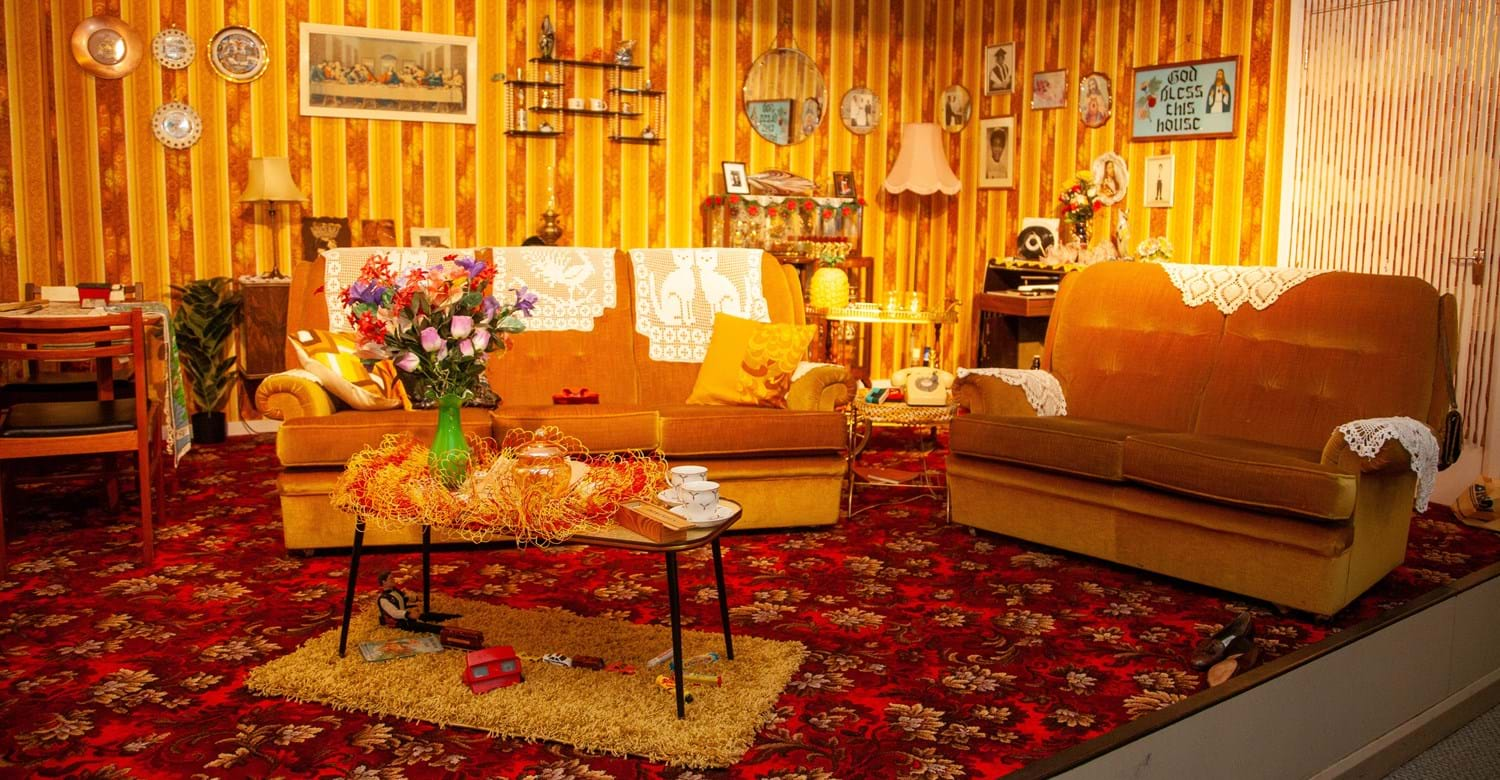
After the thematic section, there runs a series of galleries that show a central living room chronologically. Here a living space in constructed with a story, as if the people are invisible ghosts or have just walked out the room, allowing visitors to see how a room looked and functioned. This is the more famous part of the museum and the part I most wanted to see but I was actually more moved by the earlier parts. I think it was because each living space was roped off and felt like a tableau. While the earlier galleries has lots of objects to touch and cases that encourage to move around the room, the tableaus are arranged in a straight line which can be quickly looked at and marched past. Though one little boy while I was there is obviously a regular visitor because he loves to sit and stare at the pretend ‘crackling fire’. Something he was keen to show me.


As the homes become more modern, the stories they are based on become less homogenous. The earlier tableaus are all based on heterosexual families of British heritage but the 90s flat is based around a gay couple who have been protesting against section 28 and the 70s living room shows a family with origins in St Vincent. The 70s living room is hideous, but that’s not because of the St Vincent connection, but because it was in the 70s.


The Museum of the Home is free and fascinating and definitely worth a look, I just wish I could have walked through those living rooms instead of past them.

Wednesday, 1 November 2023

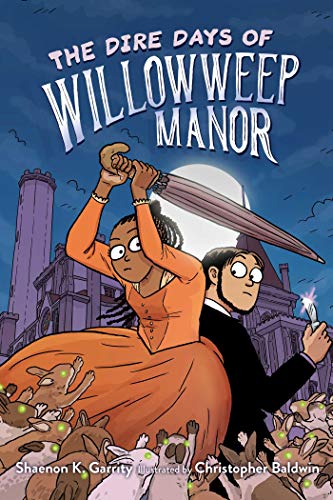
Review: The Dire Days of Willowweep Manor by Shaenon K. Garrity


 Having read a lot of gothic literature over the last few years, I’ve started pushing out into unknown areas. The other month I read a (translated) version of Belarusian gothic novel King Stakh’s Wild Hunt and watched an opera adaptation of it in Belarusian. Last week a delved into something really strange and unnerving to me, a book that is not only designated YA (pronounced “yah!”) but also a graphic novel.

Haley is a gothic novel nut. She’s written four essays about Wuthering Heights, she knows the dance, she dresses in long skirts and waistcoats, the other children laugh at her and her teacher begs her to write about something else. Walking home from school on a dark and stormy night (naturally) she sees a figure in the river and wades in to save him. She finds herself transported to Willowweep Manor, where all the rules and tropes of gothic literature come to life.. sort of.


Willowweep has a large imposing manor, which is actually a castle. You can tell the book is American, the main character complains the castle is “three centuries and four European architectural traditions smushed together”, as if that’s not exactly what is expected from one. 


 The Manor houses three brothers; one is a light-hearted flibbertigibbet with a curled moustache, one is surly and strong and the third is missing. There’s also a stern housekeeper and a ghost. There’s some fun with Haley’s knowledge of the gothic and these characters, asking if the housekeeper ever fondles her mistresses lingerie (which we later find out she does, but not in a Rebecca kind of way). We learn the surly brother manifests an Irish Wolfhound whenever he sits down. We also learn that the ditzy younger brother has gambling debts, despite never having gambled and he also has “bills from gentleman’s clubs that only exist in quantum possibility.”


Of course, the castle holds a big secret, but the secret is not a curse, or the sins of the fathers, it’s a sci-fi doo-hickey that holds their pocket dimension together - it’s not even a secret, it’s in the blurb. The characters of Willowweep even know this, which is why the younger brother knows the clubs to be only quantum possibility. Much like the world itself, the elements of gothic romance are only a skin on a sci-fi engine, and a rather thin skin at that, merely ticking a number of checkboxes. 


This mix of sci-fi, gothic, and self-conscious lampshading creates some fun moments. There’s a moment when all the gothic bad guys burst out of a room, including their core component, Italians (blaming Radcliffe for that). There’s some fun with cute possessed animals getting punched and even my favourite thing, an ornamental hermitage. But mixing gothic with the tone of the Scream movies doesn’t really work because gothic is  already a genre that is pulling itself apart between its full-blooded commitment and its rampant theatricality - it simply cannae take it.


I liked Haley. I liked her commitment to the things she loves and her enthusiasm when she enters the gothic(ish) world. I liked her snarky comments about maidens in gothic novels having little power other than to ‘tutor unsettling children’ (Though I did disagree with that. Women protagonists in gothic novels, despite their tendency to faint, are remarkably resilient and often (especially in a Radcliffe novel) are some of the only characters to come out the other side and live a happy life.) I also liked the brothers, especially Cuthbert in his dim-witted cheerfulness.


One of the most noticeable features of a gothic novel is the oddly stiff tone which takes a little getting used to. The Dire Days of Willowweep Manor is instead light and breezy. Another element are the long pages of description, which are replaced her by images. This, of course works in gothic cinema and may have worked here if the illustrations had been woodcuts, or charcoal with chiaroscuro effects but instead the images are digital, plasticky and bright. There are a few rain lashed moors, and dark castle interiors but I have seen episodes of Scooby Doo with more atmospheric visuals.


The Dire Days of Willowweep Manor is entertaining, and I’m sure lots of people have (and will) enjoy it but there isn’t all that much in it for someone wanting an unusual take on the gothic novel.