Wednesday, 13 April 2022

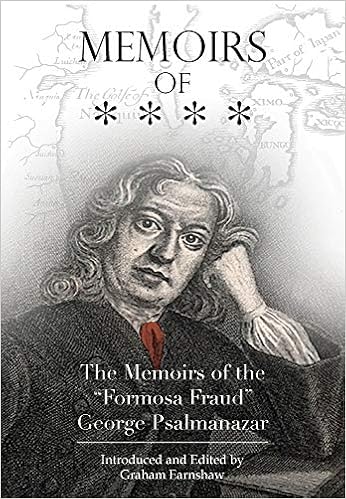
Review: Memoirs of XXX by George Psalmanazar (Part Two: Descent into Grub Street)


When we last left George Psalmanazar, he’d been discovered by a shady Scottish clergyman who’d coached him in how to keeping his story straight, baptised him into the Church of England and declared to British society that he was a Formosan. 


It’s not that Psalmanazar was completely believed, there were numerous debates. One was at the Royal Society where Edmund Halley tripped Psalmanazar up with facts and logic, asking him a question about how the stars would look and pointing out that Psalmanazar’s answer couldn’t be the case. However, Psalmanazar was a great improvisor by now and said that in his part of Formosa, the people lived underground and saw the stars through angled chimneys that changed the view. This claim about living underground also explained why he was pale with blonde hair, only poor Formosans lived outside and tanned. One of the biggest doubters was a French Jesuit who’d been to Japan and people were more invested in not believing the Jesuit than they were to doubt the Formosan. 


Psalmanazar was also helped in his deception by the truly peculiar accent he’d picked up in his travels, which made him sound like he was from anywhere and nowhere. Another help was Psalmanazar’s invented Formosan language, which he’d become very fluent in, translating the Anglican Book of Common Prayer into it to present to the Bishop of London. It’s since been lost and if anyone has the patience and know-how, it’d be a great thing to forge a copy. I’d love a furore about a forged copy of a fraudulent document, it’d be great.


Another factor that helped Psalmanazar’s deception was the fact that there was no greater purpose behind it. He wasn’t a deep-cover operative for the Catholic church designed to make the Anglicans look silly, nor was he connected or supported to any other cause. He was simply an imaginative young man who, through a series of daft circumstances, found himself trapped in the persona of an exotic traveller and newly Christian convert. He says that he already felt things had got too far at this point but he was too deep into the deception to back out. 


One of the rules he set himself was to never change anything he’d previously stated about his past or his supposed country of origin. For this reason, he’d now established that most Formosans lived underground where they were naked except for a gold plate over their genitals, that the men were polygamous and the husband was allowed to eat wives that strayed. He also found himself committed to the ‘fact’ that Formosans committed a great deal of human sacrifice. So much sacrifice that the more canny mathematicians in the audience wondered how the population grew at all, leading to more claims about the fecundity of Formosan women. These tales eventually went into his book An Historical and Geographical Description of Formosa, an Island subject to the Emperor of Japan which he wrote in Cambridge whilst supposedly preparing a course in Formosan language for future missionaries. Even there he added more deceptions, sleeping with his candles burning so it looked like he worked all night as well as all day. Later in his life, he was glad that the stories he’d constructed were so ludicrous as it would make them more obviously false to future readers.


The book was a success, running two editions quite quickly, but Psalmanazar didn’t get rich off it. As interest in him waned, he tried to patent a white form of the black lacquer known as Japan-ware but it didn’t sell. He also took to painting fans with fake Formosan scenes but they didn’t take off either. This was his dark times where nothing went right for him and. “I seldom failed at reaping some pungent shame, mortification, or disgrace, where I expected approbation and applause,” - we’ve all been there. In the end he descended into the anonymous depths of being a Grub Street hack.


I imagine most readers find the end of this book ‘the boring bit’ but for someone with an interest in the lives of Grub Street, I actually found it the most fascinating part of the book. Psalmanazar, always interested in languages, taught himself Hebrew, partly by hanging around East London synagogues. He wrote a tragi-comic play in Hebrew which, unsurprisingly, didn’t do very well. Later he wrote a sequel to Pamela and sent it to Richardson who described it as, ‘ridiculous and improbable’. (I imagine it’d have been very entertaining though).


Psalmanazar took part in a number of larger projects, including  A General History of Printing and a number of chapters for A Complete System of Geography, where he wrote about the real Formosa and, for the first time, admitted his fraud in print. The last twenty pages of the book are about his involvement in the Universal History, a huge multi-author attempt to write a history of everywhere, everywhen. We get as real sense of the bickering and in-fighting that went into a project like this, and a real sense of what it was to be a Grub Street hack, slaving everyday on one of the many big anthologies that were the key staple for many writers. Psalmanazar was given a number of chunks to write but his biggest, and the work he was proudest of, was his history of the Jewish people. Presumably he was chosen because he could read Hebrew. Unlike other writers on the project who were late with deadlines or didn’t do the research, he wrote his chapters on time and with great diligence. Also, unlike the writer of the Roman sections, he didn’t try and take up more than his space. Psalmanazar is polite about his colleagues but it’s clear that whoever wrote the Roman sections really pissed him off. For the first part, the un-named writer clearly thought his topic the prestigious section of the book and handed in too much, at the detriment to the other sections. For the second, the writers had made an agreement that where a conflict happens, the history of that conflict would be written by the person writing the history of the location of that conflict. The Roman writer ignored this, butting his elbows into the other people’s history when the Romans invaded and, in the case of the Jewish Wars, doing it half-arsedly.


The book then cuts off at the end of this section without a conclusion, I imagine he died before he could finish it.


I read these memoirs expecting to find a cheeky little trickster who enjoyed his scam and had lots of fun, instead I found a man deeply sorry for his imposture and deeply driven by a religious need to atone for that. The book has a heavily moral tone throughout but it comes across as deeply felt, this is no ‘sorry/not-sorry’ type of books but a true confession of a man who, I think, didn’t do much that was wrong. His life could be seen as one with the high-point of his entrance into England and a slow decline after but that’s not how it seems reading him. He talks about his Hebrew studies like a giddy fan, delighted in the new vistas of knowledge opening to him and about his hack writing as a good piece of solid work he can be proud of. He’s far prouder of his Jewish history than his fake Formosan one and if he did suffer from hunger and discomfort in his Grub Street years, his long life and positive attitude did not show it. He seems happiest as an anonymous yet diligent writer and that’s quite cheering.


Next week I want to talk about his connection with Samuel Johnson.


Wednesday, 6 April 2022

Review: Memoirs of XXX by George Psalmanazar (Part One: The Road to Britain)


I first heard of George Psalmanazar the same place I heard of Robert ‘Romeo’ Coates and William McGonagall, Banvard’s Folly by Paul Collins. I was also aware that the young Samuel Johnson was friends with him during Johnson’s Grub Street years. My interest in him was re-ignited when I read a number of books and saw the film about Princess Caraboo - both were claimed to be foreigners from distant lands and both created their own distinct writing styles and languages to convince others of their foreignness. The main difference was, Psalmanazar wrote his own confession.


The book starts with Psalmanazar’s will, where he entrusted his executors with a number of papers, some work on the Hebrew language and his memoir. He hopes the publication of the papers will pay off any remaining debts and also the cheapest funeral possible, desiring to be buried in ‘the common burying ground, and there interred in some obscure corner of it’, ‘performed in the lowest and cheapest manner’ and without a coffin. These instructions may be reflective of his financial situation, his guilt over his imposture or even for a slightly more ghoulish reason. Before this quiet burial he wishes that his body be ‘kept so long above ground, for as long as decency or conveniency will permit’, in other words, till he is not fresh enough to be taken by bodysnatchers. The formally famous Formosan fraud may well have been a tempting proposition to a resurrection man and keeping the body out for a while before dumping it quietly and unmarked in a common grave may have been the best preventative.


The work proper starts with a lengthy preface, which I imagine is often skipped over but I found a fascinating piece in itself. What starts as an account of his state of mind in beginning his memoirs becomes a sermon about the possibility of repentance and change. These ideas feel honest and are beautifully expressed, it seems he felt real shame for his lies and that they’d been eating him up inside his whole life. One of the reasons he wanted the memoirs published posthumously was the embarrassment of admitting that he’d lied about who he was and been believed by some truly good people whom he couldn’t face. He seems more repentant than his acts really deserve, as most of the public would have either forgotten about him or remembered the brief Formosa craze as a fun memory.


It’s also in the preface where he talks about his drug addiction. That he first took Laudanum to look cool and debonair, finding that he was pretty resistant to its more pernicious effects. When asked about his habit in the past, he’d recommended taking it with orange juice, having heard that the acid dialled down the mania but maintained the high. He recounts how he tried to go cold-turkey, which was okay in the summer but he found hard in the winter. In the end he settled on twelve drops (just under a grain of opium) in a mug of punch at the end of a long day writing. He claimed this not only kept him going but may be responsible for his good health, after all, he did die at the age of eighty-four.


Psalmanazar fails to give the main details of his life in the memoirs. He never says exactly where he was born and grew up (though it’s supposed somewhere in the Gascon region of France) or what is actual name is. He says this is so that his family would never have to hear of his shame. He does say that his father was of a noble family that had lost its fortune and had gone to Germany to seek work while he stayed at home with his mother. 


A bright child, Psalmanazar took to Latin very quickly and was soon at the top of the top class, outperforming students twice his age. Given this aptitude, his mother sought places to further his education. The first was in a private school where the tutor was very knowledgeable about logic but found it harder to lecture on metaphysics or ethics. However, the tutor was really taken by the young prodigy and signed papers to say he had passed the courses, which allowed him to go to university at the age of sixteen. University was very different and there were no allowances given to his youth or the gaps in his knowledge, which made him give up on them. His later self declares that he was lazy and proud, the two faults which were to drive his life. Even at this later date, he mainly blames the teachers and institutions he fell into for not helping or inspiring him to do better - which to be fair is pretty much my feelings about my own university experience. (Though I am aware that this is quite a childish notion for both Psalmanazar and I to have held, if we had both been less lazy or proud, we could have worked harder).


Psalmanazar wanted to return home but was in no financial state to do so. He hit upon the idea of playing a pilgrim, stealing a staff and cape from a church and forging a document that said he was an Irishman on his way to Rome. He then specifically begged clergymen and monks in Latin, telling of the persecution he endured back in the home country. By doing this, he managed to get back home and then, on his mother’s recommendation, to go all the way to Germany to see if his father could help him. Unfortunately, his father was in no real state to lend any assistance but advice, telling him to go to Holland, where his skill with Latin would open tutoring jobs. Having a few near misses with his Irish persona, he altered the document to say he was Japanese and then created his own constructed alphabet, which he grew very fluent in. 


His journeys didn’t turn out as he wished and Psalmanazar found himself in military service, though never in active duty. He noted the rowdiness of the soldiers, was horrified at their swearing, drunkenness and assignations with prostitutes. For a while he kept the lie that he was a converted Japanese person but began to have more fun pretending he was not a christian. He claimed to worship the sun and even wrote a whole prayerbook in his invented language. The joke for him was that despite being a ‘heathen’, he lead a more Godly life than the christians around him, he also enjoyed it when clergymen tried to convert him as his previous studies allowed him to walk theological rings around them.


One such clergyman was Alexander Innes, a Scottish padre attached to a Dutch legion. Rather than try to convert Psalmanazar, he got him to translate the same part of Horace into his fake language twice. When these two ‘translations’ were obviously different, he didn’t immediately expose Psalmanazar but told him to be more careful. The two constructed a plan to ‘covert’ and baptise Psalmanazar into the Anglican faith and to use this as a way into British society. Thus Psalmanazar was given the first name George and his nationality became Formosan (from Taiwan) as it was an even harder place to disprove.


In part two, Psalmanazar's adventures in England


Wednesday, 30 March 2022

Review: The Pantomime Life of Joseph Grimaldi by Andrew McConnell Stott


Andrew McConnell Stott starts The Pantomime Life of Joseph Grimaldi a little inauspiciously. He attends a church service held by clowns every February and concludes that he doesn’t really like clowns and finds them drab and uncanny. Luckily for the reader, this dislike doesn’t translate into what is a fascinating history of Joseph ‘Joey’ Grimaldi, the ur-clown. Even more lucky for this reader is that Joey wasn’t a Victorian figure, he was a late-eighteenth century/ Regency figure, ensuring that his story is filled with larger than life characters, improbable events and sheer fun. 


It doesn’t start fun though. Joey’s father, also called Joseph is a true monster of a person. Descended from a long line of performing Grimaldis, including ‘Iron Leg’ Grimaldi who caused an international incident when he vaulted from a stage into a box and accidentally broke a chandelier over a visiting dignitary, the young Joey had a lot to live up to and his dad made sure he did by using terror as his chief encouragement. The older Joseph was also a choreographer in Drury Lane which gave him access to lots of pre-pubescent girls he forced himself on, including Joey’s mother. The older Joseph locked children in cages when they got their steps wrong as well as beating them, that young Joey was a prodigy in clowning was not really an option for him. (Interestingly, one of the father and son’s early acts involved older Joseph comically beating Joey and swinging around by a chain - an act very close to one that young Buster Keaton had with his own dad. Though Buster claimed he loved every minute). Old Joseph was also a creepily morbid person, pretending to lay dead to see the reactions of his sons, leaving tuppence to the children who had disappointed him, and including a stipulation in his will that his daughter should cut his head off to ensure he was dead before being buried.


When old Joseph finally did leave this mortal coil, young Joey could really begin to make his own way. He secured contracts in Drury Lane and the summer season of Sadler’s Wells and married a woman he was besotted by after an awkward romance. She died only a year later and although Joey did remarry, it seemed to be out of gratitude to a nurse then love to a wife. On stage he was a star, possessing a comic talent that everyone seemed to recognise but no-one could explain, off stage he was a depressive, convinced that any good part of his life would have to be paid for somehow.


With daring and creative show-writers he changed the character of clown, adding the now recognisable make up and costume. He was a huge success, replicated in china, in print and in imitation. Navigating the tricky politics of regency theatre he played stints at all the main theatres, running from one to another to play two houses a night. All this took a heavy toll on his body, notwithstanding accidents (of which there were many, including accidentally shooting himself in the foot with a prop gun), his act was punishing and he was crippled by his mid-forties. Left to the mercies of theatrical charities and well-wishers, he had hope in his son, another promising clown. However, that son, JS was haunted by the ghost of his father’s act, he was always good but never quite as good. He fell into drink, drugs and epileptic fits which started after he fought a policeman and was hit on the head with a truncheon. He died before Joey, while getting ready for a performance, possibly poisoned by a jealous husband. A truly pathetic story tells of Joey and his wife Mary agreeing to kill themselves, taking pills and laying on the bed asking each other if they were dead yet. They didn’t need to try, they both died shortly after.


After a story so grim, how could I describe this book as sheer fun? The fact is, that although this is a biography of Joseph ‘Joey’ Grimaldi, he often fades into the background. His wishes and aims, a comfortable and stable family life and a successful career based on hard work, were simply more pedestrian than many of the exaggerated events and people around him.


There’s the tale of Sadler’s Wells, a theatre whose USP was a free pint of port with every ticket, which later redirected a river to make a huge water tub in which they held ‘aqua-dramas’. These including miniature recreations of naval battles with children manning scaled down man o’ wars, or melodramas where drowning children were saved by ‘Carlo, the Wonderdog’. There was also the dog ‘Moustache’, who was dressed in military uniform and led dog armies in battle recreations. Incidentally, Sadler’s Wells had a backstage code of conduct that included a fine for farting.


Other near-unbelievable stories include the one about the French clown who single-handedly sailed a ship through a storm from Ireland when the sailors all gave up, or the strong-man who became the British Museum’s main agent in Egypt, stealing all the treasures for them. Not to mention the circus proprietor who was on the wrong side of the channel during the French Revolution, escaped prison by swimming down the Seine and retired back to England where he wrote poetry about how much he hated his wife and kids. Or the story of William Betty, the twelve year old boy who became a huge star for a year playing leading Shakespeare roles in adult companies, including Macbeth and Richard III - a career which lessoned off after his voice broke. Even the relatively staid Joey and wife, Mary, found themselves being wined and dined by highwaymen posing as rich theatre fans.


There’s a lot more, this is a packed book and surprisingly, it all hangs together very well. It also explains what the original pantomime actual was and makes an attempt to explain what made Joey such a star. 


The pantomime was a form of afterpiece played after the main performance and originally based on Italian commedia dell’arte, though it had been going its own direction for some time. In a pantomime, the audience were given a situation, usually from folk-tale, though it could be inspired by other stories and even topical happenings. The characters had large immobile masks on during this part. Then, one of characters is given a magic sword (the original slap-stick) and the masks are taken off, revealing the four main characters to be one of four stock figures (This is when the Clown usually said ‘here we are again’.. meaning back as these stock figures. A catchphrase later associated with Dan Leno). The stock figures were; Harlequin, originally a trickster but increasingly a lover, Colombine, his beloved and Pantaloon, the old father/rival lover of Colombine. Finally there was Clown, a country rustic who worked for Pantaloon. This part of the pantomime was called the Harlequinade and it sounds nuts. Harlequin uses his magic wand to transform items to create chaos and outwit his rivals to Colombine.


Joey’s big revolution was to detach Clown from the country bumpkin servant role, to make him colourful and otherworldly and make him a figure of pure chaos, as unhelpful to Pantaloon as anyone else. Another skill Joey had was to perform slowly and carefully, with a wide-eyed, childish innocence. Some of his gags of transformation reminded me of Chaplin, who could transform shoes into a delicacy. In one pantomime, Joey made a snowman figure out of vegetables that then tried to box him with turnip hands - I’d love to have seen that.


McConnell Stott has a real skill at describing the ludicrous without losing the general plot of things, which makes me really excited that he wrote a book about Garrick’s Shakespeare Jubilee - I think he’d handle that story very well.


Wednesday, 23 March 2022

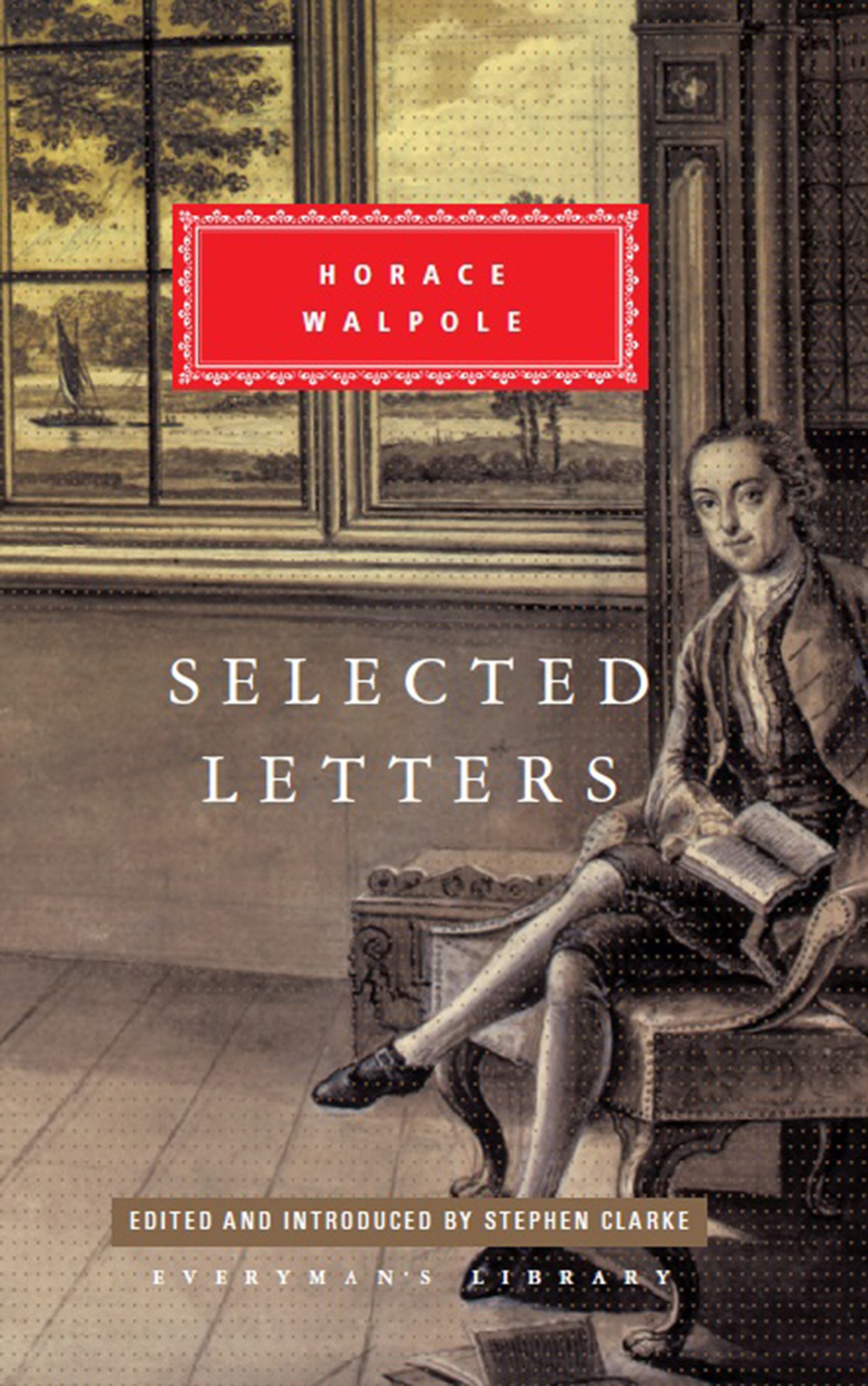
More Personal Thoughts on Horace Walpole's Selected Letters


While we had an interesting and full discussion of Horace Walpole, Selected Letters with the Dr Johnson Reading Circle, we were only led to read a certain amount of the letters whereas I read all the ones in the selection.


One of the sections we weren’t required (though were suggested) to read was entitled ‘His Literary Criticism’. This was the section where Horace Walpole opined his opinions of modern literary figures in his letters. It is no secret that Walpole was not a fan of Johnson, describing his prose as ‘teeth crunching’ but in this section he goes fully into his dislike of our dear Sammy J. He says that his Journey to the Western Islands is ‘a heap of words to describe very little’. He describes Johnson as a ‘babbling old woman’ who ‘marshals words ridiculously’ and compares Johnson’s own elevated style to the failed elevation of Samuel ‘Maggoty’ Johnson in his surprise hit Hurlothrumbo (which I have talked about in this blog). Indeed, Walpole made ‘a conscience of not buying’ the selections of poetry that included Johnson’s Lives, as he was not interested, and not convinced by what he would say, particularly about his dear friend Thomas Gray. 


it may be expected that I might be outraged or dismayed by Walpole’s lack of appreciation for Johnson as a writer, but I am not. For one thing, I am pleased and encouraged by Walpole’s understanding of Johnson’s character; “Although he was good-natured at bottom, he was ill-natured at top.” This is an insight which explains a lot of many of Johnson’s seemingly crass statements with his altruistic actions. I’m also delighted to see someone with a different opinion of Johnson’s writing. Now, we live in a time where Johnson and his writings are established part of the canon of literature and are regarded as pure truth by some people. I love to see someone from the period who is less than convinced, who provides a dissenting voice.


Walpole also provides a dissenting voice on the genius of the actor, David Garrick. Johnson himself criticises Garrick for being only an actor and for overstepping his bounds, especially during the ill-fated Shakespeare Jubilee, but Johnson felt he was the only person qualified to criticise Garrick as they were old friends and former teacher and pupil. Walpole reveals that he didn’t find Garrick’s acting all that. He liked him in some roles, some he was less praised for but found him a ‘jackanapes’ who didn’t pull off high status roles as completely as others thought. It’s lovely to see a contemporary opinion differing from the majority. He was also a big fan of the actress Mrs Pritchard, who played the main role in Johnson’s play Irene and who Johnson thought wasn’t all that good. The fact is that when a work of art comes out, especially a popular or relatively mass-media one, the reaction isn’t homogenous even if later reputation is.


His, slightly distant, view of Goldsmith is also interesting. it seems he appreciated Goldsmith’s writing most out of all of Johnson’s circle and it makes sense. Goldsmith had the most self-consciously smooth and polished style of them all. He reports on Goldsmith’s reputation as someone with ‘parts but little common sense’. Yet, Walpole is distressed at Goldsmith’s death and sees the whole Johnson set as abandoning him, that; “His numerous friends neglected him at last, as if they had no business with him when he was too serious to laugh.” Weirdly, he thought Goldsmith could have saved himself with even more of the James’s Powders that killed him.


I also loved how Walpole regarded Boswell as a strange little leech who forced himself on anybody famous and described him the ‘quintessence of busybodies’. This quintessence would lead Boswell to create a truly remarkable biography but I am always here for a little Boswell bashing.


One thing Johnson and Walpole agreed on was The Life and Opinions of Tristram Shandy, Gentleman by Laurence Sterne. Johnson thought the book was too strange to last, Walpole felt it was a fun notion to play around with in the pub but wasn’t a premise any sane man would write.


Finally, one of the things that most struck me about Walpole’s Letters was that I was reading a text that completely supported the action of Robert Walpole. The man who Eovaai cast as an evil wizard, enchanting the royal family and turning spurned lovers into baboons to be sexually tortured, who The Beggar’s Opera cast as an evil Jonathan Wilde figure, who countless eighteenth century texts cast as a money-grubbing, corrupt villain, is here, a good guy. In some ways this isn’t surprising, Horace was his son after all but in these letters he is always held up as a figure of wisdom and restraint. Horace makes repeated mention that in his father’s control of the country, the United Kingdom had a twenty-year period of economic growth, political stability and no war. One of Robert Walpole’s first acts was to end a war on a less-than generous treaty and he kept the country out of war his whole time as Prime Minister. as soon as he was engineered into retirement the country entered the Seven Years War, shortly afterwards the War of American Rebellion and then the Peninsular/Napoleonic Wars. As odd as it seems to have this notion of Robert Walpole, good statesman, Horace does make a fair argument for the stability and prosperity of his time.


Indeed, for me as a personal reader of the letters, I found they were most interesting when they presented opinions and points of view that don’t match the received wisdom we have now. Of course there were varying opinion at the time, it’s the same today, and it’s good to have them recorded. I’m still not sure Walpole would have been very fond of poor old me, however.


Wednesday, 16 March 2022

Horace Walpole's Selected Letters at the Dr Johnson's Reading Circle


 The Dr Johnson Reading Circle bundled back into the house again to talk about Horace Walpole’s Selected Letters, edited by Stephen Clarke. Walpole could reasonably be described as a keen letter writer, with his full epistolary output running to forty-eight volumes. Even with a selection of only five percent of his total letters, this book is a six-hundred page beast. Luckily we had Peter Sabor, editor of Walpole’s Critical Heritage to help us navigate the life and letters.


Horace Walpole was the son of ‘Prime-Minister’ Robert Walpole and a member of parliament for twenty years. As well as socialising in political and court circles, he collected antiquities and created his own dream castle in Strawberry Hill where he published his own works, including The Castle of Otranto and the works of friends like the poet, Thomas Gray. He maintained a number of relationships by letter, including one to Horace Mann, a diplomat in Italy, for over forty years. The letters in the selection cover topics as diverse as the Gordon Riots, the death of George II, political upheaval during the American War of Independence, the joy of rooting around old churches, experiments in interior design and nights out at Vauxhall Gardens.


An interesting area of discussion was about how far the letters were written to be performance pieces and how far they were personal communications. Walpole certainly asked for some of his letters back to make copies and the more news-based ones have a journalistic quality that beg to be shared. It’s interesting to compare his descriptions of life in George III’s court to Frances Burney’s. She, being short sighted and deeply introspective dwells upon her own feelings of awkwardness but Walpole, much more at home in such settings can dwell on the details - he takes an especial pleasure in describing the women’s dresses and hats. Even in his more intimate letters he seems to be a man constructing himself by words, and it’s really interesting to see how his image of himself changes as he gets older. 


He begins as the Eton schoolboy, sporting the nickname ‘Tydeus’, a brain-eating character from Greek mythology. As the son of the British Prime-Minister, he brashly took his Grand Tour with schoolfriend Gray until they had a falling out. When he grew older, he seemed to have mellowed, making jokes about being a mediocrity, dabbling in his hobbies (if starting a craze for Gothic architecture, giving birth to Gothic literature and accumulating a sizeable collection of arts and antiquities counts as dabbling) and attending too many social functions. Leaving middle-age, many of his letters talk about how shocking it is that someone of his esteemed years can keep the extreme hours of the partying set, before reaching old age and hobbling around with gout. Throughout it all, he maintains a playful, charming, and straightforward demeanour, whether it’s talking issues of national importance or about bickering in the corridors of power.


It’s amazing that he maintained so many relationships for so many years. While he clearly had a sharp tongue and was prepared to hold a grudge along political lines, once Horace Walpole was a friend, he was one for life. His letters are adapted to his recipients. Those to Hannah Moore are full of compliments mixed with over-the-top references to her piety and saintliness. George Montagu was given society news and court gossip, though when he lazily didn’t reply to his letters the correspondence drifted to the Lady Ossory. Horace Mann received personalised newspapers of British political life, while Revd Cole had news about antiquities and new methods to relieve gout. The most personal letters probably went to Henry Conway, whom Walpole said he loved and offered significant financial aid to at various points of his life.


Of interest to the Johnson Reading Circle was Walpole’s relationship to Johnson himself, or rather, his lack of it. Although they certainly moved in different circles; Walpole was located around court and parliament in the West of London, while Johnson was located in the City, they had many friends in common. Not only Hannah Moore, a frequent correspondent of Walpole, but Topham Beauclerk, a member of The Club whose wife gave her name to the conical tower in Strawberry Hill. The two, however, did not write and possibly never even spoke and if they did, would probably not have hit it off. Walpole regarded Johnson’s writing as ‘teeth breaking’, and while they agreed that slavery was an evil, they would have clashed on almost any other political discussion, particularly the American Revolutionary War, which Walpole saw as a fair reaction to Britain’s heavy-handed treatment, Johnson saw as a hypocritical ‘yelp’ for liberty.


The Reading Circle could have spent many more hours discussing the nuances of Walpole within his letters, and the sheer variety of subject and incident but time was ticking and the local pizza place is on reduced hours, so we had to break our meeting, still brimming with wine and thoughts. It was a delight to be in the house, a delight to have a number of new members, a delight to see each other in person and a delight spend some time with Horace Walpole. 


Wednesday, 9 March 2022

Review: The Secret History of Mama Oello


 My copy of Eliza Haywood’s The Adventures of Eovaai contained a number of extra texts, including an anonymous novella from 1733 called The Secret History of Mama Oello. The titular Mama Oello is not a mama in any sense, she’s a Peruvian princess who is beset by a corrupt politician to marry an hideous man for political reasons rather than the one she’s given her heart to. The book finishes before the problem is resolved but promises more which never came.


Like The Adventures of Eovaai, The Secret History of Mama Oello is another disguised history, using a very thinly drawn veil of Peruvian-ness to hide itself from libel laws much as Samuel Johnson’s parliamentary reports were pitched as the reports of a Lilliputian parliament, rather than the British one. Published in a separate volume was Loque Yapanqui, which promised to be a key to unravelling this text.


The plot is simple, Mama Oella is a princess, the daughter of the chief Manco Capec who is in love with an unnamed Cacique, or Lord. However, his advisors (or Curacas), especially the sly and conniving Curaca Robilda force the chief to make her marry Atabalipa, the prince of Quito. This prince has a reputation for being a decent-enough person but he is deformed and ugly. What’s more, he doesn’t seem that into it, deigning to send a proxy to marry her and even being slow about that. This gives her the chance to snatch stolen moments with her favourite in a garden and to exchange love poems whilst pining for her fate.  At the end of the text, she hears that Atabalipa himself is on the way to marry her and should land within a month and she curses Curaca Robilda as the ‘Author of he Misfortunes’.


It’s not hard to guess who Curaca Robilda is, the corrupt advisor who twist the King and Queen to his will and lines his own pockets, he’s our old friend Robert Walpole. He’s not a wizard in this book and he turns no-one into a monkey, indeed he’s a character the reader barely meets but who has tendrils everywhere and power over everyone.


Mama Oella herself is Anne, the daughter of George I who was first proposed as wife to Louis XV of France but issues of religion complicated things and she was eventually married to William of Orange, who suffered from a spinal deformity. The suggestion in this book is that Anne was already in love with another (suggested in the key as Lord Carmichael, the first Earl of Hyndford) and that they continued a connection as the preparations for the wedding dragged on. It could be that is book is a hot piece of secret knowledge, or merely baseless court gossip. Certainly, the writer wasn’t attached enough to their convictions to carry on the work and portray the wedding. Nor is there any other source suggesting a relationship between Anne and Lord Carmichael. Indeed, Anne is reported to be very keen on getting married after her first near miss with Louis XV, declaring to her brother she’d be happy to marry a baboon than not marry at all. By most accounts the wedding was a success, with a Handel hymn using lyrics written by Anne herself. Though not liked by the Dutch, it seems Anne had a pretty good marriage as well, with warm letters existing between her and her husband. If there is a basis of truth in this story, it was a passing fancy rather than an eternal love.


This is a very badly written book, or at least a hastily written one. It falls easily into melodramatic cliché, full of ‘deluges’ of tears and cries of ‘oh ye Gods’. The book also features some torturous metaphors, particularly one about the Cacique and Mama Oello’s relationship being in calm still waters but now the ‘storm clouds rage’. At another point, Mama Oello declares she’d rather have been a shepherdess than princess. My personal favourite moment in the book is when the Cacique sees her after a while and declares his love by, “seizing her fair hand and throwing himself down at her feet”, which put me in mind of a judo move more than anything else. Also, the conceit that the book is taking place in Peru is only held up by the made-up names, job titles and references to God as Pacha Camac. It does lead to a very funny line referencing the navies of the English and the Dutch as those ‘terrible canoes’.


This book is ultimately a rushed job, hurried out anonymously to capitalise on a scandal that probably didn’t even take place - in other words, it’s a very typical Grub Street production and I’m under no delusion that I’d have been writing anything better were I writing at the time.


Wednesday, 2 March 2022

Review: The Adventures of Eovaai by Eliza Haywood


 The Adventures of Eovaai immediately caught my attention by being one of the stranger titled works of one of my favourite eighteenth century authors, Eliza Haywood, someone who writes with a strange, over the top quality in itself. It’s a weird blend of fantasy, political satire and amatory novel which I found less consistently enjoyable than other works but it had its moments.


The book was initially published anonymously despite Haywood being a big name, presumably to aid the pretence that this is the work of a translator, bringing a work that has been long studied in China and which took place before the Garden of Eden. The second edition, which came out four years later, has her name on the cover. It may also be that publishing this book anonymously was a way to avoid the consequences of a story which casts the famously litigious ‘prime minister’ of the country as the villain.


Eovaai is a princess who has been raised to be a fair and compassionate ruler. When her father dies, he gives her a magic jewel which keeps both the kingdom and ruler safe. The jewel is kept safe by being set in a necklace but interested in an inscription on the other side, she proses it out where it is promptly stolen by a bird. Being the Queen who lost the jewel, her authority is diminished and the country descends into civil war, not only that but she is not personally protected and is easily taken by the wizard Ochihatou.


If the fact that Ochihatou was the sole/prime minister of a neighbouring country doesn’t ring Robert Walpole alarms, the fact that the first sentence about him describes him as ‘The Great Man’ should. The word ‘great’ was long established as describing Walpole by this point and would be the whole crux of Fielding’s later novel Jonathan Wild, in which the main joke is that greatness is the enemy of goodness. Haywood, not the subtlest of writers, makes her Walpole stand-in, Ochihatou, truly odious. He is ugly, bent and deformed but uses his nefarious magic to create what Doctor Who would describe as a perception filter around him. Using this borrowed stateliness and charm he worms into the King of Hyptofa’s court and bewitches him with a magic feather. Thus in power he lines his own pockets with unfair taxes, creates a standing army to strong-arm opponents and fills all key roles with family and sycophants - all things Walpole’s enemies accused him of. He even almost manages to seduce Eovaai but is interrupted by court business.


At this point the book is interrupted by the story of Yximilla, and here I think it becomes very clear how much fun Haywood is having naming her distant countries and people. Yximilla is a queen in love with the noble Yamatalallabec (the best name in the book) but the evil Boscomon, king of a small principality, has teamed up with the ferocious queen Tygrinonniple to invade Yximilla’s country of Ginksy, force her to marry him and rule together. Yximilla calls on Osiphronoropho, the King of Fayoul to help her but he is too far away to launch an immediate campaign. From this paragraph alone, I think it’s clear how the names, while fun really do send the reader’s eyes swimming and the complex war/political story that plays out with them in not helped by that fact. It’s not a happy ending for Yximilla, she is captured, drugged and dragged to the altar where she is forced to marry - ending any hope for her and ending the little interlude.


Ochichatou has been called to court to advise on what his country should do about the situation and when he returns, Eovaai has escaped by being whisked away by a good spirit. She finds herself still in the land of Hypotofa and sees how ruined it has become by Ochihatou’s bad management. Then she enters the stronghold of the resistance and hears a long speech by the leader of the patriots. Not so incidentally, the Patriots were the name the anti-Walpole resistance gave themselves and the speech is essentially an article by their leader, Bolingbroke. She escapes to the safer country of Oozof, which is a republic and is ranted at again, this time about the benefits of republics over monarchies. These parts were the draggier parts of the novel, being largely undigested political speeches.


However, the action ramps up again after Eovaai is kidnapped from Oozof and brought back to Ochihatou’s love pad. There she sees a monkey who hands her a tablet with some words on, these words turn her into a human and we hear her story. The monkey used to be a woman called Atamadoul and she was the maid of a beautiful princess that Ochihatou wanted to marry. Unfortunately for the Big O, the princesses parents wouldn’t allow it but Atamadoul the maid was in love and disguised herself as the princess to make a midnight flit. While disguised Ochihatou put a ring on her finger which would magically force her to lust over him constantly and away they flew. However, when they got back to Ochihatou’s love pad, he realised that she was someone else and was so furious he changed her into a monkey. Even crueller, he chained her to the wall of his love pad so she would be forced to watch him having sex with other people, the ring of lust making it even more torture to see. Most cruelly, he occasionally torments her with a horny baboon who he allows to almost rape her and says he’ll let it go all the way one day. Utterly horrifying and peculiar, you never know where you’ll end up with when Eliza Haywood goes full excess. Atamadoul has a plan, when Ochihatou returns to have his evil way, request the light is off, place her in human mode and let her take Eovaai’s place on the bed. They carry out this plan, of course Eovaai watches but then the light is turned on and Ochihatou sees the trick. Poor Atamadoul is turned into a rat this time and we don’t see her again.


However, the light has been turned on because the patriots are storming his house and he grabs Eovaai and runs off to a safe country with a sob tale about the evil patriots trying to kill their king. This ruse lasts a little while but the wizard is rumbled again and decides to whisk Eovaai back to her home country where he can marry her and run her land for his pleasure and gain. Weirdly, despite the magical flying crystals, the chariots pulled by doves and antelopes, Ochihatou says they only way they can get back is by stripping naked to be changed into birds. This means that when they land if Eovaai’s country they are naked and Ochihatou ties her to a tree by her hair and grabs some stinging nettles to torture her into accepting him.


This is when a hunk comes in and saves her. The hunk has also saved the country from the civil war and is acting as Protector. They fall instantly in love but there’s a hitch, he is only allowed to love the woman who has the case for a sacred jewel he’s found. To no reader’s surprise it turns out to be the sacred jewel from the beginning of the book and Eovaai has the necklace to put it in. They marry, the man is also the prince of Hypotofa so the two countries unite and have a great future. Ochihatou has run into a tree and killed himself by this point.


So, there we have it. Truly one of the stranger works of fiction knocking about and in parts great fun for its shocking nastiness, it’s silly naming and a fairy tale ending. It also has that boring run in the middle though. As such, this is probably the weakest of Eliza Haywood’s books that I have read so far but it is still worth a read just to go on the peculiar and improbable journey.


The introduction makes a lot of points about the footnotes that Haywood uses in the book. How they are a cacophony of voices, from the supposed translator of the book, especially his own views the centuries of scholars who have commentated on the book in China. The translator has a  problem with a particular commentator who interprets the events in the most misogynistic ways and corrects him on a number of points. Although the footnotes were a fun element, I feel that Eliza Haywood could have used them more playfully and added more jokes and tangents, as they were used in Pope’s Dunciad. They weren’t an un-fun addition, but there could have been more.