Sunday, 11 March 2012

Into the Big City and the mysterious pictures.

A few years ago I was in a bad place; between jobs, owing money to everyone and living off five pound a week for travel, food and entertainment. In between being ignored for simple jobs and going to bed early because I was hungry, I looked at advertisements for the ‘arts jobs’ government mailing list. 
One of these was for an interesting web project, and although it was unpaid it offered a share of any profit (and the possibility of a free cup of tea) so I went. What was asked for was 12 episodes with a 4 act structure each, written in the style of a hyper descriptive script. The idea was the reader downloads the script and reads it accompanied by a specially written soundtrack. The idea sounded novel, I had lots of time on my hands and I liked the lady running it. So, I signed up to the project and instantly forgot about it.
So a month later I find myself panicking that I have no idea to show the lady, the night before I get a sudden brainwave and a whole character and situation starts to form in my mind. It starts with the idea of getting some writing use out of all the eighteenth century stuff I had then started reading and developed into a very (very, very, very) rough form of the story that is becoming my next novel, ‘Into the Big City’.
I was on my way to the meeting with the lady and not having anything better to do, made a morning of getting there, wandering around the streets where I was lucky enough to find ten pounds on the floor. I decided to spend the ten pounds on something completely useless for good luck, I decided on a picture and so I went to one of my favourite browsing streets, Cecil Court.
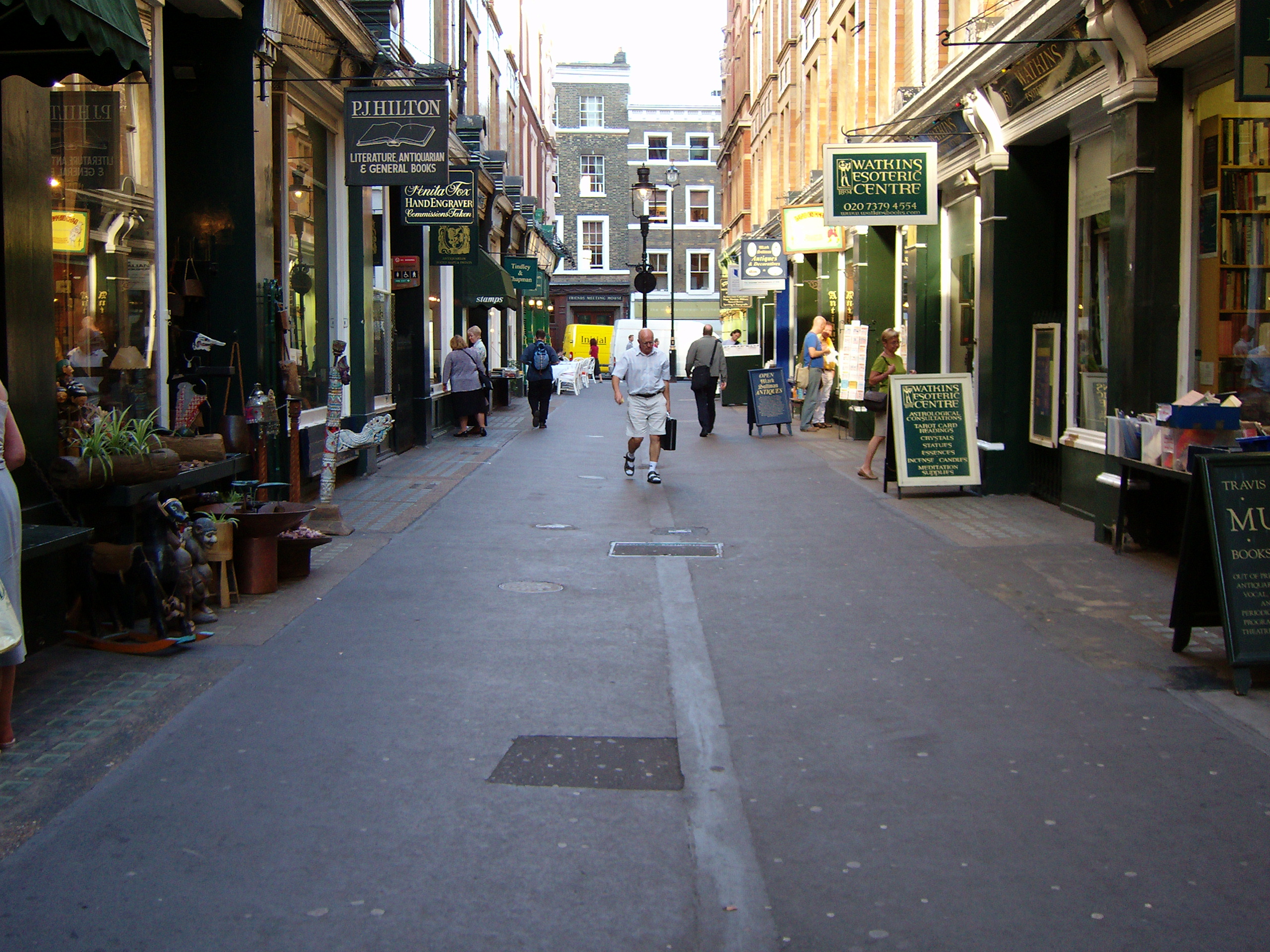

I also went into a shop I have always wanted to buy something from, T. Alena Brett. It is a picturesque shop, covered in piles and piles of old prints and owned by a very eccentric and enthusiastic lady. The shop was her dad’s and she knows all the ins and outs of her stock, never needing to add to it in her whole time there. She is not a fan of browsers but I managed to sneak in and look around.


On a sort of mezzanine/balcony type bit of there was a hand sketch of one of the characters I had written about the night before. As I looked through there was another, and another and some more characters that all looked like they belonged together. I bought as many as I could afford and went to the meeting.
The lady loved the idea and the pictures and I set to writing. Unfortunately, my involvement with the project fizzled out by the third ‘episode’ (as they were called) because I found the style of the hyper-script too strange a medium and the requirements she had for four cliffhangers in 20,000 words to be a little false, but the idea stuck and I knew I would tackle my eighteenth century novel one day. 
Now that day has come, I returned to the shop today and picked up some more of those pictures. They are pencil sketches, on cheap paper and one of them has an address for a French hotel typewritten on the back. Many of the pictures are details of things, but some full characters. The lady at the shop, who knows everything about her stock, knows nothing about the provenance of these pictures. 
In the next few weeks I will post one or two pictures and post a written character sketch of someone from ‘Into the Big City’ to go with it. I will leave my newer purchases till last so the characters can grow around those images. 
So, till then...
Yours


Wednesday, 29 February 2012

Clarissa Big Read, February

February
A short month (as February’s tend to be) but full of interest and all round good stuff.
Richardson really does write up to the moment, and the truth of the moment. The part of the book when Clarissa talks about coming back to her house after a few weeks away to find her reception to be somber, serious and worst of all, formal; really put the shivers down my spine. The scene where it is revealed to her that she is to be married to Solmes was brilliantly observed and described, each character in the room had different emotions, all of them restrained, but at the same time their behaviour showed those emotions. The way Clarissa’s mum shy’s away, the sternness of the father, the way the aunt is trying to use her eyes to apologise, the smugness of brother and sister - each character is there and accurate. The whole scene is full of this reined in, pained and somber in the way serious family conferences tend to be, and we know that it is the start of Clarissa’s nightmares to come.
I am really warming to Clarissa who is proving not to be a one dimensional ‘good’ character but somebody with conflicting and real emotion. Take this expression of defiance for example,

   “They have all an absolute dependence upon what they suppose to be meekness in my temper. But in that they may be mistaken.” When comparing this statement, and Clarissa’s general demeanour in this chapter with someone in a similar position, like Sophia Western, forced to marry Blifil in Tom Jones, it is clear how strong the complex and real nature of Clarissa and her family are. Where Squire Western rants and rails amusingly, and Sophia sobs, cries and then slips out with her maid - the quiet but solid independence of Clarissa, and the icky loading of guilt and pressure from the Harlowe family is a much more realistic portrait of this kind of position.


I also enjoy the attention to emotional detail, as Clarissa becomes more embroiled in whatever schemes are around her, she starts to take more notice in the language people are using to her. Noting down her sister describing her acts as ‘witchcraft’ and repeating phrases the whole family are using to sound as one. There is also the attention to detail as she both hates her brother and sister, tries to excuse their actions and also feels guilty for saying bad things about them. This is especially poignant when she talks about her Mother’s own meekness and wish to avoid confrontation is proving to be one of her biggest betrayals - how the pain of her Mother’s betrayal is compounded by the guilt of believing her Mother could betray her.

Finally, I enjoy how Clarissa can have a sharp pen on her, even if it pains her afterwards. I particularly enjoyed her railing against her ‘Brother’s young man’s wisdom, an plotter without a head, a brother without a heart.”

However, Clarissa’s voice is nothing compared to Anna Howe’s. Miss Howe is a brilliant voice, lively and sparky and self possessed. I love the way she banters with Clarissa, taking the piss and generally speaking plainly. She believes that, “A friendship like ours admits no reserves”, and she is certainly blunt.

First she tells Clarissa that she’s a patsy, “You are so tender of some people, who have no tenderness of anybody but themselves.” She doesn’t hide the fact that she regards Clarissa’s family to be “The absurdist family in England,” and that she has no time for all their machinations. I love how rude she is, saying that nobody could ever love brother James and that sister might have been alright, “Had she been good-natured, as your plump ones generally are.” I thrill to her bitchiness, and the proper and correct tone these characters share, both in light of their individual characters and the closeness of their relationship.

I also love Miss Howe’s self assurance, that she only copes with Hickman because he is polite and knows how to keep his distance and that although her own mother frequently wishes she was as sweetly obliging as Clarissa but that she herself was thankful for her ‘sauciness’ as it meant that she couldn’t be manipulated as Clarissa is.

Finally I like the way she teasingly, but clearly reveals the hints in Clarissa’s letter that reveal that she might indeed have a soft spot for Lovelace which could grow...much to the family’s displeasure.

yours


Check everyone else's ideas here

Saturday, 11 February 2012

‘The Memoirs of Martinus Scriblerus' Review.


The trouble with reading a breeze block of a book the size of ‘Clarissa’ is that you miss the satisfaction of getting to the end. To combat this I decided to read ‘The Memoirs of Martinus Scriblerus’, a work by members of the Scriblerus club that included Gay, Swift, Pope and Arbuthnot as members. I was lucky in that I got to enjoy an amusing and tightly written book but unlucky in that it is an amusing and tightly written unfinished book, and so didn’t get the pleasure of an ending.
The story is framed as memoirs found on the street by an editor who presents them to us. The memoirs detail the birth, life and education of Martinus Scriblerus, an elderly man raised to be a genius and who fulfils that potential and then some - becoming the most learned man in the world.  

Of course, this being a production of the Scriblerus Club, it is primarily concerned with ridiculing the psuedo-learning that was bought and sold in the eighteenth century. Martinus Scriblerus was a character used by the club in other productions, such as Peri Bathous and Dunciad Variorum
The 'Scriblerus' watch, given from Swift to Gay in memory of the club.


The first few chapters detail the birth of Martin in Seven Dials and his early lessons. There is a marked similarity between Cornelius, Martin’s father and Walter, Tristram Shandy’s father in Sterne’s later book. I enjoyed the daft extremes Cornelius goes, like eating only milk and honey for a year before sleeping with his wife in an appropriate time to create his genius.


 We are led through Martin's curriculum, being taken through all the pseudo-knowledge that he was brought up with. I like the chapters with Martin, but those chapters with his playmate, Cambe are extremely tiresome. Crambe is that typical loquacious, facetious and general pain-in-the-arse character who spouts the kind of over-eager linguistic wordplay that can really sink a book. Luckily the chapters are short and Martin soon gets tired of him as well, so we don't see Crambe again.
The book then goes onto a section about Martin’s solo studies. I particularly enjoyed his time as an early psychologist and his discovery that certain attitudes create the strength in certain parts of the muscles and similarly, that exercise of certain muscles creates certain attitudes. One of the examples I most enjoyed was that a hunchback caused by shrugging muscles shows patience and resignation to life and is most often seen in ‘henpecked husbands, Italians and English ministers’. 
This then goes onto a lovely chapter about how he tried to heal a man who loves himself. It’s a brilliant description, how the man loves himself as someone would love a mistress. How he dresses up nice for himself, flirts with himself, defends the honour of himself; even buys himself love gifts. The whole schizophrenic love tryst with himself made me giggle. The cure for this self-love? Smashing his mirrors and any reflective surface while having his friends showing him the ‘extravagance, pride and prodigality’ of his mistress. We never hear whether this cure worked or not. 
In the next few chapters, Martin falls in love himself, with a conjoined twin. The section completely enjoys the absurdities inherent in this situation, rhapsodising about his love.
‘How happy was Martin in that instant, who thought of nothing but leaping into the four soft arms of his mistress.’
There is also a dig at theatrical convention, that the twins are lovesick and are unfortunately ‘deprived the universal relief of a soliloquy’. 
However, the lady is already taken, by the circus keeper who owns her as a freak show. When he creeps into the auditorium to elope with her, he is attacked by a ‘mantiger’, wielding an antelope horn. Then he grabs a unicorn horn to defend himself. There then follows one of the sillier and most enjoyable sword fights I have ever read outside of ‘The Princess Bride’. (There is also the fact that I once had a dream where I had a sword fight against a librarian where she had a huge serrated bread knife and I was waving a narwhal about.)
Eventually, he manages to get married to her, but a rival marries the other twin. We then get a trial where the legality of the marriages are discussed. When this is done, Martin exiles himself away and we get a sum-up of his achievements after. These are just jolly vignettes of wonderfully silly ideas. I particularly enjoyed the one about working out how many people there were in London by counting the turds in the sewers, not including, ‘what is left under dead walls and dry ditches.’ Though my favourite was Scriblerus’s ideas about architecture, that he has a systems of creating buildings that will be beautiful by the time they fall naturally into ruin. 
After these little vignettes, the book just...stops. Having entertained me a good deal but not left with that satisfaction I craved.


Tuesday, 7 February 2012

The Grave of Theodore of Corsica

I recently went on a treasure hunt around Soho and Chinatown, one of the most interesting things I came across was the grave of Theodore of Corsica in the Church of Saint Anne in Soho. Anyone who fancies seeing the grave can wander in before 5pm.

King Theodore was a German nobleman who briefly became King of Corsica and died penniless after declaring himself bankrupt and handing Corsica over to his creditors. All in all, an interesting man then.

His grave was funded by Strawberry Hill man and writer of 'The Castle of Otranto', Horace Walpole, who also wrote the inscription.


"Near this spot is interred Theodore King of Corsica, who died in this parish, December 11, 1756, immediately after leaving the King's Bench prison, by the benefit of the Act of Insolvency, in consequence of which he registered his kingdom of Corsica for the benefit of his creditors:


"The grave, great teacher, to a level brings 
Heroes and beggars, galley slaves and kings! 
But Theodore his moral learn'd ere dead, 
Fate poured its lessons on his living head,
 Bestow'd a kingdom, and deny'd him bread!"


Just one of many interesting things in the area. Chinatown itself is where the Turk's Head tavern was, (the building remains, now a supermarket) as well as Burke's house, and Dryden's. I might do an eighteenth century people/ Chinese food tasting thing at some point... 


Thursday, 2 February 2012

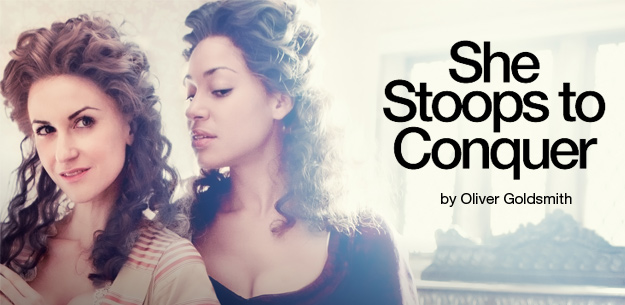
Review: She Stoops to Conquer at the National Theatre 2012


I braved my dislike of the National, namely  that the building is uglier inside than it is outside and I am always getting static electric shocks from every surface and went to pay my respects to Goldy.
I suppose the real test of a good performance is if you feel a driving desire to read the script after the performance, so I suppose the fact that I nearly missed my stop due to reliving the production was a good sign.
The story is a rather typical knockabout. Our hero is Charles Marlow, he is a man who is an energetic roister-doisterer, with a knack for a quick quip - until he talks to a lady of his own class, then he is a stuttering idiot. He and his friend Hastings have gone into the country to meet Kate Hardcastle, the lady his father wants him to marry and he knows he will make a cod’s ear of it.
On the way, he gets lost, and walks into the pub where Tony Lumpkin, Kate’s half-brother, decides to amuse himself by sending the London fops to his father (and Kate’s) house and telling them it’s an inn. The men then behave atrociously to Mr Hardcastle, condescendingly to his wife and Charles flirts with Kate because he thinks she is the barmaid. She is actually rather happy about this, longing to be treated with something other than polite diffidence. After much confusion and silliness, all is sorted out and everyone but the avaricious Mrs Hardcastle ends up happy.
However, this is not just any play, it’s a Goldsmith play and every line is a well oiled and flexible whip of sound with nearly every joke striking as true now as over two hundred years ago. I think it would be hard to perform this play badly, as smoothly written as it is. I have rarely seen a play where I wanted to play every part, even the servants. 
Katherine Kelly played Kate. She is the dutiful daughter, but she crackles with independence and fire, her willingness to play along with Marlow’s delusions, her pleasure in affecting a ‘barmaid’s demeanour’, a part played with extra relish by the actress as she has just finished a several year stint on Coronation Street where she played a barmaid. Yes, she is a dutiful daughter, but she is a dutiful daughter who announces, ‘I considered your commands as my pride; for your kindness is such, that your duty as yet has been my inclination.’ My kind of dutiful.


Marlow was also enjoyably played, his voice reminded me a bit of Hugh Laurie in ‘Blackadder’, he veered between incredible shyness and extreme boldness, depending on who he thought he was talking to. I thought the scene where he shyly tried to talk to Kate when he saw her as a lady of distinction and she had to make up the majority of his half of the conversation was very funny, especially as he was trying to squeeze out the door and she kept calling him back. I think the secret of the character, that whether he is bold or shy, he is a loser. Indeed the more he boasted of his rakish ways, the more un-rock-n-roll he seemed, he was a man waiting, wanting, wishing to be settled down and I think he will make a very pleasant husband. Certainly Kate will be the brains of the outfit.
Marlow’s friend Hastings, was a camper, dandier and more exuberant gentleman. I also enjoyed his performance most, if just because he seemed to be having such a good time. Near the beginning of the play, he and Marlow were chatting and munching fruit, and the splatters from Hasting’s apple hit Marlow in the eye, setting the acting giggling. This was thoroughly in keeping with the character and was very charming. At another point, he comes out into a dark wood to wait for Tony Lumpkin and tells himself that he is an idiot. This line could be a rather bland one, but the pause the actor left in it let the audience laugh their agreement. I also thought the shade of his coat a lovely blue.


Mr Hardcastle was played by Steve Pemberton, and as a fan ‘League of Gentlemen’ and ‘Psychoville’ I was pleased to see him. He played the part of a man who ‘loved old things’ very well. I also enjoyed the way he played the obviously furious man trying to keep his temper. However, there was nothing in the performance he hasn’t done in his telly work, so although he was very entertaining, he wasn’t surprising.


Much more surprising was his wife Mrs Hardcastle, played by Sophie Thompson. The character is a vain, greedy lady who has never been to London but gets all the magazines and so has constructed her own imaginary London for herself. This gave occasion to lots of yokel/London jokes that still go down well and also allowed her to have the most extraordinarily odd accent I have ever seen on a stage. It was a farmer’s wife’s attempt at posh and allowed her to stretch and twist her lines in all kinds of strange directions. This was very funny at times, but I have to admit, she was the only character I did get tired with. 
Tony Lumpkin got my favourite scene of the night, when a letter about a very secret assignation is given to him when the lady who should not hear the contents, and the one who should, are both in the room. The trouble is, he can’t read. He can recognise the name on the front well enough, but when he opens the letter, all he sees is ‘buzz’, which he considers a pity, because ‘the inside of a letter is always the cream of a correspondence.’ So he gives it to the wrong lady to read and all hell breaks loose. 

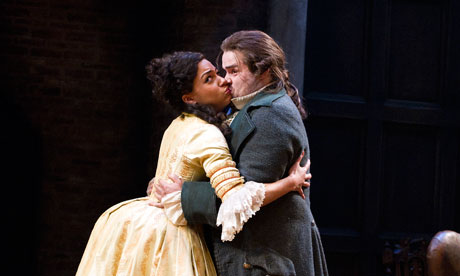
(Constance Neville: Cush Jumbo and Tony Lumpkin: David Fynn)

- All in all, I found the play so smoothly written and the actors enjoying themselves and playing not only to the type of character but to the nuances Goldsmith has added. On top of this, the scene changes are covered by scat singing servants, who at one point do a bit of percussion with pots and pans. I liked these bits, the music really suited the play very well, and it added a fun bit of texture (watch the linked video for a hint of the music). Also, one of the servants in the house would also be my perfect Corporal Trim were I to make a play of Tristram Shandy.
However, I do have one problem with the play itself. The central conceit is that Marlow thinks Harcastle is an innkeeper and treats him appropriately. Having worked ‘below stairs’ at a pretty shabby hotel, it makes me pretty uncomfortable about how it is okay to be boorish and rude at an inn, but not a gentleman’s and that all the characters think that acting like a rude idiot is fine if you think you are paying for the privilege. My experience at the hotel has taught me not much has changed in that respect. 


(The Servants and ensemble, and an idea of the music.)


Monday, 30 January 2012

Clarissa Big Read, January


January
I was a little concerned about reading Clarissa. It was not just the length, but also the reputation as a book with much dry moralising preaching and some rather icky sexual politics that I had heard made some modern reader’s skin crawl. Apart from anything else, I was worried about the detail of the piece, this whole slab of pulped tree details the events of only one year, I was worried it was going to be slow going and hard work.

So far, I needn’t have worried, the book pulls you in, fast and firm. It is more immediate then Evelina, less arch then Tristram Shandy and more coloured then Defoe’s works. Only Fielding’s works (except Jonathan Wilde) grabbed me into the story quicker, maybe Vathek also. 

    We start with Clarissa explaining to her friend Miss Howe that her brother has been injured by a dual and that she is being blamed for getting him into it. We are then given (surprisingly concisely) the longstanding enmity between her domineering, unfriendly brother, James and the charming but egotistical Lovelace. This dislike flaring up into a dual, partly over his attentions to Clarissa, which he paid only after her shrewish sister brushed him off. 

In these 20 pages we are given a clear picture of how the family works, it’s tight-nit structure and the dominance of her brother and uncles over her father and mother. We see her position as the kind, thoughtful patsy who gets pushed around. The characters and relationships are extremely detailed and full, without feeling flabby or overwritten. The only thing I would like is that Lovelace is less described and more dramatised - but I suppose that is building up to what I hope to be a grand entrance in a bit.


Samuel Johnson was once asked whether he preferred Tom Jones or Clarissa, and he replied Clarissa because it was ‘the first book in the world for the knowledge it displays of the human heart’ and I can see what he meant. Where Tom Jones gives us delightfully larger then life characters, Clarissa gives us the minute details that make a person live and breathe. Here are three I particularly liked.

The first, was Clarissa telling her friend that she wished she had died in her last fever when everyone loved her and surrounded her. I thought this a very accurate sentiment, and there are times I have wished I had died or disappeared before the bad times came.

The second was the description of how her sister played hard-to-get with Lovelace and failed because ‘My poor sister is not naturally good humoured...she must, therefore, I doubt, have appeared to great disadvantage when she aimed to be worse tempered then ordinary.’ Which I found to be a very funny description for a book (and author) I had been lead to believe was humourless. 

Finally, and my favourite was the description of her mum, a lady of such amiable stoicism that “had she been of a temper that would have borne less, she would have had ten times less to bear then she has had.” Which I think was such a lovely description of her mum, and possible in some ways any mum. They all put up with more then they have to from their children - I know mine does.
So, January had proved to be very engaging, and the family are proving to be a fascinating group of people when it comes to their minute politics.

Let’s see what February brings.


Read everyone else's views here.