
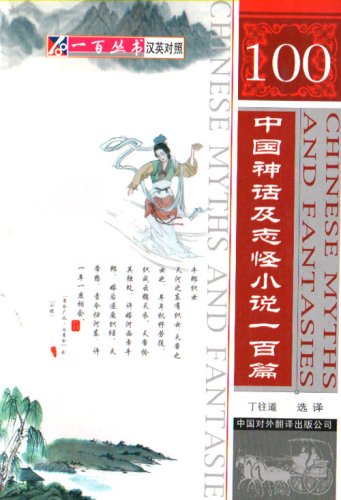
While I was reading The Tale of Genji, I couldn't carry it around with me, so I carried this dual language book of Chinese myths around as well. Consider this review a little bonus episode to the Genji.
The preface talks about how there are relatively few such myths and asks questions about why that might be, especially given the long (though interrupted) span of Chinese cultural history. It concludes that with the emergence of centralised structures, the bureaucracy and organisation of the various provinces and states, China spent less time in the sort of atomised, primitive social conditions that give rise to such stories. To be honest, I don’t know enough to say whether that is an accurate appraisal or not, but there was something in the stories themselves that supported it. Many of them are recounted as historical oddities rather than full myth, they are often grounded in a year, featuring a historical figure and often end in a strangely bathetic tone.
I loved this odd tone, with most stories ending in banal anticlimax. The figures of the story often meet something strange or supernatural, have an out-of-the-way experience and then go on with the mundane rest of their lives. There are no great heroes or heroines in this stories, just a run of minor officials, craftsmen and scholars who happen upon a ghost, god or fox, navigate the strangeness and get on with life.
The preface also talked about how Chinese writing favours the small and concise. That the nature of the writing system means much can be conveyed with little and each symbol can represent a range of nuances in themselves. This means that in translation, many of the stories read like simple records in official documents, such-and-such a thing happened, and that’s it. This added to the peculiar commonplace and bathetic tone, which I found really charming.
Some of the stories featured elements I’d heard of before; I’ve seen images of the bridge of birds that brought lovers together, there was a story where someone looked back and turned into a mulberry tree that reminded me of Orpheus, most of Apollo’s lovers and of Lot’s wife. There was a story about a tiger-wife which followed the pattern of many selkie stories (and a love a selkie story).
Many stories of gods felt like the older, stranger stories of fairies. The gods have their own rules, society and powers and if a character is unfortunate enough to find themselves noticed by one, they have to play things carefully if they want a happy outcome. Knowing the British fairy stories, it seemed ridiculous when the man charged by a river god to fix up his temple, went and destroyed it instead. Yet the god’s revenge was just to make his career go off the rails - which was presented as dire revenge indeed.
I also enjoyed how matter-of-fact the ghosts were. My favourite was about a man who finds that he has a ghost as a travelling companion and so has to pretend to be one. He has to make up excuses to the ghost about why he can’t go through walls or is so heavy footed as he walks, claiming that as a new ghost, he hasn’t developed such skills.
One chunk of the book stood out from the others. The book is arranged chronologically and they come towards the end of the selection, written by a man called Pu Songling in a collection called Strange Stories from Happiness Studio. These stories were longer, more complex and, unlike many other stories in the book, were told. There was a distinct style to the telling and a greater emphasis on the tone and structure of it. I’d like to get some translations of these at some point but my cursory googling tells me there hasn’t been many decent English translations yet.
I really enjoyed this stories, both for the differences from fairy and folk tales I’ve read before, but also their similarities.


No comments:
Post a Comment