Wednesday, 25 October 2023

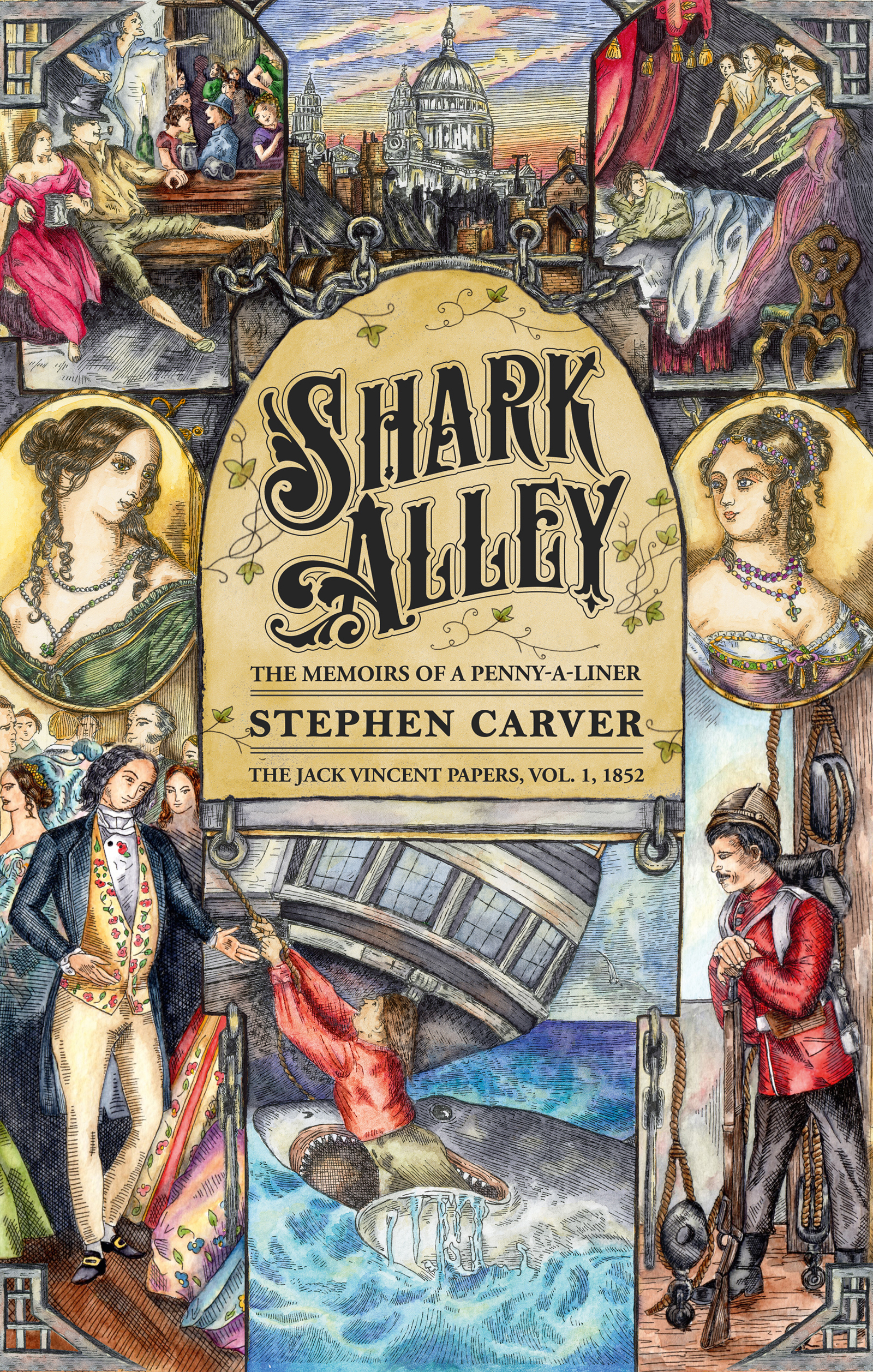
Review: Shark Alley by Stephen Carver

 Shark Alley by Stephen Carver purports to be the missing papers of forgotten writer, Jack Vincent. In his heyday one of the set of writers that included Dickens, Thackery and William Harrison Ainsworth, but now writing penny-a-line for newspapers. He has been sent on the troopship, HMS Birkenhead, which suffered a real tragedy when it sank in shark-infested waters. The book cuts between flashbacks to his life leading up to boarding the ship, and his experiences of the ship and with the tragedy

I love how Shark Alley commits to its bit. The blending of real and fictional characters and incidents is balanced really well and the book even includes endnotes by ‘editor’ Carver that explain how and why Vincent has been lost to history. There’s also an endnote, where Carver explains how he finds the papers, stealing them from a hiding place behind a copies of ancient Daily Mails in a dead hoarder’s house. 


The cover is also gorgeous with a real ‘boy’s own’ style. Originally the book was written in instalments on a website, with each containing an illustration, as a triple-decker novel, those illustrations aren’t included.


There’s some exciting shark action from the beginning, with a horse falling off the side and being yummed right up by a Great White. There’s also some premonition, when Vincent falls in a pond and has his toes bitten off by a pike as a boy - he’s not fond of water or carnivorous fish.


The first book is split into two sections, initially setting up the Birkenhead and the people on it and then going into the flashbacks. The second book alternates between flashback and ship-board action and the last book takes place on the ship and the later tribunal. I found the stuff on the Birkenhead to be a little less interesting than the flashback stuff, until the ship struck the rock and things went full throttle.


Jack Vincent is the son of a tailor who was put into the Marshalsea by the oily Mr Grimstone. There his literacy sets him apart and he reads to the other inmates, later creating his own stories. Not only are there Little Dorrit parallels, but the other inmates include the real Bill Sikes and Nancy. One visitor, David (Copperfield) even ends up being Dickens and the two talk narrative and social conscience. One day the prison is visited by Bob Logic, Jerry and Corinthian Tom, the main characters of Life in London, a popular book in the Regency - who are also real life artists the Cruickshank brothers and Pierce Egan.


Shark Alley is full of references, both historical and literary. Publishers, both mainstream and radical are important side characters. Vincent is represented as a keen Chartist, who was present at the mega-meeting in Kennington. He, Dickens and Harrison Ainsworth have a friendly rivalry until the moral panic about Newgate sends Dickens into more respectable territory and Harrison Ainsworth as a less stellar career as a historical novelist. (Carver is William Harrison Ainsworth’s most recent biographer, and a clear fondness enters the text). However, Shark Alley uses all this research to power the story along and there’s never an info-dump quality to it, all research is well digested. Particularly well handled is flash-slang (which I have seen sink other novels) and research into underworld London.


As Vincent is a novelist (he prefers the ‘ebb and flow’ of prose, me too) there are discussions of his novels. Though this is labelled ‘Vol I’, if Carver wants to branch out and write some actual Jack Vincent novels, I am all for them. The Shaking of the Timbers, is a crazy story about time-travelling on a demonically possessed boat that grows limbs. It makes a noble hero out of Captain Kidd and they fight a demonic Blackbeard. I’d love to read that. His gothic novellas include zombie babies born from necrophiliac sex and ghosts coming back to retrieve their gold teeth. There’s also the gonzo take on Sweeney Todd in The Death Hunter - I’m down for all those. There’s even mention of an experimental tale, Jack Sheppard in Space… yes please.


Carver doesn’t shy away from the grotesque. Both his parents meet horrid endings, one by cesarean and the other being eaten by rats. His sister is taken away by a strange dopplegänger and the book suggests a sequel where she is found (yes please). This goriness is brought to full force when the HMS Birkenhead sinks (as it did in real life) in an area of the sea known as Shark Alley. The book is not afraid to make the shark attacks as vicious and violent as possible, even including the literary equivalent of jump-scares. One man has his head bitten off when he looks down into the sea from a lifeboat - it’s great.


Shark Alley develops a very likeable hero in Vincent. He’s had a rough life and has responded likewise, he makes many stupid decisions but he has a young wife and son and it’s clear to the reader how much he has changed for them. It also creates a brilliant villain in Mr Grimstone, who always manages to pop in the book to ruin things. He’s everything wrong with the world, a rich capitalist politician who masks his cowardice under a pretended military service and his perversions under a pretend happy family life. Very hateable.


I’m just waiting on volume 2.


Wednesday, 18 October 2023

The Joy of Phonics

 He used to condemn me for putting Newbery's books into their hands as too trifling to engage their attention. 

     "Babies do not want to hear about babies; they like to be told of giants and castles, and of somewhat which can stretch and stimulate their little minds." 

When in answer I would urge the numerous editions and quick sale of Tommy Prudent or Goody Two Shoes: 

   "Remember always that the parents buy the books, and that the children never read them.”


  • Hester Thrale-Piozzi, Anecdotes of the Late Samuel Johnson


Samuel Johnson had a great many opinions about books that seem surprising when coming from one of literature’s greatest figures. He treated the physical objects appallingly and he rarely finished anything he read. Some of the few books he actually read from cover to cover were trashy tales about knights, giants and castles, books he had loved as a child.


When it came to the recommendation of books for children, he strongly recommended that the children choose what interest them and the parents support them. In the above quote, he denigrates all of children’s literature as it was (mainly chap-books and the output of Newbery) with the little zinger about how it’s the parents that buy the books, not the children.


For the past twenty years or so, the British government have been heavily supporting synthetic phonics as the primary way to teach children to read. That the children are taught how letters and combinations of letters (called graphemes) produce certain sounds (called phonemes). Personally, I think this is a solid strategy when used in combination with others but phonics have become in the be-all-and-end-all in education. Now the government has stated that only phonics should be used to teach children to read and as a result, they should be taught in books that are told in words that are phonetically decodable up to the reading level of the book.


I have many problems with this - principally that the English language is in no way phonetically stable and the various schemes tie themselves in celtic knots to try and avoid this problem. I could go on about this aspect for pages and pages, but here I just want to bring up a problem with the books.


They have no content.


Samuel Johnson declared that children want to hear stories that ‘stretch and stimulate their little minds’, these books do nothing of the sort. Reading is far more than turning marks on a page into sounds and those sounds into words, it’s about accessing and making use of the meaning of the sentences.. if there is no real meaning, it’s pointless.


My school has purchased a set called ‘Collins Big Cat Phonics’. At five pounds a pop, they consist of 8 printed pages and a cardboard cover loosely stapled together. They are frequently poorly designed, using stock photos or cheap illustrations. They rip, tear and come undone with the slightest pressure.


At the simplest level, the books only use words using the sounds ‘s a t p i n’. This doesn’t include sounds using ‘ai’ or consonant clusters like ‘st’. Because of this, a book at the earliest level consists of words like ‘pat’ ‘sat’ nap’ and ‘nip’. The following is a direct transcription of one of these books.


‘pit pat pit pat tip tap tip tap pit pat tip tap pit pat pit pat tip tap it pat pat it sip sip nap nap’ - this is a non fiction book about the weather.


In later books, greater varieties of sound can be used, as can ‘tricky words’, words that don’t follow the more basic phonetic structures but are essential in telling even the most basic story, words like ‘the’.


Another strange result of these limitations, is that the non-fiction books frequently include factual errors because the correct information is not phonetically decodable. The books also include what is simply the wrong choice of word. There’s one with a picture of a game of whack-a-mole where the words say ‘pat pat' - it’s whack-a-mole, not pat-a-mole. Another book  describes a girl stealing and eating a gingerbread man with the words, ‘nip a man’. The girl is nicking a man, nabbing a man, nibbling a man but in no way is she nipping it.


There’s an element of risk, me talking about this, even on a blog as out of the way as this. I’m not certain that complaining about the school’s (and indeed the government’s) phonics programme is breaking the school’s code of conduct a little - even if I am not naming the school. But one book broke me.. it was this one.


The writer, Samantha Montgomerie seems to specialise in these phonics books for many different schemes and she doesn’t do that bad a job. In ‘King of the Kicks’, she manages to tell a charming story about a kung-fu cat who foils a robbery with his moves. ‘It’s fun to think’ gives me physical pain though and I am about to break copyright and reproduce the whole book - remember, this is flimsy and badly put together and costs £5.


My big question… what is it about? Is it about taking time to think? Then why is 15% of the book about bees and another 15% about running? Why is there are complete non-sequitur about the texture of moss or the movement of a fish? Why does the picture labelled ‘We sit and think’ show children laying down? 


Even if you argue that the book is about children enjoying the countryside, why are they different children each time? This book is simply a number of stock images with phonetically decodable captions put in a random order in some pages. There’s no ‘there’ there. If Newbery’s books are trifling (and two of my favourite authors Kit Smart and Oliver Goldsmith wrote some of those books) then what are these? This book is pap, not even pap because pap is broadly nourishing. No-one is being stimulated by this, nor are they gaining a love of reading.


The fact is, that not only does a phonics only approach ignore the fact that English is barely phonetic, not only does it tie itself into knots about the six ways of making an ‘ay’ sound but it reduces reading to a dull mechanical act. Where’s the joy in ‘It is fun to think’? Where’s the pleasure? Where’s the reward? As a lover of the written word, it simply hurts.


Wednesday, 11 October 2023

Suspirius, the Human Screech-Owl


 On the 9th of October 1750, Samuel Johnson released one of my favourite Rambler essays, number 59, also titled ‘Suspirius, the Human Screech-Owl’.

Like many of my favourite Johnson essays, it’s one of those pieces where he outlines a certain type of character. Also, like many of my favourite Johnson essays, it’s not to be found in any of the readily available essay collections. (I’d always recommend getting a decent older collection of Johnson’s essays, or visit the fantastic website, Samuel Johnson’s Essays).


Pliny the elder said that the screech-owl is always a sign of heavy news, foretelling a fearful misfortune and that’s what Suspirius does. 

  “These screech-owls seem to be settled in an opinion that the great business of life is to complain.” 


Not that Johnson is utterly averse to complaining, he loves a good moan as much as the next person. He declares that it’s perfectly fine “when the sigh arises from the desire not of giving pain, but of gaining ease.” What’s more, it’s one of the duties of friendship to hear each other complain and, in the right context, an act of complaint is a social one, inviting a collective moan that brings a small respite.


Were Suspirius goes wrong, is that he does nothing but complain and moan, even when things are going well. “They were born for no other purpose than to disturb the happiness of others, to lessen the little comforts, and shorten the short pleasures of our condition.” For Johnson, a man whose pleasures and little comforts are very fleeting, getting caught in the orbit of a Suspirius is a terrible thing. There’s a wonderfully weary specificity to how he notes that, “I have now known Suspirius fifty-eight years and four months, and have never yet passed an hour with him in which he has not made some attack upon my quiet.” There’s the feeling that just before writing the essay, Johnson has spent an hour with this person and is utterly tired of it all. 


Suspirius (and I keep wanting to write Suspiria) is a relentless buzzkill. “Their only care is to crush the rising hope, to damp the kindling transport, and allay the golden hours of gaiety with the hateful dross of grief and suspicion.” There is no pleasant moment that can’t be re-framed as a portent of evil, no parade they can’t rain on.


What’s more, the screech-owl personality doesn’t just moan about the present, they cast melancholic shadows over the future. Johnson lists the writers who never finished their projects because of Suspirius, all the marriages that never took place and all the business ventures that never happened. He is not only intent on smothering the happiness of now, but strangling future happiness before it can happen. 


Johnson’s only solution to people like this is to “exclude screech-owls from all company, as the enemies of mankind and confine them to some proper receptacle, where they may mingle sighs at leisure, and thicken the gloom of one another.”


Screech-owls like Suspirius still exist, and while it may not be possible to confine them to some proper receptacle, there’s a lot of evidence to suggest that such people can spread their negativity. While simply cutting those people out might be the best solution, it’s not always possible. Instead, find the things that make you positive, try and make a positive difference to others and try not to jump onboard that negative train. I’m pretty susceptible to being swept along by these negative spirals and sometimes there’s a power in being able to simple recognise and name the cause. 


Wednesday, 4 October 2023

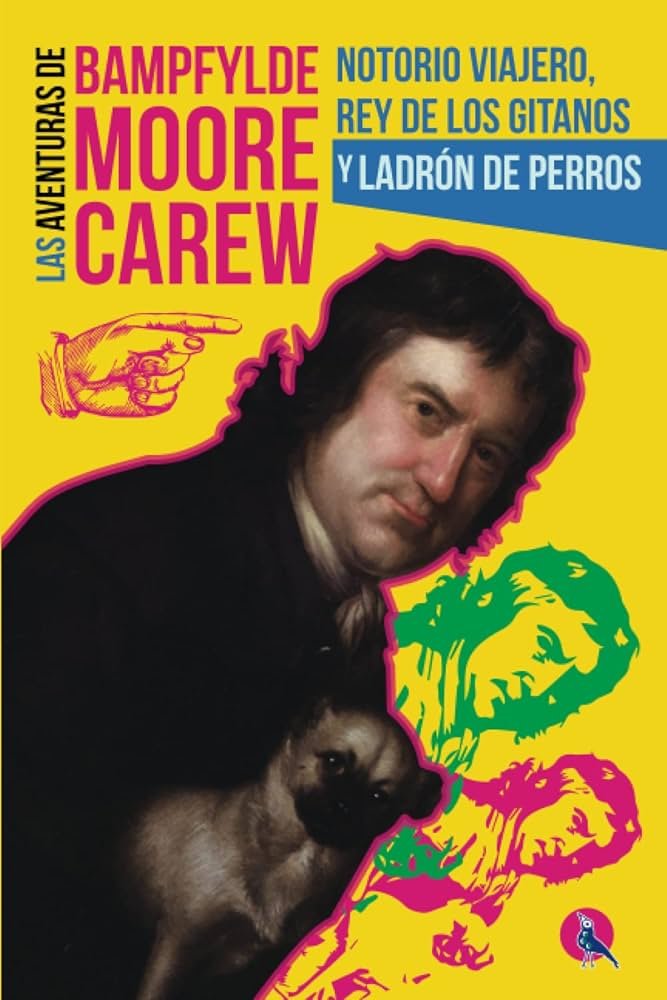
Review: The Life and Adventures of Bampfylde- Moore Carew: King of the Beggars and Dog-Stealer


 I was extremely excited to read The Life and Adventures of Bampfylde- Moore Carew: King of the Beggars and Dog-Stealer, chiefly because it is called The Life and Adventures of Bampfylde- Moore Carew: King of the Beggars and Dog-Stealer. I was also excited about the life of a real life Cock Lorrell, a beggar king with scrapes and shenanigans. I was left disappointed.

Bampfylde was a real person, born to an affluent and influential West Country family who decided not to become a lawyer of a clergyman but to turn ‘mumper’ instead. This was a person who dressed up in various costumes to con marks into giving money. He was forcibly transported to the Americas and escaped back, where he settled down and lived a more respectable life. He then wrote a set of memoirs in 1745.

These were revised in 1749 by William Owen and Robert Goadby. They added some elements to the book, such as the title ‘King of the Beggars’ and his dealings with ‘gypsies’. Indeed, the book is always obfuscating the Romani and beggars, whom the book usually refers to as mendicants. The chapters where Bampfylde grows closer to their king, before being voted the next king are largely for satirical purposes. Here are these ‘gypsies’, who live off begging and other assorted tricks, having a freer, fairer election than the United Kingdom. This element rarely comes up again, Bampfylde doesn’t seem to have to do much to be king, except be a skilled beggar, nor does he seem to get much from it. The fact is, Owen and Goadby added a lot of fiction to the text and the flavour of the real man and his adventures have been washed very thing by the later additions.

For the most part, the book tries to make a life begging seem to be a joyous thing, full of larky good fun but it just doesn’t work. For a start, there’s a stifled sameness to much of the book. When we’ve seen him in one costume conning one person, there isn’t much cunning or joy to be had in seeing him do it to another. I think we’re supposed to be impressed with Bampfylde’s skill at thinking on his feet, an exciting life of improvised tomfoolery - but the joy is somehow missing.

What’s more, there is something unpleasant about the whole ‘mumping’ game. The reader is told that “A real scene of affliction moves few hearts to pity: dissembled wretchedness is what most reaches the human mind.” As a result, the beggars in this book take money that could be given to real people in distress and even make it harder for the genuinely distressed to get help because of the suspicion the fakes have created. What’s more, Bampfylde doesn’t hear of a disaster, a house fire or shipwreck, that doesn’t awake his greed. As soon as something genuinely terrible happens, he’ll be there in a flash, dressed appropriately and taking money intended to genuinely help someone.

At one point, Bampfylde is captured and transported to America. There’s a note about a fellow transportee called Griff, who is a Welsh tailor transported for “making too free with the neighbour’s sheep.” Given it’s his wife who dobbed him in this is probably is a sheepshagging joke.

Whoever added the American parts clearly knew the place. Not only are there a few chapter of regurgitated history of those places, but a lot of small details that can only come from knowing a place. It’s also a more exciting part of the book, Bampfylde can’t just dress up and pretend to be a destitute soldier, he has to sneak past people looking for him, wade in swamps whilst weighed down by irons, and contact the right group of natives for help. Of course he escapes, and finds his way back to England before the captain who had imprisoned him.

There are some other variations on the theme. There’s a haunted house story, where Bampfylde gets money for spending a night in a haunted house. There’s an attempt at atmosphere and buildup but it mostly leads to a fart joke, where the smell of terrified farting is blamed on the decomposing ghosts. There’s also a test of Bampfylde’s famous skill with dogs, something that makes him a fantastic dog-napper. He’s challenged to test this skills on a particularly recalcitrant dog and succeeds, the test dog is called Roger.

I wanted to write a big, fun piece about this book, but I put it off for a month and am literally finding myself falling asleep as I write about it. The Life and Adventures of Bampfylde- Moore Carew: King of the Beggars and Dog-Stealer fails to have the directness and freshness of an eighteenth century work and instead feels inert and lifeless. So I think I’ll stop there.


Wednesday, 27 September 2023

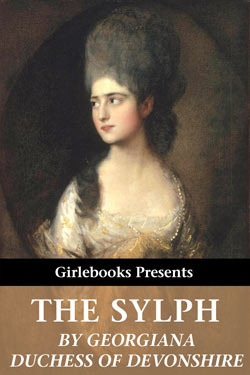
Review: The Sylph by Georgiana Cavendish


 Back in July, when I read Amanda Foreman’s Georgiana: Duchess of Devonshire, I made a note that, fairly early into her marriage, she’d written a novel called The Sylph and decided to read it. Rather like her own life, it’s an anti-Cinderella tale, where the troubles really begin with the happily-ever-after marriage.

It’s an epistolary novel of rakes and high-life, and it’s hard not to imagine that Georgiana must have read some Richardson as inspiration. Interestingly, the first few letters are from the rake, Lord Stanley, which gains him some sympathy in the reader which he will then squander away, much as he squanders everything. At the beginning, however, he seems a little impetuous but certainly not a psycho like Lovelace. 


Stanley is holidaying in Wales and sees some beautiful women, with one in particular. In following these women, he falls off a rock and is taken in by them where he must rest. As he says; “reflection never agreed with me: I hate it confoundedly”, and to pass the time he discovers a growing infatuation for Julia. Unable to win her round any other way, he marries her and takes her into London and the ‘ton’. 


Julia is a little unsure of this new life. She’s aware that she’s not all that bright; “I am a wretched reasoner at best” so she writes to her sister, who is the clever one. She’s shocked at the ways of fashionable London, especially the way that people are always doing things but never seem to think about any of them. She’s shocked how little time she spends with her husband, only chatting at breakfast and sometimes not even then. 


Most intriguingly, she is appalled by London’s fashion. She things the clothing absurd and overly showy and is utterly distressed at the hairdressing. Now more are her “brown, silky locks”, she must have her hair powdered and piled on with “half a bushel of trumpery”, all kinds of head-worn nonsense including some radishes which were originally intended for the Duchess of Devonshire. It seems odd that the woman famous for playing with tall hair and outrĂ© hair decoration is mocking it so clearly. At one masque, she lets her husband pick her costume. “What character I assumed, I know not, unless I was an epitome of all the folly in the world.”

 Julia realises that “fashion makes fools of us all”, something that could be described as the thesis of the book. An interestingly unexpected thesis for a committed leader of fashion.


While her husband ignores her, other sharks circle the naive young wife. Most obviously and disgustingly, there’s Biddulph, who desperately wants a piece of her so he can get one over on Lord Stanley. Then there’s the Baron Ton-Hausen, who seems like a decent sort. In the distance there’s also Henry Woodly, who’s loved her since they were children. Half-way through the book, another man enters, the Sylph.


A Sylph is an air spirit, and this one appears in letters and offers advice. He suggests being careful of the baron and warns about her growing love of gambling, as that is nothing more than a debt-trap. This title figure doesn’t enter until half-way through the book and Julia quickly accepts this mysterious man and his advice. The book doesn’t encourage the reader to see this man in creepy in any way but I found something very menacing about an unknown figure claiming to have deep knowledge and understanding of her.


Again, it’s interesting that the book specifically mentions gambling as a danger. Georgiana was gambling at this time but it hadn’t spiralled into the inescapable trap it became. Once again, she seems to understand and recognise dangers in the book that would consume her in life. Stanley didn’t moderate his gambling though and he quickly burns through his money and hers. In the end, he sells a “commission for his own cuckoldom”, essentially allowing Biddulph to have her. Then he goes and kills himself, and Biddulph realises he has gone too far. I wander if husband-suicide was a daydream of hers?


The book also includes a number of interesting side-stories. There’s a lesser rake who starts his seduction by giving his target a copy of Pamela because he knows that her own lover will not stack up to Mr B. Really? Mr B… he’s one of the most pathetic lovers I’ve read in fiction. Works for that rake at least.


Another good side-story is the one behind Julia’s dad. A long-ish, action-packed story of love, where he joins the army and his lover disguises herself as a soldier to meet him and they both get captured. In terms of action, it has more than the main story, but maybe less in character and social comedy.


The Sylph is a smart, funny book with some decent character building. Especially given its author, it’s strange how clearly she sees her own problems and the idiocy she’s trapped in, and how little she did with that knowledge.


Wednesday, 20 September 2023

Trips - City Wall at Vine Street, Portraits of Dogs and The Postal Museum

 During the summer holidays, I discovered that I could get an Art Pass for £25 a year because I work at a school. I was very excited about this, because I’ve long fancied having an Art Pass. It allows a person to get into some museums for free and to see big exhibitions for half price. When I got back to London, I used it as much as I could.. and here is what I saw.


City Wall at Vine Street


My first visit wasn’t actually to an Art Pass venue. It’s a chunk of London’s Roman wall underneath a new student housing block. It’s free to visit, but booking helps.


The centrepiece is a chunk of Roman wall. It’s a lot like the other pieces of Roman wall dotted around the Tower of London; neat, solid and separated by bands of red tiles. Jutting out the front is a later addition to the wall, the foundations of a Roman bastion. However, that is not all. The Roman wall was incorporated into the mediaeval wall, and that included in 17th and 18th century houses, which was then included into Victorian and 20th century warehouses. Elements of all these time periods are visible on the wall, making it not only a remarkable existing piece of archeology, but a microcosm of the whole 2,000 year history of London.


Around the wall are display cases that show objects dug up around the wall. These include roman pots and tiles with cat footprints on, the usual stash of broken pipes and a lot of green glass bottles. All of these things are simple, quotidian, largely pretty smashed up. They aren’t particularly awe-inspiring to look at. But the write-ups are really good, there’s always a way of putting the objects in their everyday context and encouraging the visitor to reflect. Some of the best exhibition labelling I’ve seen.


There are also two focus cases that have a handful of objects found in the rubbish pits of two eighteenth century houses. The housing records are used to give the people who owned them a name and there are reflections on how the different things the two families threw away reflected on the families. Included in these cases was a rabbit skeleton, not butchered but thrown whole, it may have been a family pet and the rubbish pit was its last resting place.


City Wall at Vine Street is a great example of how to do a lot with relatively little and is very recommended.


Portraits of Dogs: From Gainsborough to Hockney


This was an Art Pass venue. I’d visited to the Wallace Collection at the beginning of the summer and enjoyed it very much. I did, however, balk at visiting this special exhibition because as fun as it seemed, I wasn’t sure it would be £18 worth of fine. It was definitely worth the discounted price though.


Starting with some Roman greyhounds and a page of Da Vinci dog’s paw sketches, it then went to pictures by eighteenth century painter, George Stubbs. He actually painted 15 full length portraits of dogs, more then he did of horses. It’s fascinating how his pictures are of specific dogs, they live such relatively short lives, but are here mounted and present forever. There was Ringwood, the foxhound and Turk, a wonderfully floofy beast.


My favourite room was of Landseer dogs. He used them in allegorical and comical settings. Unfortunately, none of these dogs were playing cards (they missed a trick there) but there was a dog court, presided over by a poodle with ears like a judge’s wig. My favourite of these was titled, Dignity and Impudence, with dignity played by a bloodhound called Gryphon and impudence played by Scratch, who was, of course, a Westie.


There was a room devoted to toy dogs, which included two stuffed ones. Marie Antoinette was found of toy dogs, calling them names like Bebe and Mimi. There was a story (probably apocryphal) of a French farmer who came to Paris and learnt that the tiny, useless beasts were being sold for twenty-seven livres, and so rocked up to the city with a bunch of large dogs that he was shocked he couldn’t give away. I also learnt that Pekinese dogs were originally bred for the Imperial Chinese family, that no-one else was to own one and that it was protocol to bow to them as they scampered around the Forbidden City. I also learnt that the British came and nicked them, the first Pekinese in Britain being named Looty.


There was a Gainsborough picture, Tristram and Fox, which looked more alive than his human paintings. There was a portrait of one of Byron’s massive dogs, which he loved more than most people. There was a room of portraits of Victoria’s dogs, including many pictures by Victoria herself. This lead to Hockney’s cosy pictures of sausage dogs, which I felt looked slightly more sausage then dog.


Portraits of Dogs is probably not a sublime or grand experience, but it left me with a smile on my face. If I had a tail, it would have wagged.


The Postal Museum


This was another half price deal with the Art Pass. I mainly picked it because I’d never been before and it was close to the Unforgotten Lives at the London Metropolitan Archives. It also meant I could go to Grimaldi Park and visit the grave of Joseph Grimaldi.


The Postal Museum is in two parts, I think I accidentally went to the second part first. It was a ride on the mail rail, a narrow-gauge underground railway which used to zoom letters under the city. It was a little odd getting into the headspace of a package as I squeezed into the carriage and was whisked on a little loop. The audio commentary was really good, and there were projections at various stops telling the history of the service. Essentially, nearly all post found its way into London before being sent out to various directions - they’ve reorganised the system so it doesn’t work like that any more and the Rail Mail became defunct. I was surprised to find that Mail Rail boasts its appearance in the film Hudson Hawk, I didn’t mind that film but it’s not much to boast about.


The little museum afterwards has one of the pneumatic railway cars from 1869 (there’a a chapter about it in Barnvard’s Folly, the book that introduced me to Robert ‘Romeo’ Coates). I also learnt that it was illegal to post copies of Ulysses, and any copies found were burnt. Did you know that at one point there were railway sorting offices? They zoomed around the country, picking up letters with ingenious bag/hook apparatus and then passed them onto local stations by lobbing them into waiting nets. It’s a system that ended in the 1970s. Why is modern life so much more boring?


The Postal Museum itself is in a building a little further along. I learnt the post service was set up by Henry VIII and originally only took the King’s mail. However, later monarchs learnt they could make money by having other people to pay to use the service and so a regular postal system was set up. By the 18th century, they made more money by carrying passengers as well.


There was a good selection of stuff from the Georgian postal service, including guard uniforms and an 18th century mail coach. The best part was a section telling the story of a coach in 1816 which was attacked by an escaped lioness, which took out one of the horses before being shot. The post was only 45 minutes late.


The rest of the museum tells the more modern story of the postal service. There’s stuff about the development of stamps, post boxes, uniforms and different vehicles. My favourite being the ridiculous 5-wheeled cycles. The have the large ‘penny’ wheel of the penny-farthing, supported by four stabilising ‘farthings’. Another nickname for the ridiculous contraption was the ‘hen and chickens’. They were really only popular in Horsham, where they were invented.


It’s a museum very well set up for younger visitors, with lots of interactive elements and things to do at a more suitable height.


Unforgotten Lives: Rediscovering Londoners of African, Caribbean Asian and Indigenous Heritage 1560-1860.


Another freebie without the Art Pass. I talked about this and a matching lecture last week.