Saturday, 7 January 2017

The Best Books (I read) in 2016


It’s been a strange year, reading wise. Two factors have encouraged me to read a larger selection than usual - the first being a push on my part to reading female authors in the second part of the year; the other being a free book-swap point at my local tube station, which has thrown up a few interesting selections.

Also, I’ve had enormous difficulty in picking and ordering these books. Much of what I read was of equal quality so I found myself writing up twenty-five books and then whittling down. However, even after I did that, I’ve been moving them all about repeatedly - but I think I’ve decided.



Here are the top fifteen books of the year….


15
Momo by Michael Ende (translated by J Maxwell Brownjohn)

Momo has a magic power, she actually listens.

She lives in the ruined Amphitheatre where she becomes essential to the community around her. Then the men in grey come. They convince people to be efficient and save time, leading them to lose sight of Momo and each other. Momo then has to defeat the men in grey with the help of a tortoise called Cassiopeia, who can see slightly into the future. 

Although the allegorical nature of the book was a little too obvious, the message it was trying to convey, about having time for your friends and interests, was one which I think more people need to hear. The book had a wonderful fairytale quality, the real life in it is not utterly real and the strange metaphysical worlds of Nowhere Lane and the time-vault bleed in nicely.

This is is the kind of book that I will read again at some point when life is getting on top of me as a reminder to take the time for what really is important in life - and if that isn’t a message to teach children, I don’t know what is.


14
Perfume by Patrick Suskind (translated by John E Woods)

This was a nasty, bitter, strange and misanthropic book - but it was also kind of brilliant.

Grenouille has no life, except for the pursuit of scent. He has no personal smell himself and so seeks it out obsessively as he launches into the world. A chance meeting with a woman who smells of innocence leads him to try and recreate it as a perfume, using murderous and bloody ends.

I will admit, I saw the film of this first and I didn’t think much of it. I didn’t understand Grenouille and I didn’t understand what he was doing or why. The book allows you to go much deeper into his head and then it all becomes clear. His actions are completely comprehensible from his own perspective - indeed, his journey is a noble and grand quest for the ultimate scent. However, to everyone else, he is a vicious, alien and insanely cold murderer.

I also liked how smell is used as a substitute for soul, that a person’s smell was a soul and all Grenouille was seeking was the perfect one.


13
Dead Souls by Nikolay Gogol (translated by Robert A. Maguire)

Dead Souls is about a man called Chichikov, a bureaucrat who travels around rural Russia hoping to buy the names of dead peasants…and for the most part, we aren’t sure why. He is met with flattery, flirting, suspicion and more as he tries to charm the inhabitants to sell him their ‘dead souls’.

This book grew on me. At first, I found it a little bland, the town is un-named and the main character is referred to as 'neither fat nor thin'. I'm not sure when I started to like it but by the time Chichikov got to the landowner, Sobeyavich, I was hooked. (I was particularly taken by the fact that all of Sobeyavich's furniture reflects him and all cries out 'I am of Sobeyavich').

I can't speak Russian, so I don't know how it reads originally but the translation gives the impression of a really engaging authorial voice. I loved how the metaphors often lost control into nonsense, the conversation between 'Mrs Pleasant in all Things' and 'Mrs Merely Pleasant' and a wonderful imagining of a typical pandering obituary that finishes, 'In the end, all he had going for him was thick eyebrows.'

I was also interested in Chichikov. I didn't see him as some awful demonic figure, all he really wanted was a comfortable life but his fear of insecurity always pushed him to go one or two steps further then he should. That said, I imagine that had there been the proposed third volume, things would have escalated.


12
The Pleasure Garden by Leon Garfield

Only two Leon Garfield’s this year - but this one makes the list.

Leon Garfield was always an adult novelist who was sidelined into writing for children. This book, though marketed as one of his children’s books, this is one of the most adult he has ever written.

Garfield makes a number of unusual moves compared to his usual formula. The hero is a grown up, the Revd Martin, he is said to be possessed by an angel. He buts horns with Dr D, a man possessed by a devil. When someone is killed in the Mulberry pleasure Gardens, the secret world is stirred like bees in a hive.

Again, Garfield writes beautifully, he so often makes me laugh and can often find ways to describe things in startling detail. I loved the notion that the owner of the gardens uses small children hidden in the trees to capture secrets and her relationship with them was peculiarly sweet and manipulative.

Essentially, this book is about loneliness. The garden is the spot where lonely people go to meet or to forget their loneliness. Dr D is the spirit of loneliness, sneaking up on people and offering them the pewter season ticket to Mulberry gardens - a ticket out of loneliness. Rev Martin is the spirit of generosity and warmth. I won’t tell you who triumphs.

One of his best.


11
The Travels and Surprising Adventures of Baron Munchausen by Rudolph Erich Raspe (and others)

I’ve already spoken in length about this book - to be certain, it has reached this list for the first half of the text I had and not the rotten sequel.

Munchausen makes a great super-hero, playing in the very reaches of probability and I had as much fun with this book as I was probably intended to.


10
Notes on a Scandal by Zoe Heller

This is the story of two teachers in a North London secondary school and deals chiefly with the younger teacher’s love affair with a pupil but is narrated by the older of the two.

I was unsure at first, the details of the staffroom were well observed and the characters true but there was something odd and studied about the writing. It was almost like someone writing about a staffroom in a sitcom rather than a real one. However, I should have had faith because this was not a fault of the author but developed into one of the hallmarks of the narrator.

As I read, I become increasingly gripped - not by the story itself but the slightly told story of the narrator. I began to realise there was something about her that didn’t ring right. Not to go in too much detail (I’m not used to reviewing books so new that spoilers may actually be an issue) the narrator is one of the best monstrous characters I have ever read, particularly because she never realises she is one. Very unsettling and worth a read.


9
Jonathan Strange & Mr Norrell by Susanna Clarke

Jonathan Strange and Mr Norrell is a brilliant, almost flawless bit of world building with a beautiful and fairly consistent tone and a plot which is plain and solid enough to hang those elements on. The characters, though good, are swallowed a little by the world building and tone. To make the book truly great, those characters would need to have the vivacity of Dickens.

I am not a big fantasy fan on the whole, I find the exciting worlds they portray as pretty shallow. This world building was one I loved. There was a full, messy and detailed history of English magic behind it and although the information given is piecemeal and incomplete, I always felt that there was a coherent history behind it all. I also loved how magic worked. At first it was completely mysterious, then it became a little clearer and by the end I had a real clear idea of how it was linked to creating alliances with nature and objects usually thought to be inanimate. This meant the magicians could ‘speak’ to their environment and change them through magical words, props and rituals - much more engaging than a more ‘point-and-flick’ approach.

The world building was also carried by the tone of the book. It was as if the novel itself was one of the dull books about magic that are mentioned within it, with footnotes and digressions that followed the format of those meandering histories. However, at other times it was more novel-like with a sort of Thackery/Austen mashup and a lot of delicious, wry prodding.

The plot itself was functional, which was all it needed and the characters were engaging. I really liked poor Mr Norrell, whose caution was really quite justified in the end. I also enjoyed Strange and his journey from lazy magician for fun, to driven madman. My favourite character was probably the Gentleman with the Thistledown Hair. I loved how noble, selfless and kind he thought himself to be as he casually killed people and ruined their lives, not ever realising that even Stephen, who he regarded as a best friend, feared and disliked him. However, the characters did get lost inside their massive world and it would have taken some oomph on their part to properly own the book and make it a complete masterpiece.

That said, it was all good fun and I would call it enjoyable and engrossing.

8
Purple Hibiscus by Chimamanda Ngozie Adichie

Kambili lives with her brother, her mother and her father, Eugene. He is a local hero, a champion of free-speech, a pillar of the church and a viciously abusive parent. In the course of the book, a trip to her Auntie Ifeoma stirs up emotions that can’t be repressed.

This book has some of the tightest writing I have ever read. The central family are set up quickly and efficiently and nothing distracts the author from the shifting and nuanced balance of love and fear that constitute their relationships.

I loved the portrayal of Eugene; a man loved by his community who is brave and right but feared by his family, who love him as well. The complex soup of emotions Kambili has for him is beautifully done, not lessening the terror he evokes but not skimping on the love either.

The tension in the book ramps up with the smallest details, especially as the book progresses and you get to know the characters, it was the most nail-biting and disturbing book of the year - in a year where I seem to have read a larger share of thriller-esque books than usual.

(My only niggle - is that I would have structured the ending differently… but I can’t go into that without revealing how it ends).

7
By an Unknown Disciple by Anonymous (though a little research found the author was called Cecily Spencer-Smith Phillimore)

I discovered this in a weird way; picking it up on a shelf outside the tube station, anonymous and peculiar and interesting.

It’s…almost a novel I’ve wanted to write. A novelisation of Jesus’ ministry and life with a focus on humanising him and emphasising the different ideas and interpretations the disciples have of the teaching.

The humanising of Jesus gets a little trite but the disciples fare better, and despite this grounding of the gospels (none of the miracles are completely ‘as is’) Jesus is still magic and there is still something else going in.

The pharisees are also treated well, you can see their reasons for killing Jesus and the fear Jesus creates in the ruling classes.

The resurrection is handled beautifully, it doesn’t happen on stage but it happens symbolically and thoughtfully.

That said, the book does veer into Cecil B De Mille territory - though, it being written in 1919, it’s not fair to lambast it too much.

6
The Strange Case of Dr Jekyll and Mr Hyde by Robert Louis Stevenson

Like ‘A String of Pearls’, the Sweeney Toddy story, the big and mysterious twist the book is building up to is pretty much the only thing a modern person knows of it - meaning that the shock ending is completely expected.

That said, this is a short book, it is a tight book and it is a very well written book. Jekyll himself is a little weakly drawn but Hyde, in his undefinable wrong-ness is brilliantly told.

Brilliant also is Mr Utterson, a character who is ostensibly a boring man, but such a well drawn boring man that he is not boring.

I was also extremely intrigued in how Jekyll is normal Jekyll but Hyde is pure evil Jekyll - and that Hyde grows stronger with each evil act, taking over Jekyll completely. It is a very mature and grown up horror, the horror of becoming someone you hate (and the horror of the slight attraction of doing so).

So, a small book but a lot to reflect on.

5
Little Women by Louisa May Alcott

At first, ‘Little Women’ reminded me a great deal of Sarah Fielding’s ‘The Governess’. It was about an enclosed environment with a number of girls with very clear and different personalities learning life lessons from a benevolent elder woman - And this was very pleasing, I enjoyed ‘The Governess’ immensely.

As the book continued, especially in the second half, a larger through-story developed and with that the characters. I liked the people in the book a lot, especially the girls and I liked watching them change and grow up.

There is a sweetness and warmth to the book, which makes it a very cosy place to be. Even with the threats of illness and poverty, there was an essential ‘niceness’ to the people that made spending time with them something I looked forward to. That said - my copy did not include ‘Good Wives’, where tragedy gets closer to the March family. 

I really enjoyed the differentiation in the girls - and how when we were shown something they had written, be it a family magazine or letters, it was possible to tell immediately which family member it came from. I also enjoyed the insights into how notions of girlhood and womanhood played out. I have read people saying that it is reactionary, I would disagree and say that although the outlook is conservative, it does tease and question the artificial limitations put on women - particularly in the case of Jo.

One of the contenders for the Oxford Dictionaries’ word of the year was ‘hygge’ - a Danish word for cosiness (that I am lead to understand is never properly translated into English). This book gave me a very real sense of what hygge might be. 

4
The Natural History of the the Unicorn by Chris Lavers

I loved this book. 

What makes it fascinating is that it is not really a history of the unicorn, it is the history of knowledge and its creation, dissemination and manipulation through the centuries with the unicorn as representative of all brand of knowledge. It’s like a full-length expansion of TH White’s wonderful final chapter in his Book of Beasts.

There is a cast of liars, fabulists, genuine knowledge-gatherers and single-minded allegory hunters - each different place and person touching the unicorn legend and taking it somewhere else. ‘In reality, the beast dissolves into the globe-encircling milieu of human imaginings’ - which is just where the unicorn should be.

My favourite aspect of the book was when it doubled back on itself, where legends, informed by certain creatures led people to re-find those creatures in search of the legend. It could be a disappointment that the unicorn doesn’t evolve from one creature but I much prefer the hodgepodge figure that is drawn out here, which has ‘blossomed with the aid of real animals…’ including ‘…an ape’s runaway brain.’

Much of the writing is sardonically funny and I laughed at this book a great many more times than I was expecting to. Other people who describe this book as dry, academic or hard to read must have read a different book because I found this a constant delight.

My main criticism would be that the light tone of the book sometimes undercuts the authority with which other parts of the book are delivered, (see his explanation of the enlightenment).

3
The Song of Roland by an Anonymous Author (translated by Leonard Bacon)

Another book I have given a full review to. Although it is almost a year later, there are parts of this book I go back to in my head and just smile. It’s a gorgeously goofy bit of excessive valour and knightly enterprise - and it’s short. I can’t recommend this more.


2
Love in Excess by Eliza Haywood

The Eighteenth Century book that most deserves a bit more attention. 

It starts slow but by the time that third volume comes, excess has built on excess and we all have a lovely time.


1
The Song of King Gesar by Alai

This is an abridgement and translation of a Chinese novel in which about 70% is an abridgement and translation of a Tibetan epic…that’s a lot of filters.

But King Gesar was still pretty typical national myth stuff. A God is born human to fight the demons and struggles with humanity - plus magic, fighting and betrayal. King Gesar and King Arthur essentially walk the same path.

What made it really interesting was the Buddhist take on it all. That the Supreme Being assigns different religions to different regions, that people are re-incarnated (Gesar was was a God, but the God was once a demon).

I was also intrigued about what a dick Gesar is. Khrothrung, the big bad uncle, is de-fanged by everyone knowing he is bad, so most of Gesar’s problems come from the avoiding of his responsibility. Instead of fighting monsters, he hides in a tent or goes to a lend of monsters and has a lovely time with a witch or generally sulks. Gesar is only heroic at times and is mostly heroic because he is forced to or shamed into it by various floating deities.

Within the book, the King Gesar tale is revealed and told to a shepherd, who wanders about Tibet and learns his storytelling skills, searching for the locations of the story and occasionally being visited by the ghost of Gesar. I enjoyed how he was chosen to sing the song due to his likeness to the Anancy-esque character in Tibetan literature. 

I also enjoyed how the introduction of the storyteller character allowed the author to comment on how retelling and re-understanding the Gesar story changes because it’s an oral story - whereas a written story can be questioned and challenged with the original of the story remaining unchanged in its written form but lacks the ability to evolve with the people.

All in all, it’s an interesting introduction to a set of myths and stories I knew nothing about.


That’s it for 2016 in reading, let’s see what 2017 brings….

(Well actually, I just read a novel where everyone is a bee and am starting Candide, so that’s how it starts).


Wednesday, 7 December 2016

The Fortunes of Francis Barber by Michael Bundock - at the Dr Johnson Bookclub


It was a special treat for December’s Johnson Reading Group, the author was among us (and had been for some time). 

‘The Fortunes of Francis Barber’ is a meticulous, clearly written and enjoyable account of the life of Samuel Johnson’s black servant, who later became his chief heir. 

There is painstaking research (and a little admitted guesswork) in finding his origins as a Jamaican slave; of how he was brought to London, freed and put into Johnson’s house. After being a little schooled, he went away to work for an apothecary and later into the navy. Brought back by a worried (and overbearing) Johnson he went to school again (a 20-odd year old man amongst teenagers) and worked in Johnson’s houses. Then he married and had children - this family being around Johnson at the end. Having been left an astonishing amount of money, the family moved to Lichfield where they ran into hard times and medical bills. Barber’s family survived and there are direct Barber relatives walking about today.

That’s the outline, but the journey is where the pleasure is. Bundock’s prose flows easily, with a sly humour in the background and a keen eye for telling details. The two most moving to him were the slips of paper, scraps from the making of Johnson’s dictionary, where Barber practised writing his name and the country ‘England’. The other being a prayerbook, which Johnson first gave to Tetty his wife and later to Elizabeth, Barber’s wife. A thoughtful gift and a strong indication of the worth he saw in Elizabeth.

We were struck by Francis - his ability to make friends (and the odd enemy), his adventurous nature - he chose a sailor’s life. We were struck by his apparent ability to enjoy himself and his looseness with money. We wondered how a man, a former slave, who had been educated at a grammar school and at the elbow of Samuel Johnson, was seen by other servants or by other black people in London. We were struck by the black nightlife, the balls, parties and gatherings of black Londoners, which Francis seemed a part. The evidence is small, incidental parts in letters and journals, the odd mention by Johnson, but the book teases out a notion of the man and his life - which we enjoyed teasing out even further. As one member said, ‘we know he read, what would he have made of Robinson Crusoe?’ What would he have made of Colonel Jack for that matter?

What of Barber and Johnson’s friends? It’s clear Hawkins hated him, he seemed to resent the amount left to Barber and to dislike him generally, giving seven pages of his Life of Johnson over to attacking Barber. In examining this relationship, Bundock said he tried to be fair to Hawkins - but none of us were on his side. Goldsmith seemed to be oblivious to Barber, in that pretty Goldsmithy way. Boswell and Barber became good friends, trading money, kind wishes and juicy tidbits of Johnsonian lore.

As for Johnson himself… it seemed to be a Father/Son relationship. It seems that Barber could never be a grown up in Johnson’s eyes and that Johnson was always a commanding figure in Barber’s, but there does indeed seem to be a love there - only two people had Johnson sign ‘affectionately’.

As well as all this, we spun in myriad directions: How could Thistlewood be a learned man and such a monster to his slaves? Did the CoE really own slaves and plantations? What connections did a celebrated Lord Mayor of London have with the slave trade? … And how did a Grub Street hack manage to get away with a life of Samuel Johnson by Francis, Barber - the (phoney) recollections of Johnson’s hairdresser? (Note the strategic comma.)


As usual, there was more to say then time to say it and conversation flittered through the house long after the evening was officially over. Another enjoyable evening and a book that I recommend be slipped into the stocking of anyone with a historical fancy - a rarely told tale, told well.

Wednesday, 16 November 2016

Under the Glass... Six: Succession of Delight


It’s been a while since I have done one of these but there are three lines of poetry that have been going round my head all week. They are the following;

‘We never are deserted quite;
’Tis by succession of delight
.......That love supports his reign.’

They are the closing lines of my second favourite poem, Christopher Smart’s ‘On a Bed of Guernsey Lilies.’ It was a poem written a few weeks after he had been forcibly (and heroically) rescued/released from the private madhouse he’d been staying in for years. He was going to face some tough times; his work would no longer be taken seriously, he would have real trouble in maintaining his life by his pen and he was going to die cold and alone in the Rules of King’s Bench - a sort of open prison for debtors.

This poem does not reflect that grim future though, it’s about one of Smart’s favourite topics - gratitude. 

A Guernsey Lilly is a late blooming flower, one of the last to show its colours before winter definitely arrives. In thinking of these flowers, Smart reflects on how there are always glimmers of hope, pleasure and even delight, no matter the circumstances. He compares the flowers to welcome visitors on a rainy day and feels that a mind truly open to the world can use such things as visitors and flowers to properly anchor hope.

Johnson, in my favourite poem, ‘On the Death of Dr Robert Levet’ describes hope as ‘delusory’ but he repeats in Rambler after Rambler, in Rasselas, in his poem London, that hope is a necessary delusion. That although people are more likely to move from ‘hope to hope’ than ‘pleasure to pleasure’, they need that hope to survive.

I think Smart is more perceptive. In this poem, hope is a pleasure in itself. Something to treasure and keep safely anchored. From Smart’s perspective these hopes are a ‘succession of delight’ that are given as little shining moments to remind us that love still exists and can still reign in each life. (Of course Smart also means God when he says love - I suppose because God is love).

For me, it’s the first of these three lines that elevate the poem from lovely to beautiful… indeed, it’s the last word of that line. ‘We never are deserted quite’. It seems pretty clear that the ‘quite’ was put in to rhyme with the ‘delight’ in the next line but it is the addition of ‘quite’ that pushes the line just slightly into the realms of despair. Smart knows pain, he knows confinement and he knows humiliation. He can sympathise that life can sometimes feel as if love has deserted it, that it is barren of shining moments but ‘we never are deserted…quite’. It never quite happens.

This then leads into the following two lines where were are reminded how we are not deserted and how life really can be a ‘succession of delights’ if we are but open to them.

Now, why have these lines been running around my head?

Partly, it’s because of the changing season. The world has suddenly become dark and gloomy. The mornings are dark, the evenings are dark, the air is wet and dank and cold. Yet, last night I saw the moon beam in the sky and it still sits brightly outside now.

Also, the general mood seems dark and gloomy. As people start to reflect on 2016, there have been all sorts of political upheavals and uncertain futures on top of the spate of famous deaths and the (depressingly usual) stories of war, famine and atrocity. Talking to people, it really seems that many feel that they have been deserted and that love is an increasingly small and precious commodity. 


To those people, I would like to remind them that they ‘never are deserted quite’ and to encourage them to look out for the little shining moments that remind them that life really can be a ‘succession of delights’, if they but recognise them.


A Guernsey Lilly

Wednesday, 5 October 2016

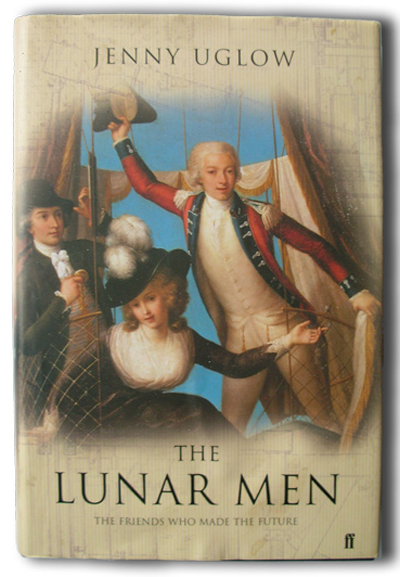
The Lunar Men by Jenny Uglow - at the Dr Johnson Bookclub


On the 4th of October, the Dr Johnson Bookclub met again after their summer break. There was much happy helloing, how-you-doing and what’ve-you-been-up-to-ing. We’d met up to discuss ‘The Lunar Men’ by Jenny Uglow. Many members had been on the trip in July to Lichfield to visit Johnson’s hometown and birthplace but also to explore Erasmus Darwin’s house and museum. (I’d visited it earlier in the year and can read my write up here). This recent visit meant that some of the locations in the book were fresh in our minds and informed our discussions.

The praises for this book were effusive. Not everyone had got through it, and all agreed it was a much longer, denser book then they first imagined. It tells a joint biography of seven or so men who met in each others houses to discuss whatever was on their minds, usually topics of a scientific bent and who thus found themselves at the forefront of pretty much every forward-looking and modern discovery of the late eighteenth century.

To list some of the achievements of the Lunar Society is something which is almost unbelievable; canal building, efficient steam engines, huge leaps in carriage technology; theories of tectonic plates, hot and cold weather fronts, evolution and technological standardisation - the pottery of Wedgewood, machines that spoke, the discovery of oxygen as well as huge experiments in social organisation, education, freedom of knowledge and knowledge of freedom. The book has to be recommended purely for the sheer amount of exploration and ingenuity the group had some major role in furthering.

Add to that, Jenny Uglow had the ability to explain all of the technical and scientific information in ways that had a room full of arts students feeling that they could understand it. Rarely has a book allowed a group of old-book nerds talk with relative authority on the theories of de-phlogisticated air. For an evening, we all became natural philosophers if not actually scientists. As George Elliot said about science in Middlemarch, ‘It leads to everything; you can let nothing alone’.

This was partly because of the clarity of the book, but partly because of the style of the Lunar Men themselves. They saw no knowledge as barred to them, they allowed their curiosity to wander over every spectrum, often blurring art, science and industry into one gigantic exploration. There was much lamenting over the compartmentalisation of knowledge in modern academic and research centres which may have impeded the serendipitous acquisition of knowledge because the focus is always so narrow.

We discussed if groups such as the Lunar Society could ever happen today. Whether it is possible to have that cross fertilisation of knowledge, whether you need a Darwin figure spinning ideas out to the rest of the group, a Dr Small healing the fractures. We also revelled in the Not-London element of it all. How these men, many of them dissenters and outside of the Oxbridge system, created an intellectual haven away from the strictures of London life. There was something gleeful in celebrating Birmingham and Derby, Glasgow and Truro - a reminder that not everything that happened in the eighteenth century took place under the sound of Bow Bells.

There was also a fondness for the warmth of the book. We did not merely have cold scientists and industrialists, we has people. There was optimistic Boulton in partnership with pessimistic Watt; careful experimentalist Wedgwood and haphazard Priestley, inventive Darwin and conservative Withering - with Edgeworth and Day circling round and providing strange anecdotes and hundreds of children.

We also thrilled in the book to see the Lunar Men grow up, marry some Lunar Women and have Lunar babies. We grew to know the families, see them study together, play together and at times, die in each other’s company.  We had the daft details as well as the big story - whether that be outdoing each other in ludicrous carriages, keeping sheds of skinned horses, dealing with a man who had a bed made of iron or wading in the garden pond to catch gas but catching a cold instead.

We also wondered why a group of men could get canals built in under ten years with their own money, PR skills and charm but Westminster can’t complete HS2 until the forever future.

It was an excited and breathless discussion, with voices pinging from all sides of the room, many fighting to join in - and that has to be the sign of a provocative and informative book.


As often happens, I was more enlivened by the discussion then the book, which tilted a little too much on the industrial/technical side for my taste - but a very good book which told me a little more than I wanted to know about some extraordinary people.


Thursday, 15 September 2016

Review: Love in Excess by Eliza Haywood


Love in Excess was one of the best-selling novels of the first half of the eighteenth century, going through several editions in four years and mentioned in the same breath as ‘Gulliver’s Travels’ and ‘Robinson Crusoe’ (though it may not have sold as well as first thought). Not a book much read anymore, I decided to look at it to see if it’s still worth reading and why its reputation has dwindled.

I particularly don’t want to spoil the plot of this one, as much of the pleasure I had in reading it was from the enjoyably ludicrous twists of plot, so I shall leave the synopsis a little vague. 

In the first part, Count D’elmont, a handsome and successful soldier comes back to Paris and is caught between two women who love him…or at least love the idea of him. The first is Alovisa, who is rich and scheming, the other is Amena, who is innocent. The second part deals with a love pentagon and the third deals with a love…nonagon. Each love tangle is resolved by the end of the part, for better or worse, only for it to get more ridiculous in the next. However, the dafter it gets, the better it gets. This book revels in its excess and is all the better for it.

Had the novel ended after the first part, I’d have been fairly dismissive of it. D’elmont is not in love and is, at most, flattered to have the women fighting over him. Really, he is a passive dupe for the schemes and passions of the women that surround him. The excess of the language at this point seems histrionic rather than romantic, neither woman in love with him as much as she is the notion of who she could be with him as a husband.

Had the novel ended after the second part, I’d have been a little more enthusiastic. D’elmont falls in love himself and it’s not with his wife. He is lead to be more angry, more desperate, more underhand then before, which makes him more interesting. This part also brings in some of the noteworthy writing, Haywood is very good at describing natural, unforced beauty;
    ‘…she had but newly come from bathing, and her hair unbraided, hung down her shoulders with a negligence more beautiful than all the aids of art could form…’ It is development of these sensuous descriptions that become one of the chief pleasures of the third part.

The third part of the novel is where things really hit their stride. D’elmont has become self aware, his mishaps in the previous parts of the book has lead him to the realisation that he is truly irresistible to women. This is not a boast but a real problem for him. He exiles himself to Rome and swears off women but to his great annoyance they can’t help falling in love with him, throwing themselves at him and creating all sorts of problems and schemes to snare him in their clutches. He is also trying to help a friend with love troubles and having women fling themselves at his person does not make it any easier. While passive D’elmont was dull, passionate D’elmont was dumb, D’elmont trying to politely unentangle himself from almost every woman he meets is extremely entertaining.

There’s also a definite sense of Haywood really beginning to enjoy her excesses, the book is at it’s best when it is rapturous or full of grief, when passions are high and sentences are breathless. At her best, she is too long to quote, but I found a lovely bit about kissing,
‘A while their lips were cemented! rivetted together with kisses, such kisses! as collecting every sence in one, exhale the very soul, and mingle spirits!’
This joy and pleasure in language becomes noticeable all over the third part, one of my favourite non-kissy ones was the description of a shocked man ‘wildly throwing his eyes’ over a spectacle.

The novel ends, as these things should, with a set of marriages. However, just before the marriages a very likeable character dies an extremely pathetic (in the sad/pitiful sense) death - a death that occurs in the same paragraph as the weddings. I was left with a sad lump in my throat, a happy smile on my face and a critical faculty reeling with the exuberant, silly, tonal whiplash of it all.   I’ve never left a book feeling quite the same mix of emotions and for that, I am very glad I read this book.

If the book is hard to read now, the formatting is a large part of it. My copy was a very generously annotated one from Broadview but the run-on sentences, long paragraphs, lack of chapters and creative spelling can be a chore for the eyes. There were moments of deep passion where I found my vision passing over the text but very little being understood. In re-reading, I’d sometimes also find that not much had happened. If the modern reader can get through these hiccoughs, then the book is very entertaining and becomes more so as it goes on, so why has it fallen out of favour?


It can’t have helped the book that its author was female, those compiling the usual canon of British novels in the 19th and 20th centuries did certainly favour male authors but I don’t think Eliza Haywood’s gender is the only thing to blame for the book being lost to history. Those early (pre-Pamela) eighteenth century novels and pseudo-novels that survived into the 19th century seem to have done so as children’s fiction. ‘Robinson Crusoe’ became a ‘boy’s own’ adventure story and ‘Gulliver’s Travels’ and ‘Pilgrim’s Progress’ were read as fantastical journeys but ‘Love in Excess’ can’t be sent to the nursery, it is too tied up with sexuality, particularly female sexuality to be bowdlerised or infantilised and so couldn’t keep up with changing tastes in the same way. It doesn’t deserve to have been left behind, find a copy and give it a go.