Monday, 4 April 2016

Review: Marcel Theroux, 'Strange Bodies'.


This is a novel published in 2013 and set in 2008/9, which would seem a little too modern for the interests of Grub Street - hold your horses, you’ll see why shortly.

Ostensibly, it’s a metaphysical mystery, rather similar to Scarlett Thomas’s The End of Mr Y, Dr Nicholas Slopen dives down his own rabbit hole of identity loss and confusion after finding some possibly new letters by Samuel Johnson…. - see, told you this book would be relevant to this site.

Nicholas Slopen is quite the stock character; a lecturer and editor of Samuel Johnson’s letters, who is ashamed of his past, ashamed of his poverty and has a wife and children who are ashamed of him. He matches Ariel Manto in The End of Mr Y, and could fit in any number of David Lodge books. 

In investigating these new Johnson letters he falls into a conspiracy involving eccentric music producers, Russian gangsters, Russian utopians and a mysterious process called The Process. In doing so, he muses on identity - how much it comes from a physical unity, a unity of memory or whether it is just the epiphenomena of words. 

I’m not going to reveal much more about the plot, it had enough twists and turns to keep it lively and Slopen was a critical and interesting enough character to walk around in the head of for several hours - oddly, this aspect of identity borrowing wasn’t really touched on.

I did enjoy the modern London setting; characters watch films at the Prince Charles, buy prints in Cecil Court, mooch around Green Park and go to various pubs I have also been to. I got the sense that, wandering around London in 2009, I might have actually met these characters.

But what really brought the book alive for me was the Samuel Johnson fan-wank.

Slopen is a Johnson fan, and when he reads the possible Johnson letters, he describes them as meeting with an old friend, recognisable by the ‘sinousity of the sentences’ in the same way he recognises the individual walk and shape of a lover. There are a number of other times when Slopen reads Johnson, and Marcel Theroux, the author of this book, describes the feeling of reading Johnson very well.

It turns out the letters are forgeries, written by a man called Jack who believes himself to be (or may actually be) Samuel Johnson. My favourite favourite part of the book is when Jack and Slopen live together for a few weeks and we get to see Johnson navigate the 21st century.

Hanging out with Sammy J in the modern streets of London is a bit of a daydream of mine, I have written a few little sketches on here about Johnson in the modern day and had a number of other scenes planned. I also have, deep in the recesses of my scribblebook, a plan for a novel which engineers Johnson into modern London in a time travel variation of Aristophanes’ ‘The Frogs’

Whether he is watching Brief Encounter, consoling Slopen on his divorce, declaring lamb dhansak ‘a practical joke’ or extolling the delights of melted cheese at a pizza place, the proxy-Johnson is a brilliant character. Theroux takes a lot of the parts of Johnson’s character I planned to; for example, the part when he goes ice-skating and the story I wrote of Johnson at a roller disco both relate to his fondness for ‘sliding’. This vision of Johnson in the modern world also deals with the main problem I had in writing it, and the reason I stopped. Johnson was a man unhappy in his body in his own timeline, it was impossible to imagine his move to the 21st century would cause him more distress - and so it does in this version, Jack/Johnson needing to be medicated and even restrained on a number of occasions. 

I was left wondering, why did Theroux choose Johnson for this book? The theme of identity was tackled by him, but not really one of his most prominent themes. Why not ‘resurrect’ a writer of travels like Swift, or an envisioner of the future like HG Wells, or one of the Russian writers that were regularly referred to? I think part of it is material, we already have a solid picture of Johnson in Boswell and his own works and it is easier to feel we have ‘met’ Johnson then other, blurrier figures. There is also Johnson himself; solid, wise and empathetic - that is irresistible. 


Thursday, 31 March 2016

A little video clip.

I was looking at videos of Adam Phillips, a child psychologist and writer and was most intrigued by the title of the book 'Going Sane'. 

There was a documentary made of the writing of his book, where he is interviewed by Melvyn Bragg, who I find is pretty good at wheedling out good answers. 

Here is a clip that explains his view of what the new writer ought to be in the 21st century.

I found it interesting. (Though scratchy audio with poor sibilants).


'The true aim of writing is to enable the reader better to enjoy life, or better to endure it.'
Samuel Johnson


Monday, 21 March 2016

Austen's Juvenilia at the Dr Johnson reading circle.


This post starts with a confession. Previous to reading Jane Austen’s Juvenilia for the Samuel Johnson Book Club, I’d never finished an Austen novel. I’d dallied with Pride and Prejudice but starting it on the night-bus home from a drum-n-bass club underneath Leicester Square (I received some strange looks from the bouncers after they found it in my pocket).

I also have to confess that the copy I bought (containing both Austen and Bronte Juvenilia) wasn’t complete, more embarrassing because the editor of the Cambridge edition of the Juvenilia was present…I was very intrigued about diving into the unknown. He told us how the books were discovered, that various manuscripts were flogged off by impoverished members of the Austen family, finding there way into the British and Bodleian Libraries, who guard their precious works very closely.

After reading the Juvenilia (or what I had of it) I was delighted to discover how very funny I found it. As the writing grew more sophisticated, the humour was less sharp (and far less silly) but it remained throughout and I was far keener to pick up an Austen book again. These earlier works are stripped down, they are short novel parodies that especially burlesque the sentimental novel. There was something about the works that reminded me very much of ‘Modern Novel Writing,’ a work by William Beckford (of Vathek fame) who created a sentimental novel by chopping up other sentimental novels and recontextualising them. We had great fun sharing our favourite absurdities; those crying themselves to death, those running mad and those falling in love with every person they meet.

One of the highlights of the evening was a group reading of the play ‘Mystery’. (Full script here https://www.janeausten.co.uk/the-mystery-an-unfinished-play). In this short piece, the audience repeatedly finds itself just at the end of something interesting. As short as the play is, it’s a wonderfully sustained joke and there were many laughs in its short time. 

We also discussed the issues of editorship, many of us having suffered from overzealous editors who feel the need to explain even the smallest and most obvious details. We wondered about the impact of the internet on those styles of editorship, where simple details can be looked up.

The evening went by very quickly, and we again bundled off to the pizza place to surprise the waiters with our fruity choices of pizza.


Next week, we flex the biceps and carry the weight of Boswell as we discuss his meeting with Johnson.


Monday, 22 February 2016

Roy Porter on the Enlightenment

Just a teeny note here.

I was mooching around on the BBC's brilliant (and very wide ranging) series of discussion shows, 'In Our Time'. In one of them, Roy Porter is discussing his book. It is free to listen on the BBC iplayer and the link is here.


Thursday, 18 February 2016

Review: The Song of Roland

This is romantic, epic and very, very silly.


Although the Eighteenth Century may be a big passion of mine, I have to admit myself interested in more things then I have time or energy to pursue. One of these interests that has been bubbling up the ranks has been in chivalry and chivalric romance.

Partly this is due to my attempt to read Don Quixote as a young teen. I never finished the book but always had a desire to - in preparation for this, I have been working myself up, reading the words that inspired that story. As part of this I read a very entertaining abridgement/translation of Ariosto’s Orlando Furioso that made the top spot in last year’s favourite books list.I thrilled at that book’s high-jinks, daft capers and cartoon/superhero heroics and wondered about the source for such things.

Ariosto took inspiration from two great chivalric traditions, the ‘Matter of Britain’ and ‘The Matter of France’. The first is better known today, it charts the actions of King Arthur, the Knights of the Round Table and often feature wizards and fairies. The other is the doings of Charlemagne and his knights, the key source of these stories being The Song of Roland. 

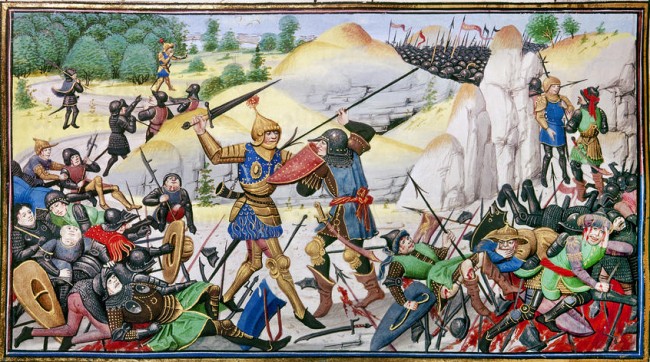
Written some time in the tenth century it tells of Roland (later Italicised as Orlando), Charlemagne’s nephew and best knight who is put at the end of the column and betrayed by Ganelon to King Marsile and the Moors of Spain. Roland, 12 great knights and the wise Olivier are attacked by hoards of Paynim (or foreigners). Instead of calling for help on the Oliphant, a war horn, Roland fights on, killing hundreds. Only at the last minute does he call for help, blowing on the horn till his lips and temples bleed and summoning Charlemagne who arrives too late to save Olivier, the bishop Turpin or Roland. Charlemagne then wages war against the Moors and has Ganelon’s body torn in four by horses - there is even a sequel teased by Gabriel telling Charlemagne to get going and fight somewhere else.

First thing was, I was surprised at how short it was. My copy of the unabridged Song is 121 pages as opposed to the abridged Furioso’s 500. The other surprise was the lack of supernatural elements, that very lack making the over-the-top actions of the ordinary people all the more strange and cartoonish. It makes the reasons behind character’s actions seem completely daft… Ganelon betrays a huge chunk of his army in order to get back at Roland for a perceived plot. Roland chooses not send for re-enforcement (and destroy the Muslim army) because it would insult his heightened dignity. Roland’s wife just ups and dies as soon as she hears Roland is dead. All sort of actions make no sense.

The goofiness of the text is not helped by Leonard Bacon’s translation. There is an old fashioned, rather camp quality to the writing. A knight’s armour is described as ‘becoming him well’, and the Muslims shout the frightening ‘What ho, ye Frankish villains, ye shall joust with us this day’ and another time explaining that they fight ‘right fiercely’. A number of times people are also ‘beat nobly in the face’. 

My absolute favourite, which made me laugh out loud is when Roland’s friend has been killed and he described it as something which, ‘sore irketh me’. Another time a knight rides to a friend with four lances stuck in him, and the other knight says, ‘I deem thou hast been in a fight’.

There are many people who are killed by having a sword driven through their helmet, hat, ‘mighty hair’, body, saddle and horse….. there must be about twelve people being spit in half in this way. Some eyeballs are burst out, a few brains ooze from helmets and many people are struck through with banners. 

Another strange detail is the extremely ornate description of swords and armour. There are named swords, ‘Joyeuse’ - belonging to Charlemagne and ‘Durendal’ - Rolands’ sword which contains half a cathedral’s worth of reliquaries in it. Another odd detail is how many helmets are gem encrusted, or made of gold. Gold swords would seem daft to me, but almost everyone in this has one.

Finally in the funny stuff is Charlemagne. He does quite little and is always described in the same way, namely - he has a white beard. Almost every action of Charlemagne is playing with his beard in some way. It is often described as a flower for some reason. I can’t work out how a flower resembles a beard at all. Very close to the beginning of the text we get this quote,

‘Aye plucked he with his fingers at the beard on lip and chin; 
And the tears came into his eyes, he could not keep them in.’

I understand that he's supposed to be playing with his beard in sadness, but to me it just sounds like he is plucking his beard and nose hairs, and it’s making him teary - just as you would be if you picked your nose hair.


I have to say that mostly this book made me laugh. There is no wonder that this leads to Don Quixote, it’s a farce to begin with, but there were some lovely lines in the poem, and I’ll leave you with those.

‘High were the peaks about them, and dark the vale and black,
Sombre the rocks about them, and terrible the track.’

‘The sun broke on them splendid, and fair the morning came;
There was no bit of armour but was blazing in a flame;
And to make it more glorious a thousand horns blew clear,’

‘Mighty was the battle and furious the fight.
Fiercely the Franks stuck into it in their anger and their might.’

‘Darkling are all the summits and very great and high,
And deep are all the valleys and the streams run swift thereby.’


Wednesday, 27 January 2016

Roy Porter's Enlightenment, at the Samuel Johnson Reading Circle


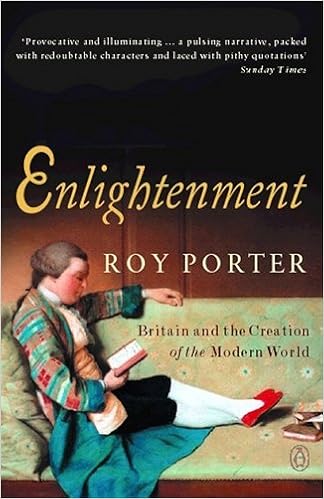
On Tuesday the 19th of January the intrepid souls of the Dr Johnson’s House Reading Circle sat down to talk about The Enlightenment. Luckily they were aided in this mammoth task by Roy Porter’s mammoth book Enlightenment: Britain and the Creation of the Modern World. 

The book is an expansive look through the long eighteenth century, focussing on the scientists, writers, talkers and doers of the period to make an argument that there was an English Enlightenment, even if it didn’t look much like the version spread by continental philosophes.

With such a large topic, and each of the 22 chapters able to generate a few hours of discussion in itself, the conversation moved quickly from one place to another and rapidly switched back from the sublime to the ridiculous and back again. (I apologise for the ridiculous). One of the key factors of the book is that it is lazy to say The Enlightenment, as there were many different projects all with broadly Enlightenment ideals, creating many kinds of Enlightenment. Whether this was from the rationalisation of Anglican Christianity, the hundreds of different protestant groups or the full atheism of Hume - all held a certain optimism that life, society and human nature may all be understood, and improved.

The book explored the life and thinking of many English people, focussing particularly on the influence of Locke, Bacon and Newton as opening up new vistas of thought; from the improvability of human-kind and society, techniques for exploring the material world and the simple laws of motion - then it explored lives of people like Thomas Day.

Thomas Day was a bit of an all-rounder; hanging out with Erasmus Darwin and the rest of the Lunar Society, writing a bestselling novel, campaigning for the abolition of the slave trade and … training up a wife. Day, unable to find a perfect woman, decided to create one. To do this, he adopted two young girls from orphanages, one for a wife and one as a spare, and tried to train them into the perfect woman. He tried to encourage them to be stoic by dropping hot wax on them and firing blanks at their petticoats. Unsurprisingly, the experiment didn’t work and neither became Mrs Day, lucky for them.

There was an interesting discussion about whether Day was manipulating the women, or whether they were playing him. The contract they signed allowed the women a comfortable life if the experiment didn’t work out and could it have been possible that both were holding out not to have to be his dearly beloved? 

Day’s attempts at experimentation ended in disaster when he decided to test out a theory that horses didn’t need to be broken to be ridden, he was kicked and died soon after.

In Porter’s book, Day’s story is almost played out for laughs and many sitting round the room wondered whether the book, in trying to argue his case, was rather too optimistic about the whole Enlightenment. We thought he could have included more about how individuals took on enlightenment ideas for themselves. Samuel Johnson being a very good example, a man whose Christian Humanist tendencies struggled with fully accepting the Enlightenment thoughts but whose rational nature couldn’t let him abandon them.

Afterward we all went for some pizza and discussions continued. Is the long eighteenth century a useful time period? When did people start using it? (We reckoned the 1920s) And how many of us had jaunted up to the Isle of Wight at some point? 


The waitress told me, with some element of surprise, that the Venezia was the most favoured pizza on our table. Her tone suggested that it was not a particularly popular pizza in general, what is it about Johnson-ites that are attracted to sultanas on pizza? - Now that is the big question.


Wednesday, 20 January 2016

Under the Glass... Five: Writerly Diligence


I’ll admit, I’ve fallen off the wagon. 

The wagon in question being writing. I’ve barely written a sausage in three months. (Indeed, the log on my computer tells me that it has been 101 days since I last had a ‘proper’ go at my Death of a Dreamonger revision.) 

Samuel Johnson, on his tour through Scotland gave some of his typically useful and kind advice.

"A man may write at any time, if he will set himself doggedly to it."

Not sure why I haven’t been quite so dogged of late; it’s not been through lack of ideas, nor has it been any kind of crippling self-confidence thing - I’ve just been…lazy.

I may blame it on shorter days, or the fact I am trying to have earlier nights; or that after I have worked, cooked, cleaned and read a few chapters, I’m just not in the mood.

This causes me a bit of a problem - because I’m not sure what else I am meant to do with my life. I work, but I only do that to fund my writing life. I read, but that’s not producing anything. I go to museums and theatres, I drink with friends and eat with family - but without writing I feel I am doing nothing. I start to wonder if I am just a burden on our fragile natural resources and London’s limited cheap(er) living space.

Samuel Johnson himself went through great swathes of his life without writing anything, sometimes for years at a time, and he produced a body of work that could be described as ‘not too shabby’.

And, typically for him, Samuel Johnson also offers some genuine words of sympathy for the lazy writer.

“Composition is for the most part an effort of slow diligence and steady perseverance, to which the mind is dragged by necessity or resolution, and from which the attention is every moment starting to more delightful amusements.”

I sometimes wonder what Johnson would make of our world now. I have the suspicion that he wouldn’t have made so much of himself, he was almost chronically prone to distraction in the life he led; what would he do in a world where youtube offers millions of easily digestible nuggets of information, there’s just one more personality quiz to decide ‘what kind of house-elf are you?’ and there are another 50 hilarious lists of auto-correct fails.


My own diligence may be very, very slow, but I do also persevere. Maybe I should make a resolution and drag myself back to it…after the next youtube video of course.