Saturday, 21 January 2012

Review via Badly Photoshopped Poster.

Just watched this dull piece of film.


The Artist is good though.

Clarissa 'January' post coming soon.


Saturday, 14 January 2012

Review: Trivia, by John Gay

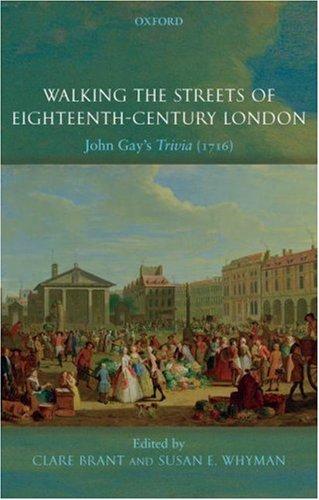
My copy of the poem was in this book, alongside some interesting essays.


Yes, it’s an extended poem about walking around London but that doesn’t necessarily mean it is crap - it rhymes at least.
John Gay takes the part of ‘The Walker’, a seasoned perambulator of the mean streets of C18th London. He tackles weather, cheats, pickpockets, porters carrying heavy goods and fops and dandies covered in powder. Never aiming to get somewhere in particular, he gives us advice on the perils of the city whilst observing its inner workings. 
The poem is organised into three books, the first is about the preparations for walking, the second about walking in the day and the third about walking in the night. The poem has little summaries down the sides of the text, allowing you to navigate it. These summaries seem to serve a similar role to the long chapter titles of some C18th novels. They include such things as; ‘of walking with a friend’, ‘signs of rainy weather’ and ‘useful precepts’. The informative nature of these summaries help create the effect of a ‘how to’ book that greatly add to the ironic tone - more about that in a bit.
The poem makes hundreds of interesting points about the day-to-day life going on around The Walker. These include a description of some common pickpocketing practices,  advice about buying a decent coat and a particularly nice little bit about the politics of ‘giving the wall’, the wall being the covered part of the path away from the open gutters. This part reminded me an awful lot about that common urban dilemma - who to give up a seat to on a bus. 

Here is a little bit about a winter danger, a rowdy game of football.

‘Here oft’ my Course I bend, when lo! from far
I spy the Furies of the Foot-ball War:
The ’Prentice quits his Shop, to join the Crew,
Encreasing Crouds the flying game Pursue.


As you can see, this is written  nice perky little heroic couplets and these couplets trip all the way through the poem. 
The poem also contains two tangents of a mythological strain. The first it the invention of little overshoes called pattens and the second is the story of how Cloacina, the Goddess of Sewers created the shoeshine boy and gave him his trade...these parts are parodies of some classical thing or other but I have to admit were lost on me. Interestingly, on my little Wikipedia look at Cloacina, it turns out she was worshipped with rhymed prayer.

While you would have to be a very worrying type of person to laugh out loud at this poem, it does create a very nice ironic tone between the trivial subject matter of going for a walk and the deadly serious manner it is portrayed. From the title, ‘The Art...’ to the tone of The Walker’s advice, the poem pretends to be a useful and instructional manual for walking around the city - something most of the readers would be used to doing. 

This allows Johnny Gay to do a few things; the first is to poke fun and dramatise the chaos of the city with it’s hubbub of life and movement. The second is to mythologise the small things in life, to bring them to centre stage, a preoccupation in Gay’s work (and Scriblerans in general). The third is to satirise the new strain of people who were using the new urban medium of cheaper books and daily newspapers to set themselves up as experts, he does this in the character of The Walker.
The Walker is a bit of a prat. He starts off self-importantly pontificating about the correct types of shoes, coats and canes to wear and carry for a good walk. He presents himself as the debonair man about town but has no part or place with everyone else. He derides the people that ride and carriages and sedan chairs, saying that walking is the finest way to get places and yet complains about all the obstacles that get in his way. His friends, incidentally, found it hilarious that Gay should have a success with a book about walking where he would have ridden everywhere if he could.

Finally, The Walker presents himself as a tough and streetwise traveller but spends most of his walk fearing and fussing over dirt. In short, he is the kind of know-all-know-nothing sort of expert parading his knowledge for a disinterested audience on a plentiful but cheap mass media object - so an arrogant blogger then, or a TV chef. It is through reading the poem in this light that is probably most enjoyable for the modern reader. 

To sum up: 
Although not a scintillating page turner, ‘Trivia’ manages to be an entertainingly wry read and an evocative slice of London Mythologising. Best read accompanied by ‘The Four Times of Day’ engravings by William Hogarth before leaving the house for a ramble and paying attention to your own area.


Saturday, 7 January 2012

Review: The Anatomy of Melancholy by Robert Burton - First Partition, 1621.


The main attraction I had to this book is that it was the one that Samuel Johnson said was the only only one that ever got him out of bed two hours before he intended.

Although I never sacrificed hours of my sleep to this book, I did sacrifice a great deal of money. I saw it in a charity shop for five pounds at a time when five pounds was my entire food, entertainment and travel budget for the week. I remember that week, I had to beg for the bus fare home from a job interview. So, was it worth it?
Yes. This is a truly and completely absorbingly fascinating book. It’s a sort of compendium of everything written about melancholy from ancient days to modern renaissance writers. The works are read, summarised, compiled, digested and explained by Robert Burton, an Oxford scholar and sufferer of melancholy himself. 

Like the earlier Essais of Michel de Montaigne, also a product of a solitary and bookish kind of loneliness, this book is a huge, tangental and deeply human work, although the content of the book doesn’t come from Burton, the style and tone sing out, stamping his imprint all over it.

Durer's Melancolia 1

Burton has tried to organise his thoughts and his words. i
Ironically, it’s his organisation that, in part, makes this book such a difficult book to navigate. Things that seem to naturally belong together to Burton, don’t to me, so you have to learn to trust him. 

If a reader wishes to find something specific, eyewatering diagrams of the layout are helpfully provided. In general, the book is laid in four parts; the first is an introduction ‘Democritus to the Reader’ as well as an abstract and general description of melancholy. The second part is called the ‘First Partition’ and contains the medical background, causes of melancholy and the symptoms - it is these two parts that are being reviewed now. The next two partitions contain cures for melancholy and a special look at romantic and religious melancholy, these will be read and reviewed in time.

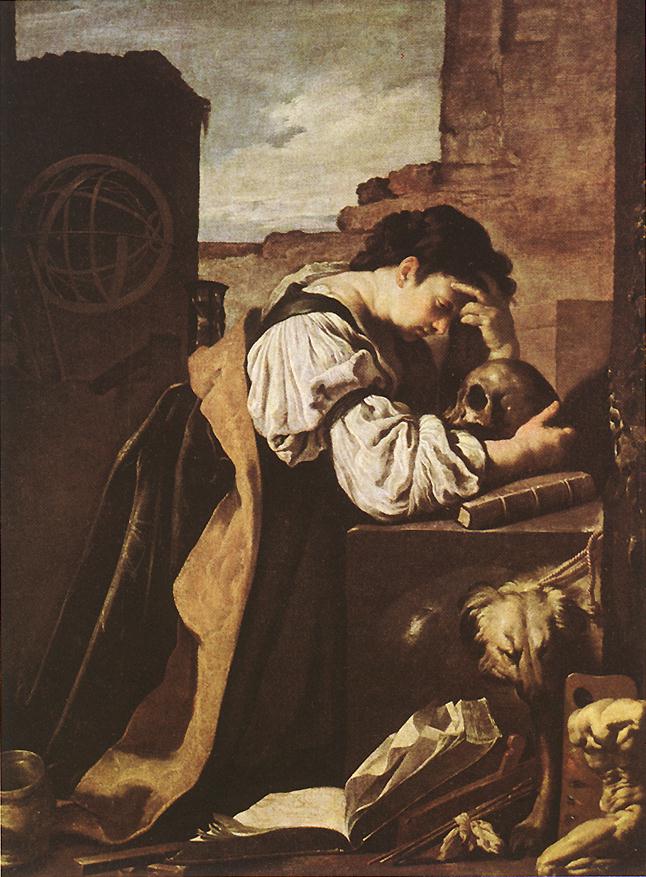
Melancholy. Domenico Fetti

It’s hard to summarise what I have learned from the book, as there is so much in it, but I’ll give a few interesting points. 

The first is that melancholy is not what we consider it today. Technically it is ‘black bile’, one of the humours and a natural part of the human body. The disease of melancholy is when this black bile is produced in excess but it reacts differently with different parts of the body, with the other humours in their own varying amounts and with the general quality of a person’s body (usually described in terms of heat/cold and dry/moist). 

This different reactions mean that melancholy can have many different effects. Some get sad, some fear pointless fears, some fight everyone, others talk to themselves - melancholia also has physical symptoms, haemorrhoids, flatulence, headaches, aches in general, tiredness - indeed, the holistic nature of the view of the interactions between body, soul and mind is the source of the interest of the book, and the difficulty of it. In reading this book, the reader is entering a completely different intellectual planet, in which mind/body dualism is an interesting idea only beginning to be thought about and expressed. 
One of the delights of the book is how so many of our beliefs of the body now would be nonsense then, and so many of beliefs of the body then would be nonsense now. In a discussion of the (ancient) trope of the melancholy wit, the laughing clown, we get the following explanation for laughter.
    “...abundance in pleasant vapours, which, in sanguine melancholy especially, break from the heart, and tickle the midriff, because it is transverse and full of nerves: by which titillation the sense being moved, and arteries distended, or pulled, the spirits from thence move and possess the sides, veins, countenance, eyes.”
I find this delightful because of this idea of the wholeness of the body - but also the attempts at rigour which now appear risible.   

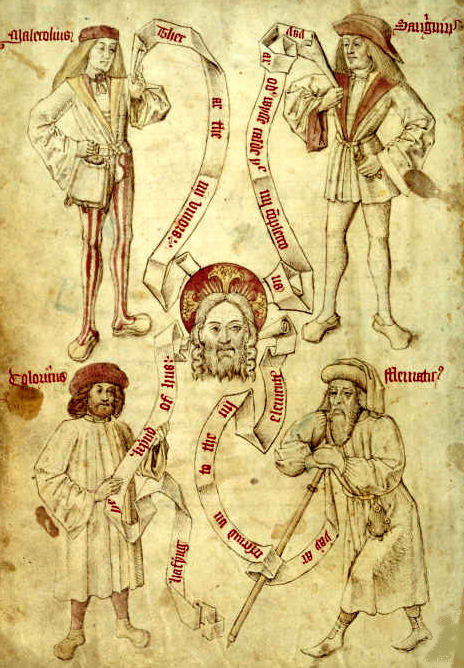
The Humours

However, the book is not just a relic, because it talks about  issues that are still alive and thought provoking. The book (or at least the intro and first partition) touches on loads of subjects but is really all about the difficulty of being human; the fears and sadnesses we have, the sheer weight of responsibility and agency that comes with being alive (or worse, having those things repressed). 

At the end of the partition, there is a discussion of suicide, where Burton gives us many reasons for and against. It’s a really interesting discussion - written at a time when suicide is still officially a crime and is only one part of the book where the reader is encouraged to look at something from many angles. What lifts the book further, is that he not only gives the big issues but lots of funny little stories as well, such as women giving birth to rats and talking dogs and such.
In terms of style, this book is painful to read. Burton swings from quote to story, lurching around like a mechanical bull - and lots of it is heavily larded up with Latin (which is mostly translated, thankfully). We will get a story about a man who is convinced he has frogs living inside him, to a village tormented by a teasing echo, to a man collapsing after a bite with a dead dog, to a Roman Emperor mourning for his son - nothing is off limits or taboo and very little is considered excess. 

Burton compiles lists that can go on for pages, he never uses one word when 40 will do (and 10 of them in Latin). It is not a tidy read or clean read or concise read. It is a bloated overelaborate mess. (For a delightful example of Burton’s style, listen to a part of the last partition from an audiobook where Burton is simply saying no more then ‘Love is Blind’. http://www.youtube.com/watch?v=WGJWREm5rhA ).  

Yes it is hard, it is over-thorough, pedantic, bookish to a fault, overinflated, over-egged, overkill, too much, excessive, like a balloon pumped too far - but it is delightful in its baroque elaborateness, often very funny and these lists help the book power along at a speed. 
I have recently heard the phrase ‘Victory Read’, a book you read to feel the pleasure of conquering it like a mountain. There will be an element of the victory read when I have finished the entire thing, it is a difficult read, and much of the pleasure is hard won but at the same time it is a fascinating read, offering glimpses at a time where the entire view of a person’s relationship with their body and around them is conceived differently. It is helpful we are led there through the amusingly OTT authorial voice of Robert Burton. Sometimes excess is it’s own reward.

[NB: Finished in 2015.] 

The third partition was the most entertaining. Burton is very funny talking about love, he is obviously a man of affections and humour and it shines through very well.

He is also rather tolerant to women - so many of his sources are anti-woman and he merely laughs at them and says that everything said about women could easily be applied to men.

The religious melancholy bit was very interesting, especially as it revealed 17th century views on Islam and atheism. 

The very last bit on despair dragged though - too Bible heavy for me and even more repetitive than usual.

Burton and his pinched smile

Today I will give Burton the last word, the last sentence from the first partition and good advice to us all.
“We ought not to be so rash and rigorous in our censures as some are; charity will judge and hope the best; God be merciful unto us all!”

Monday, 2 January 2012

Plans for 2012

Happy New Year - the time when we magically become better and slimmer people.


I have a number of projects I want to work on over 2012.


In terms of my own fiction I will be going through and correcting Death of a Dreamonger and beginning the long, slow submitting process. I hope to send 5 agents letters by Easter and hope to have got somewhere with it by the summer.


I also plan to work on my new project Into the Big City, which I may preview in parts on this site.


There are also places to go and things to see, most excitingly (at the moment) She Stoops to Conquer at the National, and maybe a little trip to Johnson's Birthplace in Lichfield.


As well as all this and the usual topics and such, I plan to do another reading group because I had such enjoyment reading Evelina at The Duchess of Devonshire's I thought I'd do another - but this one's a biggie. I will be reading Clarissa by Samuel Richardson - all 1500 pages. The thing weighs twice the amount I did at birth, so I suppose I will have taken up weight lifting also.


The lovely people organising this immense challenge are;


Lakeside Musing


and


Tip of the Iceburg


The plan is to take the year of the book's action to read the book - I am a rather impatient reader though, so I'm not sure how I will stick to this, I may jump ahead a little. However, without the support, I can't imagine starting at all.


So a busy year on the reading and writing front planned for me, I am hoping this is the year when I find myself represented and my book published.


I hope your 2012 will be equally enjoyable.


Thursday, 29 December 2011

Writing News

I am delighted to announce that the first full and complete draft of Death of a Dreamonger has been completed. It is a mysterious, funny work with a thrilling climax - I will be very proud of it. 
While I am waiting for it to simmer down and I can see it with fresh eyes, I plan to start my next book. This book will fit in a little more with the general theme of the site as I plan to write a mid-eighteenth century book. 


The exciting and unique idea is that the novel will not merely be set in the eighteenth century, but will be an eighteenth century novel utilising much of the narrative style, authorial tics and general attitude to the work that is present in books from that time.
This will of course be a difficult and problematic task, but I feel there is so much vitality in the eighteenth century novel, and the varying approaches to it, that this book promises to be something exciting and lively, with much zip and cheek and a big dollop of playfulness.
I plan to use Henry Fielding and Tom Jones as the main inspiration but there will be chapters and sections in the style of Sterne (who I love more than Fielding, but am too cowardly to stick to all the way through) Richardson, Burney, Godwin - as well as sentimental chapters and gothic chapters... The whole concept excites me and is really getting me going.
Although most of my inspiration will be from the mid-eighteenth century, I plan for the title of the book to hark back to those 'blurb title pages' of Defoe. However, this hasn't been fully thought through yet, so I am currently calling it Into the Big City for short.


The story is about a young man, addled by a little learning, who believes himself to be a poet of rare and exceptional talent. He leaves his Warwickshire village and enters London with a view to making his literary fortune.


There he finds things much harder than he expected, getting stuck in the middle of gang warfare between a hardened thief-taker and a highwayman. His stupidity and innocence often save him as he stumbles around the city trying to make his own way.


Will he avoid the criminal's knife and the magistrate's noose? Will he find love or fortune? Will he ever write a poem anyone would want to read? ... Those are the questions we shall find the answers to.


Until next time


Saturday, 17 December 2011

Ho Ho Hogarth

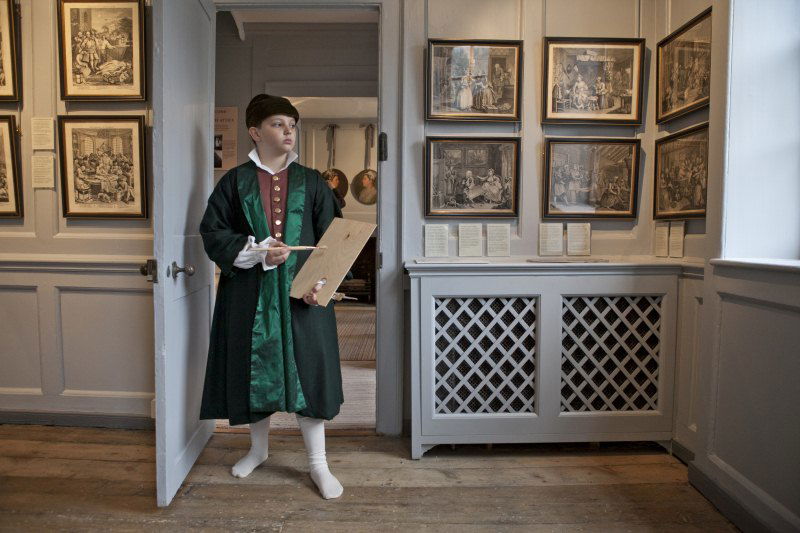
Today, on a cold December day I decided to visit Hogarth’s House, newly reopened after being restored from fire damage and to do a little bit of Christmas shopping. 


The house is a thin, modest affair, once in the corner of an orchard but now next to the A4. Among the traffic and the mess is a brewery, I’m sure Hogarth would have liked that. Whether he would have liked the huge roundabout named after him, that is less sure. The political cartoonist, Martin Rowson made his own comment on the roundabout, a print of which hangs in his house. 


Now, the house is not large and does not contain any paintings, if you want them I recommend the Tate Britain and Sir John Soame’s Museum (though would I recommend them anyway) but it does contain several sets of prints, ‘Harlot’s Progress’, ‘Rake’s Progress’, ‘The Stages of Cruelty’ and ‘Marriage a la Mode’. The prints are clear and well displayed and you can get as close to them as you’d like. Indeed, comparing the paintings of ‘Rake’s Progress’ and the prints, the prints are clearer, starker and more interesting. Also, many of the prints have interesting doggerel underneath them, Hogarth’s friend wrote them for ‘The Four Stages of Cruelty’ but I don’t know who wrote ‘A Rake’s Progress’. These prints are the highlight of the Hogarth House collection.


The house also owns a number of personal items, including the stool used by his dog and also an original brass print, an art case, some jewellery and a copy of his ‘Line of Beauty’ book. There is something special about this, Hogarth’s objects in his house. The house has been tidily restored and the whole house is coloured in pearl according to research on the paint used. 
(There is a fascinating article about eighteenth century paint choices here: http://patrickbaty.co.uk/2011/11/13/hierarchy-of-colours/)
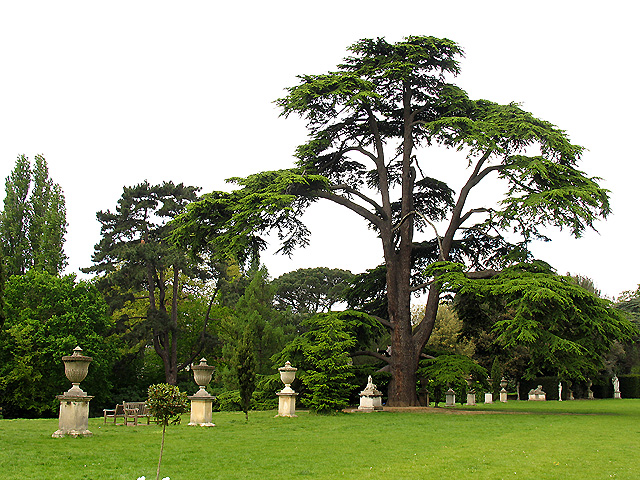
Hogarth’s House is a good place, a small bus ride from Hammersmith and no price to enter. Also, it is a very short walk from the also very interesting Chiswick House. This was a house built by Lord Burlington, designed by William Kent and later lived in by William Cavendish and his wife Georgina, Duchess of Devonshire. Although the house itself is not open until April Fool’s day, I got to wander the gardens. They are fascinating, full of grottos and vistas and follies and more statues of chubby emperors and urns then anyone but an eighteenth century lord could ever wish. 


As I wandered the gardens, the shining winter sun cast long shadows through the trees and bounced seductively off the hundreds of urns. What with the hundreds of pretty women doting on bouncing dogs and the families with smug dad’s running after small beamingly screaming children and the place looked like a white middle class vision of heaven - and that’s no bad thing, visions of heaven never are.
The rest of the day continued to be blessed, I went Christmas shopping and found deal after deal, bought more and better presents then I hoped and didn’t hear a single crying child or het up mum. A man even gave me his seat on the bus. 
So I will have a merry Christmas and I hope you will too.
Yours


Sunday, 11 December 2011

Review of Colonel Jack by Daniel Defoe

Colonel Jack the book is a bit like chewing gum, it bursts forward with plenty of flavour before losing that flavour and becoming bland drudgery; just chew, chew chew.
The first half, the flavoursome half, begins with the birth of Colonel Jack, the bastard son of some gentleman. Jack has been farmed away to keep him from shaming the family. He is nursed by a lady who also has a son called Jack. The two Jacks are joined by another bastard called Jack and the three boys begin to be known by their nicknames; Major, Colonel and Captain.
The boys are left to the street when the kind nurse dies and live in complete poverty, begging for food and sleeping in the sooty grime of a glassblowers – they are also extremely happy with their lot. The Jacks develop different personalities, the Major is a friendly, genial boy easily led astray, the Captain is a rough brutish boy and the Colonel is generous and clever, but the most naïve. 
The boys are pulled apart to try different crimes, the Major and the Colonel apprentice themselves under different pickpockets and the Captain joins a gang of kidnappers. Our hero, Colonel Jack, sees this as just another kind of living and works diligently at it, the way he would had he become the apprentice of a more respectable trade. We do not hear much of the Major after this point.
After twenty-six years of pickpocketery, the Colonel joins a group of highwaymen, his disgust at robbing an old lady mean that he decides to give up his life of crime and join the army. At this time the Captain turns up on the run and they run north to Scotland together. The Colonel becomes extremely upset at the Captain’s inability to hold back his criminal tendencies. Cornered in Scotland, they take a boat back to London but it turns out the boat is actually heading for Virginia and the young men are indentured servants, white slaves on the plantations for a fixed period of time. Now it is the time for the Captain to leave the story and never come back.
Up to this point the book has been thrilling. The lives of the raggedy street-urchins are vigorously and directly described. The descent into crime is even more interesting, as the Colonel learns the tricks of the trade, we learn them with him. We learn what is a good haul for a day in other people’s pockets, how to redeem someone else’s banknotes and when an amount is too much too handle. Moll Flanders has a similarly interesting section. Unfortunately the story begins to run out of steam in America.
At first we get the very interesting account of the white slaves of America, how criminals and the destitute went to that country as slaves for a fixed period, to then be given some land to carve for themselves. That the colonies are full of ex-cons doing very well for themselves. The Colonel then becomes an overseer, as overseer we get the interesting black/white divide. The whites are only temporary slaves and can be reasoned with, the blacks are permanent slaves and only respond to the whip. The Colonel makes the revolutionary discovery, treat the blacks as people and they will respond likewise (and not laugh behind your back, as common wisdom had it).
Unfortunately for the reader, the Colonel is freed from slavery to become a prominent merchant and land owner. He also discovers religion, and like Cliff Richard after him, he loses his bite and doesn’t regain it. After a whole bunch of religious stuff, where even he gets bored, the Colonel goes to Europe to join some wars for the fun of it. He marches around a bit, marries a few times and then sails back to his plantation. Then he gets involved in some trade disputes with the Spanish, which trebles his wealth and the novel ends - it really does just whimper to a close.

The character of the Colonel is an interesting one. He is an innovator and a pretty optimistic soul. He sees something and improves it, often in a humane way. He has a photographic memory of everything he ever stole, those items obviously being of worth to him as prizes as well as food. He has a notion that Defoe seems to admire of ‘just getting on with it’. He’s also a bit like Del Boy, moving from one thing to the next knowing that ‘this time next year, we’ll be millionaires’. Like Del Boy, the Colonel is a chancer, willing to take any opportunity.

Weirdly for one of these books, he never finds his old family or inherits off them or anything…not sure if I am disappointed or pleasantly surprised. It does emphasise the fact that, at this stage in its progress, the English novel (or the species of writing that will become the English novel) is more a vaguely logical construction of events rather than what we would recognise as a plot.
 This lack of a plot is a fatal flaw to the enjoyment of the book as a whole, but that is not to say it is not an enjoyable book - it is actually very enjoyable. Defoe’s wish to create and maintain the verisimilitude of the book means that we get hundreds of fascinating details about every aspect of the Colonel’s life. The reader gets an apprenticeship into c18th crime; a revised ‘how-to’ manual on how to treat black slaves; an account of being a merchant and all manner of interesting details.

 I think Defoe was missing a trick with his three Jacks, if he had kept all three going, comparing and contrasting their lives throughout, there may have been more feeling of structure - although that may have introduced too much artifice into the story and taken away from the realistic tone.
Yours